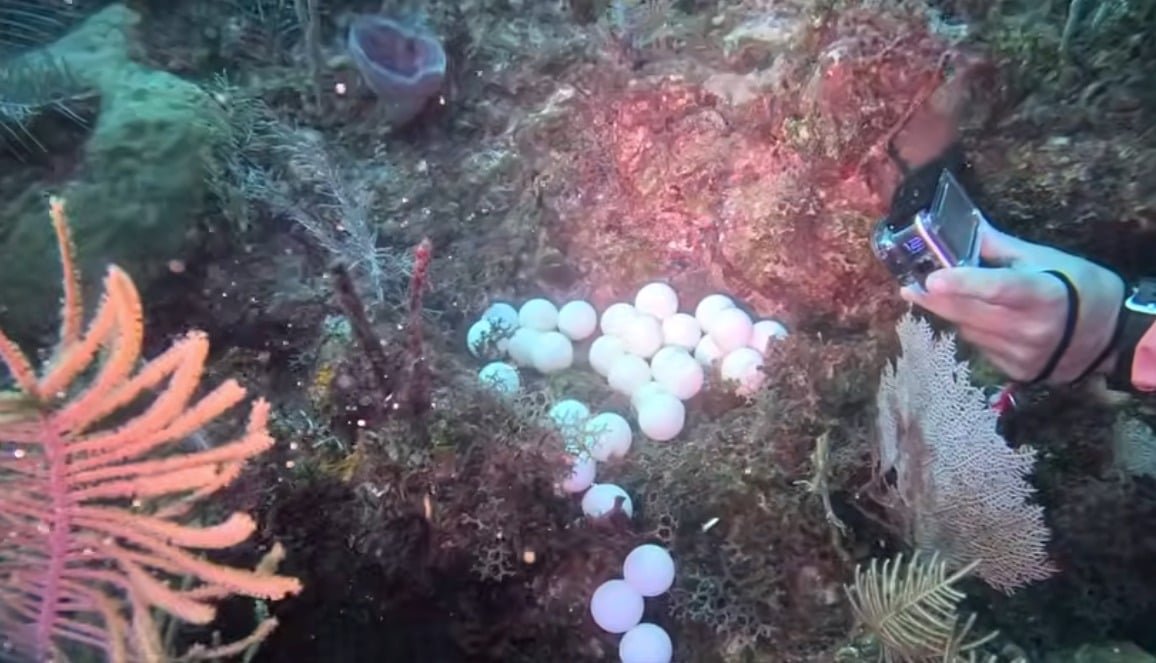
Mahahual, Quintana Roo — The sighting of a sea turtle laying eggs directly into the ocean off Mahahual, documented by the group Mahahual Underwater Explorers, was initially treated as an isolated event. Conservationists now say it is a symptom of a structural ecological crisis caused by the relentless buildup of sargassum along the Mexican Caribbean coast.
The accumulation of macroalgae has turned into a physical barrier — a wall that blocks female turtles reaching the shore during nesting season. When sargassum piles exceed 30 centimeters in height, they seriously impede a turtle’s ability to cross the beach, according to local environmental groups.
An adult female sea turtle can weigh over 100 kilograms and is perfectly adapted for moving through the ocean, but not for battling a wall of seaweed on land. Wet sargassum gives way under its weight, flippers lose traction, and the animal exhausts its energy reserves just trying to move forward.
Víctor Rosales, a representative of the community organization Proyecto Aak Mahahual, said turtles have been documented spending more than 30 minutes in an exhausting struggle to get past the algae, often without advancing significantly.
The impact on nesting is dramatic. Researchers from El Colegio de la Frontera Sur (Ecosur) and local environmental defenders reported that during the most critical sargassum influxes, nesting in Mahahual collapsed by nearly 50 percent. The historical average of around 110 nests dropped to just 55 for vulnerable species such as green and loggerhead turtles.
With their habitat choked off, turtles are being displaced northward. In Uvero, more than 30 kilometers from Mahahual, at least 18 nests were identified on beaches where topographical conditions still allowed females to come ashore — an exile driven by the transformed coastline.
The crisis extends to the next generation. Research conducted on beaches across the Greater Caribbean found that sargassum piles above 20 centimeters significantly reduce hatchlings’ ability to cross the sand and reach the sea. Above 30 centimeters, the barrier becomes almost impassable, turning the beach into a deadly trap for newborns.
The ocean egg-laying is not a random event; it is the result of an ecosystem pushed to its limit. It is physical evidence of what happens when a species that depends on sand to reproduce is denied access to land by a barrier it cannot overcome.
Environmentalists say sargassum in Mahahual has ceased to be merely an aesthetic problem. It is now a structural conflict that is drastically altering where, how, and how many sea turtles can nest on these historically vital shores.
More Environment
- Yucatán Peninsula Lost 285,580 Hectares of Jungle in 4 Years
- Quintana Roo Crews Clear 70,000 Liters of Water in Bacalar and Chetumal After Heavy Rains
- Yucatan Drafts Rules for Artificial Lakes After Worker Dies of Amoeba Infection
- Quintana Roo Wins SEMARNAT Approval to Restore 33.5 Km of Beaches
- Yucatán Monitors Low-Pressure System in Gulf of Mexico for Possible Cyclone