
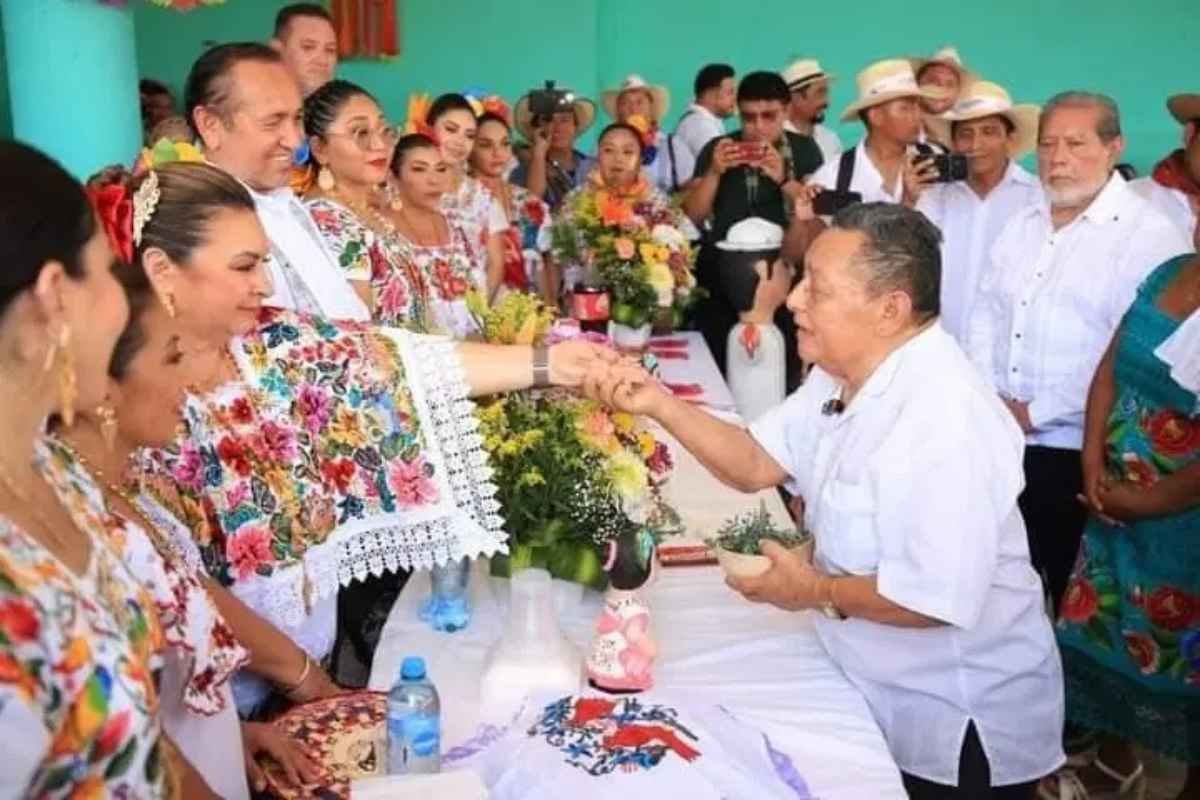
Kantunilkín, Quintana Roo — Keeping the annual fiesta in honor of the Virgin of the Immaculate Conception alive is a commitment that goes far beyond devotion. The 12 diputados de plaza and seven traditional guilds spend their own money to organize the celebrations, offer free food to residents and visitors, and fulfill promises that in some cases have been passed down through generations. Costs can reach 180,000 pesos per organizer, while the economic recovery is minimal.
With more than a century of history, the celebration draws thousands of believers every December and preserves religious, ceremonial and community practices that form part of Kantunilkín’s identity.
History
According to city chronicler José Moisés Gaspar Maglah Canul, there is no exact date for the arrival of the Virgin’s image in the area, though it is estimated to date from 1864, when the community built its first church with local materials.
According to old stories collected from elderly residents, including Enrique Cauich Tah, the effigy was brought from Chemax, Yucatán, by a priest fleeing the Caste War, which began in 1847. The priest owned land in the area and, unable to return to his hometown, brought the Virgin with him and placed her in a shrine in the old settlement of K’oon Che’en, whose name means “well’s hollow.” Over time, residents adopted her as their patron saint.
From Maya Ritual to Bullfights
The chronicler said that in those days the image inspired deep respect among residents. According to the beliefs of the time, those who passed in front of the church without crossing themselves fell ill. It was even said that dogs and birds died when crossing in front of the temple.
Faced with the fear this belief aroused, elders asked for a K’eex, a ceremonial cleansing performed by Maya priests to calm the power the population attributed to the image.
During the final years of the 19th century, celebrations consisted mainly of novenas. Around 1900 the first bullfighting festivities began with the so-called “baxa wakax,” in which bulls were tied to posts and rudimentarily fought in the main square.
By 1920, the bullfights had a formal ring in the area of the social club. The first jaranera orchestras came from Yucatecan towns such as Tixcacal and Yodzot and accompanied the first local musicians, among them Desiderio Abán, Florentino Cocom, Eduk Che and Genaro Iuit.
At that time, those responsible for organizing the fiesta were known as Nojoch Kuuch, or “great bearer.” They were in charge of obtaining and slaughtering pigs, preparing foods such as the traditional relleno negro and coordinating activities.
When the main organizer could not fulfill his duties, the K’aabel Kuuch, or “second bearer,” took over through a formal ceremony. At the end of the festivities, participants performed the muc pib, a Maya rite to return and give thanks to the earth.
In 1950 the first organized guild emerged, made up of chicle workers, the forerunner of today’s system.
Promises Paid Out of Pocket
The economic dimension of the celebration is reflected in the expenses assumed by the diputados de plaza. For Alicia Poot, the commitment is neither a business nor an opportunity for profit, but the fulfillment of a promise inherited from her father and the continuation of a family custom: keeping the doors of her home open to feed anyone who arrives.
Preparation begins several months before December with the cazá, or reminder, a visit the organizer makes to the homes of members to inform them about the details of the fiesta, the dates of the bullfights and to request their collaboration.
During these visits, the organizer usually offers tequila and cigarettes to group members. If they accept, they reaffirm their commitment to contribute fees of around 500 pesos per person. The funds go toward paying for charlotadas, bulls, bands and food.
However, the contributions do not cover the total cost. At last year’s celebration, Poot invested 180,000 pesos of her own money, from preparations through the days of the fiesta, and recovered about 29,000 pesos through fees from her 70 members.
The difference does not weigh on her, she said, because she fulfills her promise out of devotion and has her family’s support. At her home, authorities, residents, visitors and police officers are received with free food, soft drinks and beer. The hospitality is offered equally to members and to people passing through.
Eddier Euan has had a similar experience. He has led the organization of the Dec. 2 bullfight for 15 consecutive years. For him, the festivities are an act of faith that leaves no room for economic gain.
A significant part of his salary and of the savings he accumulates over a full year of work goes toward fulfilling his promise to the Virgin. Among the preparations is organizing the primicia in the bullring, a ceremony in which protection is sought from the owners of the land to prevent accidents involving people and animals.
At his home, the slaughter of pigs begins on Dec. 1 so that the food is ready for the next day. They buy large quantities of recados, salt, tomatoes and chiles, and prepare the pib for the relleno negro.
The doors of his home also remain open to any resident of Kantunilkín or tourist arriving from Cancún, Puebla or Mexico City. As long as there is food in the pot, a plate is served to whoever arrives, because the essence of the patronal fiesta is to share with the community without distinction.
Organization
Devotion also sustains the organization. Román Ávila, known as “Cholenco,” heads the farmers’ guild, whose celebration takes place on Dec. 6. For him, expenses become secondary when a promise is involved.
Some years ago, he and his family suffered a car accident from which they emerged unharmed. In gratitude to the Virgin of the Immaculate Conception, whom he credits with saving their lives, he took on the commitment of organizing the guild for eight consecutive years. He is currently in his seventh year at the helm.
Born in Holbox but Kantunilkín at heart through devotion and tradition, Ávila explained that preparing the festivities takes a full year. At his home, the novenas in honor of the patron saint begin on Nov. 27 at 7 p.m.
For the celebration, the 14 members confirmed so far each contribute half a pig.
More Culture
- Punta Allen Cooks Turn to Seafood Cuisine to Win Back Tourists After Slow Season
- Musicians in Mexico’s Maya Zone Honor Santa Cecilia with Rosary and Matán
- UIMQROO to Open Planetarium, Awards Scholarships to 49 Students
- Quintana Roo Gastronomy Expands to More Municipalities
- Dzibanché and Calakmul Maya Treasures Cross Ocean for Denmark Exhibition
More Zona Maya
- Young Developers Launch Lyra App to Connect Passengers With Mototaxis in José María Morelos
- Maya Traditional Cooks Showcase Flavors and Knowledge at First Quintana Roo Gathering
- Maya Ka’an Communities Strengthen Monitoring and Governance of Their Aquifers
- Playa del Carmen to Promote Community Tourism at Travel Fairs
- Beekeepers in Mexico’s Maya Zone Report Damage From Badgers, Beetles and Ants