
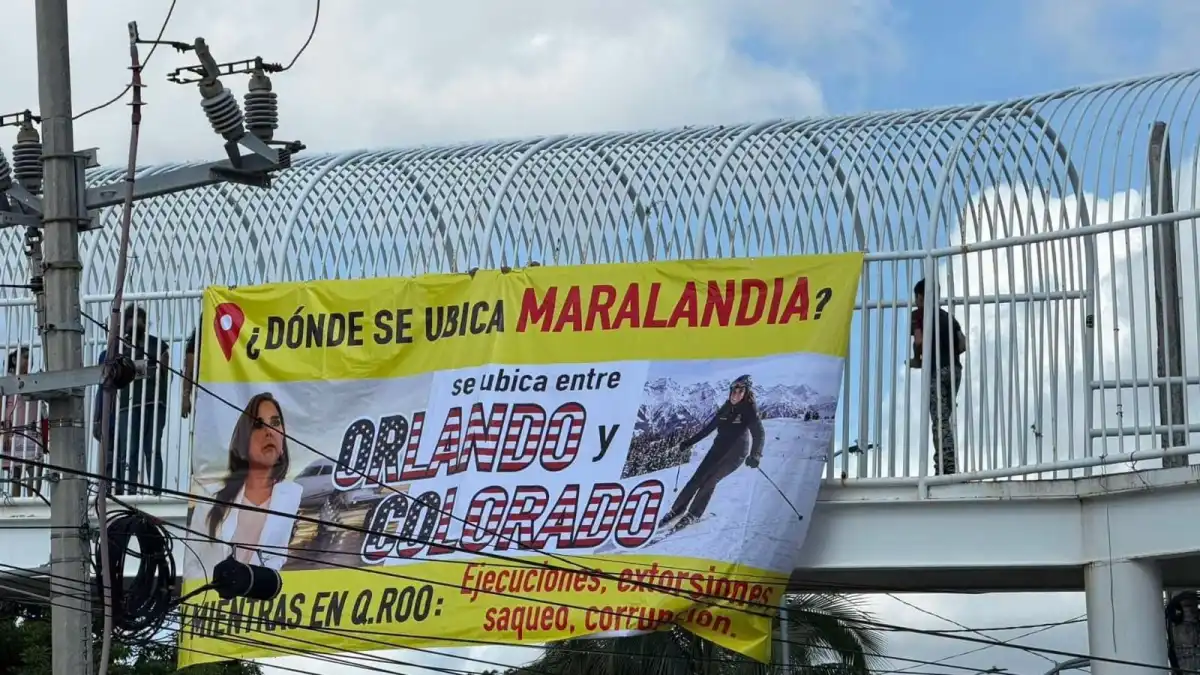
Cancún, Quintana Roo — A group of activists hung banners on the pedestrian bridge in front of Plaza Las Américas in Cancún on Sunday morning, protesting the judiciary, institutions they say are failing, and Quintana Roo Governor Mara Lezama Espinosa, whom they blame for the state’s situation.
The action was documented in a video shared on social media. The footage, filmed from the bridge itself, shows a small group of men and women, along with one minor, gathered at one end of the walkway. The woman recording explains that they had come to the Plaza Las Américas bridge to hang the banners as announced and would remain there for a while.
The full text of the banners is not clearly legible in the video, but the person leading the action summarized the purpose of the protest: a demonstration against the judiciary, against institutions that do not work, and against the person at the head of the state. She also said several people at the scene identified themselves as victims of the system.
The protest took place at one of Cancún’s busiest pedestrian and vehicle crossings. The pedestrian bridge in front of Plaza Las Américas connects two high-traffic areas over Tulum Avenue, one of the city’s main roads, making the banners visible to drivers, public transport passengers, and pedestrians who cross daily.
As of the video’s circulation, no police intervention or removal of the banners was reported, and neither the state government nor the judiciary had issued an official position on the protest. The lack of response leaves the demonstration as a public complaint, with no formal channel of dialogue opened with the participants.
The action adds to a series of recent protests in Cancún in which victims’ groups, mothers searching for missing relatives, and activists have used banners, signs, and blockades to demand progress in investigations and judicial proceedings and attention to disappearance and violence cases. In early November, members of the Quintana Roo Mothers Searching Collective and the Xtabay Feminist Collective blocked access to the Hotel Zone for several days with banners and signs, demanding justice and denouncing unfulfilled agreements.
On social media, the banners drew mixed reactions. Some users expressed support for the protest and its organizers, while others questioned it, linked it to electoral timing, or doubted its reach.
Some comments revived earlier criticism of the governor, including questions about trips outside the state and insecurity in Quintana Roo, though those allegations have not been proven in a judicial process. Sunday’s protest was not large-scale.
It was a symbolic action by a small group at a visible location, the kind of demonstration aimed above all at drawing attention to demands that, according to the protesters, institutions have not answered.
More Politics
- Morena Bars Tulum Councilman From Party Posts Over Luxury Travel Posts
- Quintana Roo’s Government Transition 30% Complete Across 86 Agencies
- DEA Hails Capture of ‘Chapo Isidro’ as ‘Significant Victory’
- Quintana Roo Has Arrested 11 Former Mayors Since the 1990s
- Former Cancún Interim Mayor Carlos Canabal Ruiz Released After Judge Declines to Charge Him
More Cancun
- Mexico Posts Largest Air Passenger Drop in Latin America and the Caribbean
- Two-Car Crash on Playa del Carmen-Cancún Highway Leaves Several Injured
- Cancún Hotel Zone Sees Surge in Tourists at Beaches and Nightclubs
- Mexican Authorities Seize Suspected Drugs and Pickup Truck in Two Raids in Quintana Roo
- FGR Raids Cancún Property in Supermanzana 68, Detains Several Suspects