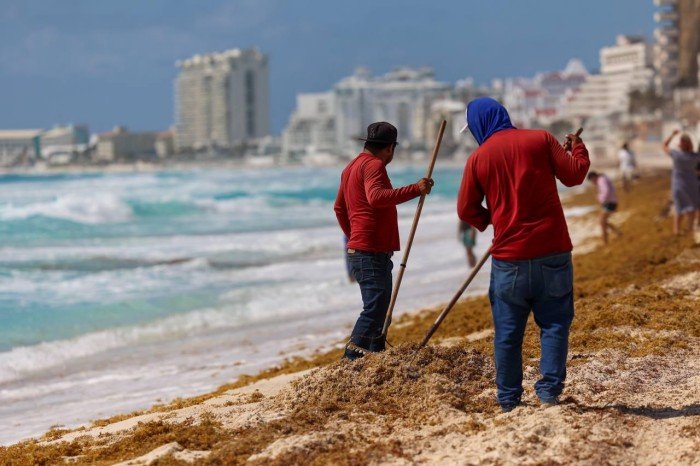
Cancún, Quintana Roo — Cancún has already collected nearly twice the sargassum it removed during all of 2025, and officials expect the total to climb past 30,000 tons by the end of August.
Arturo Quintero Díaz, head of the Public Services Department in Benito Juárez, said Thursday that 26,600 tons have been collected so far this year. He spoke to reporters at the municipal palace in Cancún.
“By the end of the month, I believe and estimate we’ll reach 30,000 tons, which means we’ll be collecting double what we hauled in last year,” Quintero said.
Last year, workers from Zofemat and the Public Services Department collected about 16,000 tons of sargassum, a figure that was already surpassed by May 2026, he noted.
The official said the situation remains fully under control, so there has been no need to activate the extraordinary brigade protocol of the community program “Todos contra el sargazo” (Everyone Against Sargassum).
As of Thursday, the city had collected 4,300 tons of sargassum in August, already exceeding the 3,600 tons collected in July. The beaches most affected by the seaweed landings are Delfines, Coral, Ballenas and Marlín.
Quintero said the coastal cleanup strategy begins every day at 6 a.m. with the deployment of cleaning crews and six specialized mechanical sweepers. The heavy machinery significantly speeds up algae removal, reduces physical strain on workers, and helps preserve the international certification and appearance of Cancún’s beaches.
About 250 workers are deployed for seaweed collection, including roughly 120 from the Public Services Department’s Coast and Beach Directorate, with the remainder from Zofemat.
More Environment
- Yucatán Peninsula Lost 285,580 Hectares of Jungle in 4 Years
- Quintana Roo Crews Clear 70,000 Liters of Water in Bacalar and Chetumal After Heavy Rains
- Yucatan Drafts Rules for Artificial Lakes After Worker Dies of Amoeba Infection
- Quintana Roo Wins SEMARNAT Approval to Restore 33.5 Km of Beaches
- Yucatán Monitors Low-Pressure System in Gulf of Mexico for Possible Cyclone
More Cancun
- Tropical Wave 36 Floods Northern Quintana Roo, Hits Tourism
- Cancún Residents Call Protest Against Aguakan Over Unsafe Roadworks on Avenida Colegios
- Cancún Real Estate Fraud Suspect to Face Trial at Liberty After Judge Rejects Pretrial Detention
- Park Hyatt to Open in Riviera Maya on December 3 With 148 Rooms
- Woman Killed by Gunshot to the Head in Cancún