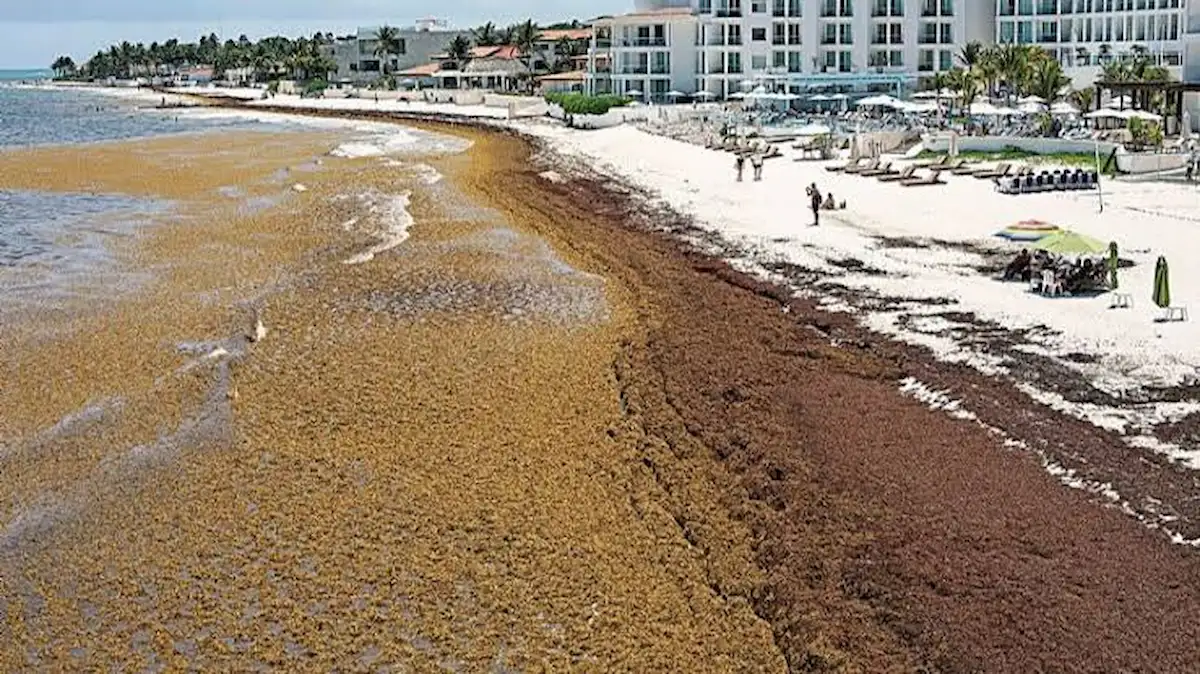
Playa del Carmen, Quintana Roo — The 2026 sargassum season has put the Mexican Caribbean on high alert, with official figures from the state’s Secretariat of Ecology and Environment (SEMA) showing that 86,473.38 tons of the macroalgae have been collected along Quintana Roo’s coastline, making this one of the most critical years since the massive influx began.
Playa del Carmen is the hardest-hit municipality, where 31,413.20 tons have been removed — more than a third of the state total. That figure makes the tourist destination the main point of impact for sargassum landings in 2026, surpassing even Benito Juárez (Cancún), which has accumulated 20,880.75 tons.
The remainder of the collection is distributed among Puerto Morelos with 10,572.24 tons; Tulum with 9,663.08 tons; Othón P. Blanco with 9,446.56 tons; Isla Mujeres with 3,348.20 tons; Cozumel with 1,113.10 tons; and Lázaro Cárdenas with just 36.25 tons.
The figures reflect the intensity of the phenomenon along the Riviera Maya, where beaches receive large daily amounts of sargassum driven by ocean currents and prevailing winds. The accumulation forces permanent cleanup operations to prevent the algae from decomposing on the sand, a process that generates foul odors, affects water quality, and disrupts coastal ecosystems such as reefs, seagrass beds, and turtle nesting sites.
To address the contingency, the Quintana Roo government maintains a strategy that combines the installation of anti-sargassum barriers, offshore collection, and daily beach cleaning with support from municipalities, the Mexican Navy, and the hotel sector.
According to the latest SEMA report, 16 kilometers of anti-sargassum barriers are currently installed at various points along the Quintana Roo coastline, aiming to contain part of the macroalgae before it reaches the beaches and reduce the volume that must be collected on land.
However, oceanographic conditions and the constant arrival of new sargassum masses keep pressure on the main tourist destinations of the Mexican Caribbean.
Since early 2026, specialists warned that the Atlantic was experiencing a historic amount of floating sargassum, estimated at more than 42 million tons, leading to expectations of a high-intensity season for the Mexican Caribbean. That forecast is now reflected in official collection figures, which continue to rise as summer progresses.
Although there are projects to use sargassum for producing biogas, fertilizers, and other materials, the volume arriving on the coasts continues to exceed processing capacity, so much of it must be taken to controlled disposal sites.
With Playa del Carmen as the municipality with the highest landings and over 86,000 tons removed across Quintana Roo, the 2026 season confirms that sargassum remains one of the greatest environmental, tourism, and economic challenges for the state, with rising costs to maintain the beaches that support its main economic activity.
More Environment
- Activists Protest Pig Mega-Farms in Yucatán, Demand Crackdown on Pollution
- Quintana Roo to Pitch Sustainability in Reworked International Tourism Push
- Cancún Seaweed Firm Ensol Caribe Eyes Expansion Into Dominican Republic and Belize
- Environmentalists Warn Tulum Jungle Road Could Open Door to Real Estate Expansion
- Only Four Sargassum Fishing Permits Processed in Mexico, Imipas Says
More Playa del Carmen
- Car With Two Children Overturns at Paamul Curve on Highway 307
- Playa del Carmen Opens Nominations for Elvia Carrillo Puerto Award Honoring Outstanding Women
- CFE and Playa del Carmen to Review Plan for Submarine Power Line to Cozumel
- American Says Stolen Truck Was Resold in Playa del Carmen With Forged Paperwork
- State Adult Education Institute to Open Branch in Villas del Sol