
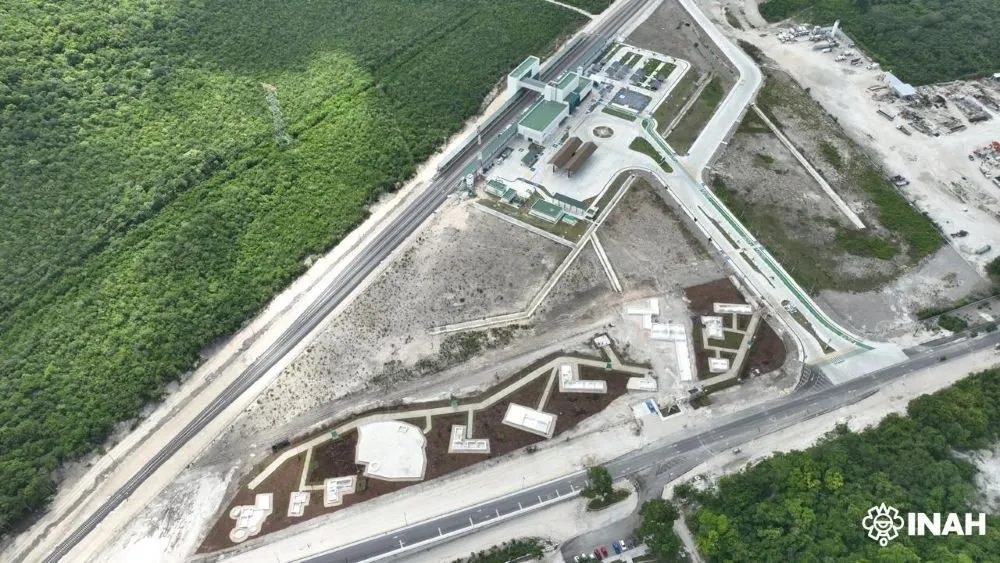
Mexico City — Renowned archaeologist Eduardo Matos Moctezuma, winner of the 2022 Princess of Asturias Award for Social Sciences, has sharply criticized the so-called “Memory Parks” built with archaeological monuments discovered during the Maya Train project in Campeche and Quintana Roo, arguing that their creation violates fundamental archaeological principles.
Speaking at a panel organized by the National Institute of Anthropology and History (INAH), Matos questioned the decision to move archaeological remains from their original contexts and concentrate them in new spaces.
“The way it was done is not valid within archaeology,” he said, referring to parks created with pieces and structures found along the Maya Train route and later relocated to various sites in Campeche and Quintana Roo.
He noted that several specialists, including emeritus archaeologist Noemí Castillo, Jorge Angulo, and Sergio Gómez, have raised technical objections to the project. The parks in question are Ka’Will in Xpujil, Campeche, and Balam Tun in Chetumal, Quintana Roo.
“Voices like those of Noemí Castillo, Jorge Angulo, Sergio Gómez, among others, have been heard, showing elements that contradicted the image that everything was going very well,” Matos said.
The spaces have been described in previous panel discussions as “archaeological Frankensteins” because they bring together elements extracted from different sites to form new structures far from their original locations.
Matos also rejected the idea that these projects could be justified under the concept of anastylosis, a technique used to reconstruct monuments using their original pieces.
“But in the case of these parks, someone mentioned that it was anastylosis … Well, no! Because parts of monuments are being moved to parks — what is the point? Memory Parks? I don’t know what memory,” he said.
The archaeologist also recalled that the 1964 Venice Charter, one of the main international references for the conservation of historical heritage, does not contemplate this type of reconstruction through the relocation of archaeological elements.
Concern for INAH’s situation
During the same event, Matos expressed concern about the current state of INAH, the institution where he has worked for more than six decades.
“There is disenchantment, because I see that the real and sustained support for everything concerning our institution is declining,” he lamented.
He denounced the lack of new positions for archaeologists and anthropologists, as well as insufficient resources to ensure the continuity of research and conservation of the country’s cultural heritage.
More Culture
- Isla Mujeres Ready for Luz y Vida 2026 Festival With Free Pandora Concert
- Hanal Pixán 2026 in Puerto Juárez: Four Days of Maya Day of the Dead Traditions
- Mattel Unveils Barbie Día de Muertos 2026 Doll Inspired by La Catrina
- Playa del Carmen Opens Registration for Audiovisual Workshops
- National Geographic Names Maya Ka’an Among Top Destinations to Visit in 2027
More Quintana Roo
- Quintana Roo Tops 152,000 Metric Tons of Sargassum as Playa del Carmen and Cancún Lead
- Court Gives Profepa 72 Hours to Clarify Tren Maya Closure Order
- Quintana Roo Beaches Lose Up to 14 Meters of Sand a Year as Restoration Plan Advances
- Quintana Roo Youth Sailors Join Mexico’s Team for Optimist Championship in Uruguay
- Mara Lezama Hands Out 100 Sewing Machines in Chetumal to Boost Women’s Self-Employment