
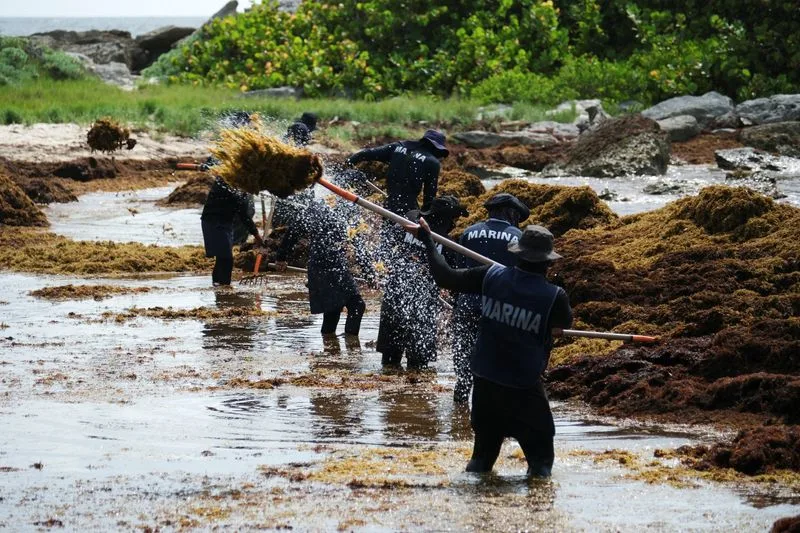
Tulum, Mexico — A record wave of brown, smelly seaweed is washing up on beaches along Mexico's Caribbean coast, forcing closures in top tourist destinations and inflicting mounting economic damage on hotels, restaurants and shops.
The unprecedented mass of sargassum – a brown seaweed that drifts across the Atlantic in vast mats and is pushed by ocean currents toward Caribbean shorelines in the springtime – has prompted the federal government to prepare an emergency plan to combat the issue.
In the eastern state of Quintana Roo, a tourist hot spot home to once-crystalline beaches including Cancun and Playa del Carmen, environmental officials project 119,000 tons of sargassum to wash up on the shore by year's end, surpassing last year's record of 96,000 tons.
"Warmer temperatures are going to give you more sargassum," said Brian Barnes, a research assistant professor at the College of Marine Science at the University of South Florida who studies the phenomenon, adding that a combination of nutrients and long days of sunlight also plays a role.
Once stranded on beaches, sargassum quickly begins to rot, releasing a stench often compared to rotten eggs.
"The drop in tourism is extremely serious," Tulum Councilman Eugenio Barbachano said, laying the blame on the sargassum epidemic. "The low season is not just low, it is critical."
Workers line many beaches along Quintana Roo's Riviera Maya, knee-deep in seaweed as they shovel heaps of sargassum off the shoreline to polish the coast – an arguably Sisyphean task as some of the season's worst months may still be to come.
Quintana Roo Governor Mara Lezama has said managing sargassum costs the state roughly 11% of its GDP, or about $2 billion annually, while the Riviera Maya hotel association estimates the cost of combating the seaweed at roughly $150 million annually.
Still, in recent weeks, dozens of Quintana Roo beaches have been placed on red alert for the algae, some even closing. In late June, 92.5% of the state's beaches registered an "excessive" level of sargassum, according to a local monitoring network.
"Quintana Roo is a state that sells beaches, blue sea and water activities," said Carlos Solis, a local tourism service provider. "It affects everything."
Marine scientists also warn that the decomposing seaweed starves underwater plant life of sunlight, reducing biodiversity, and can even leak arsenic and other heavy metals into the sand.
Workers who shoveled sargassum off beaches in the past report itchy and burning skin, headaches, fatigue and nausea linked to the algae, according to a 2025 study published in a scientific journal.
In an effort to combat the seaweed, the Mexican Navy has deployed a sargassum-fighting fleet, including 11 specialized coastal ships, an amphibious sargassum collector, 18 support boats, two barges and four drones. It has also installed more than 9,000 meters (29,500 feet) of containment barriers to protect beaches.
The government is due to present a revised response plan on July 30 in hopes of better tackling the issue.
Brian Lapointe, research professor at Florida Atlantic University’s Harbor Branch Oceanographic Institute, said the Caribbean needs a system that connects "satellite observations and modeling forecasts with targeted intervention before sargassum reaches the beach."
Some tourists are braving the seaweed-blanketed waters.
"I went swimming today," said Wendy, a Swedish tourist. "I expected worse."
More Environment
- Cancún’s Benito Juárez Recycling Drive Recovers 6.8 Tons of Waste
- US Releases 1 Billion Sterile Flies to Stop Screwworm’s Return
- Delphinus Blue Planet Pulls Out of Deal to Buy The Dolphin Company, Leaving 101 Marine Animals in Limbo
- New Pemex Oil Spill in Gulf Won’t Reach Campeche Beaches, Company Says
- Cozumel Beach Club Kuzá Targets 4,000 Daily Visitors in Protected Area With CONANP Backing
