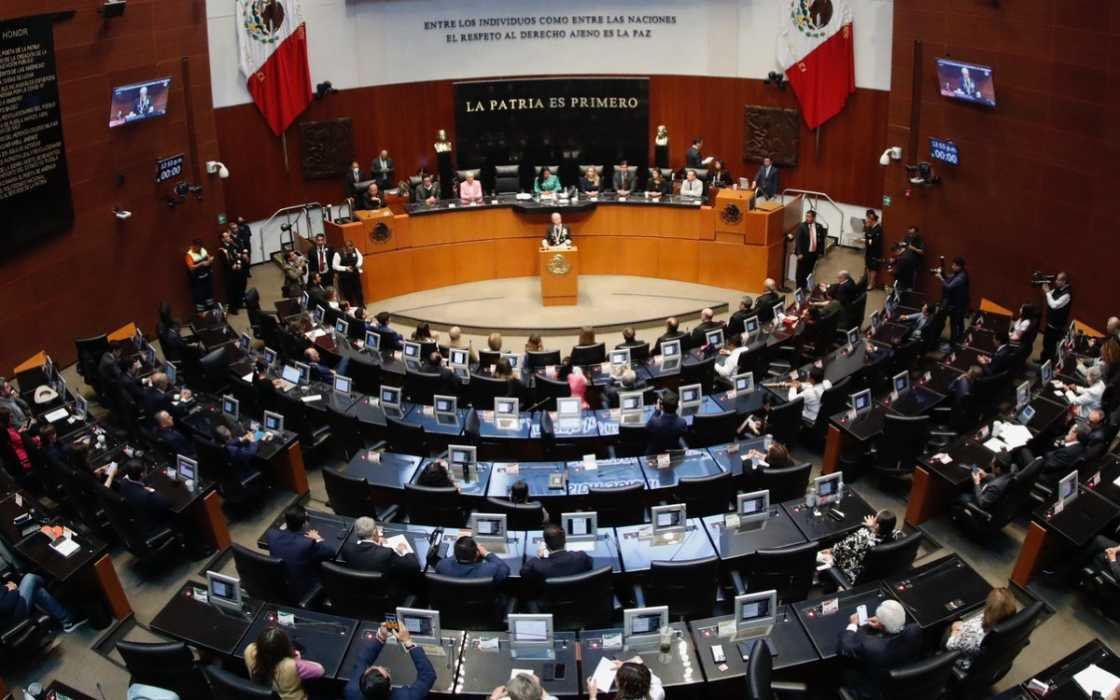
Mexico City — Mexico’s Senate approved the government’s 2027 fiscal package on Tuesday, authorizing 10.64 trillion pesos in revenue and up to 1.7 trillion pesos in net domestic borrowing despite opposition objections over rising public debt and higher fees on foreign tourists.
Lawmakers approved the Federal Revenue Law along with amendments to the Federal Fees Law and to provisions of the income tax law (ISR) during the Oct. 27 session, with votes supplied by the ruling Morena party and its allies, the Green Party (PVEM) and the Labor Party (PT).
The revenue law passed in general with 79 votes in favor and 34 against, and in particular with 75 in favor and 34 against. There were no abstentions.
Senators from the PAN, PRI and Citizens’ Movement (Movimiento Ciudadano) rejected the package, arguing that it adds pressure to public finances without resolving structural problems in tax collection and economic growth.
Borrowing ceiling set at 1.7 trillion pesos
One of the most contentious points was authorization for the federal government to contract up to 1.7 trillion pesos in net domestic debt during 2027.
Opposition legislators warned the move would push the country’s public debt close to 55 percent of gross domestic product (GDP).
PAN Sen. Ricardo Anaya questioned the government’s continued reliance on financing to meet its budget commitments and said the financial cost of the debt would absorb a considerable share of public resources.
The PAN argued that the borrowing planned for 2027 is especially worrying because interest payments on earlier obligations will amount to nearly 1.6 trillion pesos.
Morena legislators defended the measure, saying that authorizing a borrowing ceiling does not mean the full amount will be drawn down. They also said the provisions will keep social programs, public investment and government services running.
Foreign tourists to pay more
Another contested change is the reform to the Federal Fees Law, which raises charges for a range of federal procedures and services.
Among the changes is an increase in the non-resident fee (DNR), paid by foreign visitors who enter Mexico under certain immigration conditions. The charge will rise from 983 pesos to 1,158 pesos in 2027, an increase of 175 pesos, or about 17.8 percent.
The measure matters especially for international destinations such as Cancún, Playa del Carmen, Tulum, Cozumel and the rest of Quintana Roo, whose economy depends heavily on foreign visitors.
Opposition lawmakers questioned raising the cost for tourism without guaranteeing that the additional money goes directly to tourism promotion, infrastructure or improvements to destinations. They also noted that part of the revenue from the fee is channeled to the armed forces, a point that has angered tourism industry representatives.
The Federal Fees Law reform passed in general with 79 votes in favor and 34 against, and in particular with 75 in favor and 34 against, after the full Senate rejected amendments proposed by individual legislators.
6.26 trillion pesos expected from taxes
Under the approved revenue law, the government expects to collect about 6.26 trillion pesos in taxes during 2027, roughly 59 percent of total projected revenue.
The main sources are income tax (ISR) and value added tax (IVA). Other revenue comes from social security contributions, fees, duties, asset sales and services, as well as financing.
The majority bloc defended the forecasts, saying the package creates no new general taxes and does not raise ISR rates. The opposition countered that the collection policy does not distribute the tax burden fairly across economic sectors.
Criticism over tax relief for large taxpayers
Another source of controversy was the inclusion of provisions that will let taxpayers settle outstanding debts through relief on fines, surcharges and enforcement costs.
PRI Sen. Carolina Viggiano questioned that changes approved earlier by the Chamber of Deputies removed restrictions that originally limited large taxpayers’ access to those benefits.
She said the original proposal set a 300 million peso income limit for the regularization scheme, but that condition was dropped during the legislative process.
The opposition argued the change could benefit large companies with tax debts while other taxpayers continue to face heavier obligations and controls. Ruling-party legislators said the measures aim to encourage debt regularization, strengthen compliance with tax obligations and improve collection.
Spending budget still pending
The Chamber of Deputies must still debate and approve the federal spending budget, which will set out how resources are divided among government agencies, social programs, infrastructure, security, health and education.
Unlike the revenue law, which both chambers vote on, the spending budget is the exclusive prerogative of the lower house.
The package approved by the Senate now moves through the process for enactment and publication, with entry into force scheduled for Jan. 1, 2027. The spending debate will take place amid questions over the growth of public debt, the government’s financing needs and the impact of the new charges on sectors such as tourism.
More Politics
- INE Chief Guadalupe Taddei Resigns Amid Contract and Travel Scandals
- Graffiti Artists Erase Cancún’s ‘Wall of Corrupt Politicians’ as Activists Prepared to Restore It
- Quintana Roo Green Leader Hands Over 80K-Member Party
- Sheinbaum Says Mexico Won’t Take the Bait: ‘We Will Not Fall for Any Provocation’ From the US
- Why Mexico’s Treason Charge Over a U.S. Raid Matters