
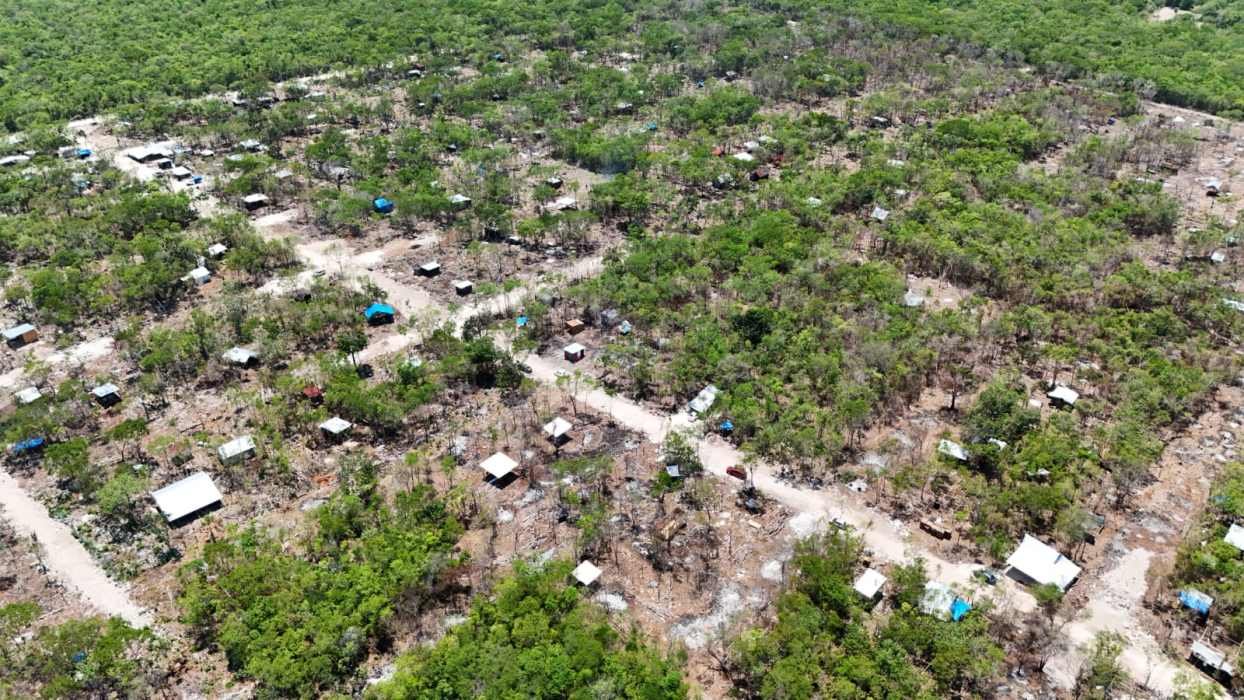
Playa del Carmen, Quintana Roo — Business leaders are cautiously welcoming the first formal steps to regularize long-standing informal settlements along the Juárez Avenue ejidal corridor, a zone that has symbolized both the explosive growth and the structural challenges of Playa del Carmen over the past two decades.
José Ramón Cárdenas González, president of the Riviera Maya Business Coordinating Council (CCE), said efforts to legalize the Alfa y Omega and San Judas Tadeo neighborhoods are overdue but necessary. The municipal Housing and Regularization Department has announced that approximately 1,000 lots will be addressed in the first phase, part of a broader area known locally as In House, San Judas, Las Torres, and El Sauce in Puerto Aventuras, where an estimated 4,000 lots lack full legal certainty.
“These actions will allow us to allocate public resources and equip the area with infrastructure,” Cárdenas González said, referring to basic services such as drainage, paved roads, street lighting, and formal water connections.
Informal settlements are not new to Playa del Carmen. Rapid population growth — driven by tourism expansion since the early 2000s — has consistently outpaced formal housing supply. According to INEGI census data, Solidaridad’s population grew from roughly 63,000 residents in 2000 to more than 330,000 by 2020. That surge fueled the proliferation of irregular land occupations, particularly on ejidal land surrounding the city and along key access corridors.
Neighborhoods like Colosio, In House, and various settlements along the federal highway and Juárez Avenue emerged in similar ways — through land invasions, informal sales, or unclear tenure arrangements. In many cases, residents have lived for years without formal property titles, limiting access to financing, municipal services, and infrastructure investment.
Regularization programs in Quintana Roo typically involve cadastral surveys, environmental assessments, coordination with ejido authorities, and legal titling processes. While they can provide families with property security, they are also controversial. Critics argue that regularization may inadvertently incentivize future invasions if enforcement does not simultaneously prevent new illegal occupations.
Cárdenas González emphasized that preventing new invasions must remain a priority. “Invading private property remains an illicit act,” he said, underscoring the need for consistent enforcement alongside legalization efforts.
For the private sector, legal certainty is closely tied to investor confidence. Formalizing land tenure can open the door to infrastructure upgrades and new development while reducing legal disputes that often complicate real estate transactions.
As Playa del Carmen continues to expand, the balance between social housing needs, land legality, and sustainable urban planning remains one of the municipality’s most pressing long-term challenges.
More Local News
- Direct Sales Open Path to Formalization for Mexican Artisans, Says Luz Valdez
- Playa del Carmen Hosts Corn Fair to Celebrate Mexico’s Agricultural Heritage
- Cancún to Host National Climate Change Colloquium in October
- Riviera Maya Hotels Offer Free Nights When Sargassum Blocks the Beach
- Nayarit Overtakes Quintana Roo in Mexico Tourism Investment
