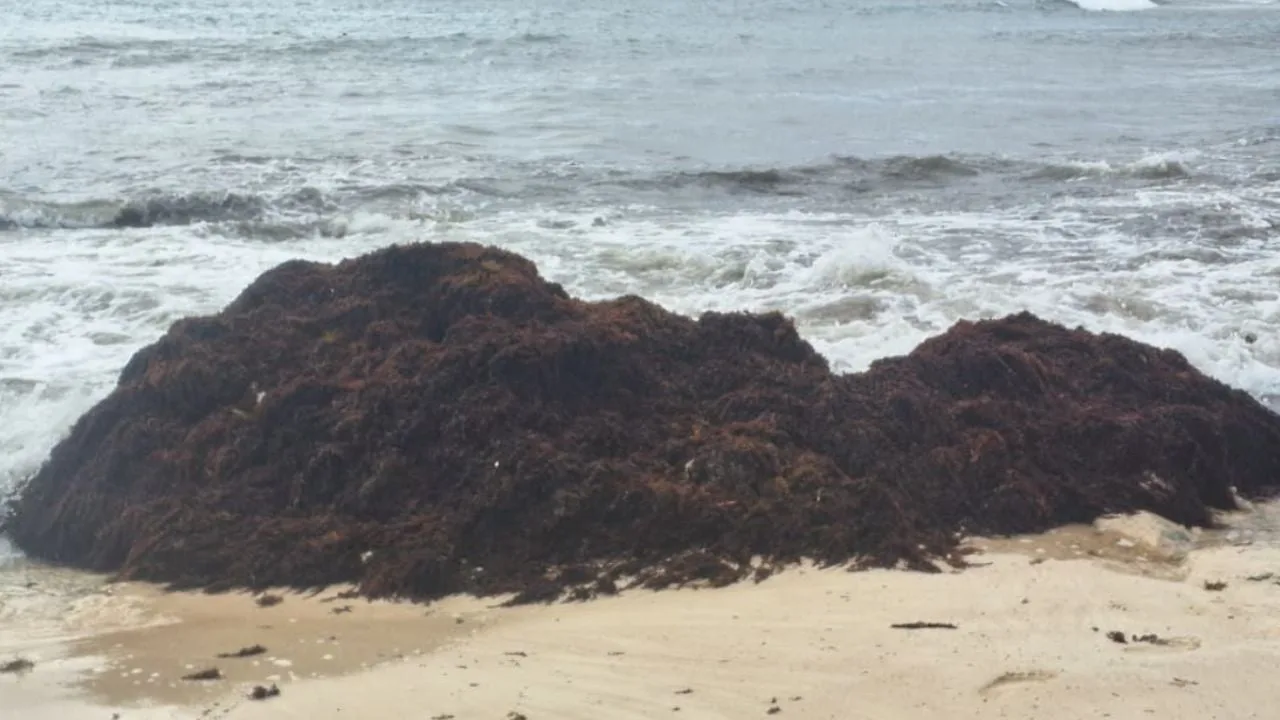
Playa del Carmen, Quintana Roo — As sargassum continues to pose major environmental and economic challenges for the Mexican Caribbean, livestock producers in Playa del Carmen are pushing a proposal to turn the seaweed into an opportunity for agriculture: using it to restore soil and grow grass for cattle feed.
The project is led by sheep farmer Fernando Chico, owner of Rancho Tigre Grande northwest of the city, with support from the municipal Agricultural and Fisheries Development Department.
Department director Alejandro López said in an interview that the initiative is in a key phase of scientific analysis. Specialists from the Yucatan Scientific Research Center (CICY) have collected samples to determine whether sargassum can be safely used in farming and livestock operations.
“The idea is to use sargassum to restore agricultural soils and then plant forage grass to feed the animals,” López explained.
Laboratory results will be crucial to provide technical backing and ensure the seaweed poses no risks to agricultural production or the environment, he added.
If results are favorable, the next step will be coordinating with state environmental authorities, particularly the Secretariat of Ecology and Environment (SEMA), and other agencies involved in sargassum management and disposal.
López noted that specific regulations govern the handling of sargassum, and any use scheme must meet environmental and administrative requirements before receiving permits.
“Once we have the technical support, we can meet with environmental authorities and better organize the project to move forward with implementation,” he said.
The proposal comes during an intense sargassum influx season in Quintana Roo and a drought that is hitting the region’s livestock sector.
In addition to exploring sargassum reuse, the municipal government is working on direct support for livestock producers to cope with the lack of rain, including delivering feed such as cracked corn and other supplies to reduce the economic impact on ranches.
“We are working with ranchers. This year we will also support them with a percentage of feed because of the drought. We know the situation is hitting hard, and we are looking for alternatives to back them,” López said.
Regarding logistics, López clarified that the goal is not to impose new fees or taxes on participating producers, but to establish mechanisms to transport the material to authorized sites where it can be safely used.
Each interested producer would be able to use sargassum on their land once permits are obtained and transport arrangements are made, possibly in coordination with transport groups or through agreements with authorities.
If scientific studies confirm its viability, Playa del Carmen could become one of the first municipalities in the Mexican Caribbean to promote a circular economy model that turns a major coastal problem into a tool for strengthening agricultural production and restoring degraded soils.
More Environment
- White Sea Turtle Rescued in Cancún’s Hotel Zone
- Quintana Roo Records 29,413 Sea Turtle Nests at Season’s Midpoint
- Quintana Roo Reports 1,200 Screwworm Cases as Officials Await Sterile Fly Release
- Semarnat Approves Floating Marina in Cancún’s Nichupté Lagoon
- Cancún’s Benito Juárez Recycling Drive Recovers 6.8 Tons of Waste
More Quintana Roo
- Sheinbaum Announces 187 Primary Care Clinics and Major Projects in Quintana Roo
- Sheinbaum Touts Billions in Quintana Roo Infrastructure Ahead of Cancún Accountability Event
- Delphinus Blue Planet Pulls Out of Deal to Buy The Dolphin Company, Leaving 101 Marine Animals in Limbo
- No Long Weekend for Quintana Roo Students: Classes Held Sept. 14-15, Suspended Only Sept. 16
- Quintana Roo Bill Would Jail Pet Owners Who Abandon or Neglect Animals