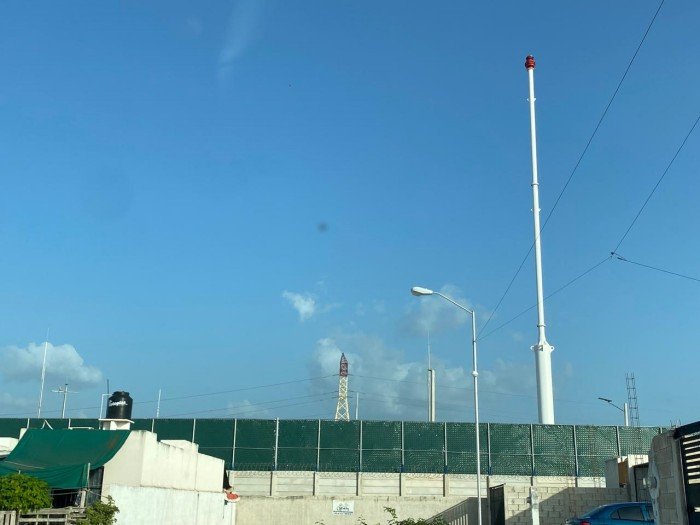
Umán, Yucatán — A young resident of Gran Calzada has a simple answer when asked where a natural gas compression station should have been built instead of beside her neighborhood.
“On another world,” she said. “They should have put it on Mars.”
Her comment reflects a dispute that has continued for months between residents, government agencies, the subdivision’s developer and Energía Mayakán, the Engie-controlled company operating the station beside the fourth phase of Gran Calzada.
Residents say noise, vibrations, strong odors and uncertainty over emergency procedures have disrupted daily life since construction and testing began. Energía officials maintain that the facility has the federal permits required for its operation and is part of an important expansion of the natural gas system serving the Yucatán Peninsula.
The installation is commonly called a “booster,” although it does not produce electricity or extract natural gas. It compresses gas to maintain the pressure needed to move it through the Mayakán pipeline toward power plants and other customers.
The broader expansion is expected to increase the pipeline’s transportation capacity from 250 million to 567 million cubic feet of gas per day. The project includes nearly 700 kilometers of additional pipeline through Tabasco, Chiapas, Campeche and Yucatán.
The Federal Electricity Commission and Engie announced construction in June 2024, describing the project as a way to improve fuel supplies for power generation in southeastern Mexico. The gas will support CFE generating facilities, including the Mérida IV and Riviera Maya combined-cycle plants. The entire expansion is expected to be completed during the first half of 2027. CFE valued the wider project at more than US$2 billion.
That regional purpose has done little to ease concerns in Gran Calzada, where some homes stand immediately beyond the station’s perimeter wall.
Residents Report Noise, Odors And Vibrations
Families say they had already purchased and occupied their homes before construction of the compression facility began nearby. They maintain that neither the developer, Grupo Casitas, nor public authorities adequately informed them that the station would be built beside the subdivision.
During construction and equipment testing, residents reported dust, powerful lights at night and noises that caused windows and doors to vibrate. Since operations began, they have continued to complain about mechanical noise, odors and occasional smoke or vapor coming from the property.
Parents have attributed headaches and sleep disruption among children to the activity. One mother said she began keeping her home closed and restricting outdoor play because she feared a possible leak.
A young resident also recalled an odor reaching her school, which she believed was gas. Her account has not been supported by a publicly released air-quality test or an official finding that a leak occurred. No government agency has publicly connected the reported headaches to emissions from the station.
The child has heard that the project is intended to improve electricity supplies but remains confused because her neighborhood continues to experience power outages.
“They say it’s for energy, but our lights still go out,” she said.
The station’s operation would not, by itself, prevent local blackouts. It transports fuel to generating plants, while interruptions at a particular home can result from failures elsewhere in CFE’s generation, transmission or local distribution network.
Court Initially Suspended The Station
Residents organized through Colectivo X un Yucatán con Energía Segura and Salvemos Gran Calzada. They submitted information requests and environmental complaints, held demonstrations and filed amparo case 2113/2025 against several public authorities.
The lawsuit argued that officials had failed to provide adequate environmental oversight, risk analysis and community protection in connection with the station.
On November 5, 2025, a federal judge granted a provisional suspension temporarily stopping installation and operation of the compressor. The suspension was an interim measure and not a final judgment on the legality or safety of the project. The court later declined to issue a definitive suspension, allowing operations to continue while the underlying case proceeded.
By June 2026, Yucatán Energy Agency Director Pablo Gamboa Miner said the compressor station was operating at full capacity. That statement referred to the Umán installation, not completion of the entire 700-kilometer pipeline expansion.
Gamboa said the facility held authorizations from the federal Environment Ministry and the Agency for Safety, Energy and Environment, known as ASEA. Residents have repeatedly requested copies of the risk findings and emergency plans they say should govern the site.
Separate questions have been raised about municipal land-use and construction records. Residents said an information request to the Umán government did not locate local permits for either the station or sections of the housing development. Federal environmental and energy approvals do not replace any municipal authorizations that may be required, although the absence of records in a municipal response does not by itself establish that the facility lacks all legal authorization.
State officials have placed some responsibility on earlier municipal administrations and Grupo Casitas for allowing homes to be built in what the government describes as a buffer area near existing energy infrastructure. Residents argue that authorities at every level shared responsibility for planning and approving the projects.
Engie Proposal Covers 33 Homes
In June, Gamboa disclosed that Engie-Mayakán had proposed purchasing 33 homes in the row closest to the station. He said participation would be voluntary and that two families had already entered arrangements to have their mortgage debts paid while they searched for other homes.
The offer does not mean each family would automatically receive a replacement house. The reported plan involves negotiating a purchase price and paying outstanding mortgages, including Infonavit loans.
Residents say that distinction matters. A mortgage payoff may leave a homeowner free of the existing debt but without enough money to purchase a comparable property at current prices. Families also want to know how improvements, moving expenses and the disruption of leaving their neighborhood would be valued.
Several residents said they learned about the 33-home proposal through public comments rather than direct notification. They have requested individual negotiations and written terms explaining who qualifies, how properties will be valued and whether compensation would extend beyond mortgage balances.
Gamboa has said owners who do not wish to sell may remain in their homes while the station continues operating.
Disagreement Continues Over Community Meeting
The conflict also extends to how consultation should be conducted.
Residents said Yucatán Energy Agency representatives agreed verbally on July 16 to hold a community meeting inside Gran Calzada. They were later told it would take place at the agency’s offices in Mérida at 5 p.m.
The community rejected the change, arguing that many working residents could not reach Mérida at that hour. They requested that the meeting be held in Gran Calzada at 9 p.m., when more families could attend and officials could directly hear the operating noise residents describe.
Alongside the gas-station dispute, families continue to complain about broken playground equipment, a shortage of trees and promised recreational spaces that have not been completed. Those concerns are separate from the pipeline litigation but contribute to residents’ view that the subdivision was developed without adequate services or long-term planning.
For the children growing up there, the conflict is experienced less through technical reports than through disrupted sleep, adults discussing legal action and uncertainty about whether their families will have to move.
The girl who wanted the compressor sent to Mars said she would prefer something much simpler for Gran Calzada: more trees, safe playgrounds and a neighborhood where the station is no longer beside her home and school.
More Community
- Playa del Carmen Launches ‘Parquemanía’ to Revive Public Parks
- Playa del Carmen Council Approves New Unit for Older Adults
- Quintana Roo Expands Tourist Police Force With Specialized Training Programs
- CURP Digital vs CURP Biométrica: What Mexico’s New ID Means for Online Bank Accounts
- Cancún Motorcycle Taxi Drivers Protest After Two Vehicles Torched