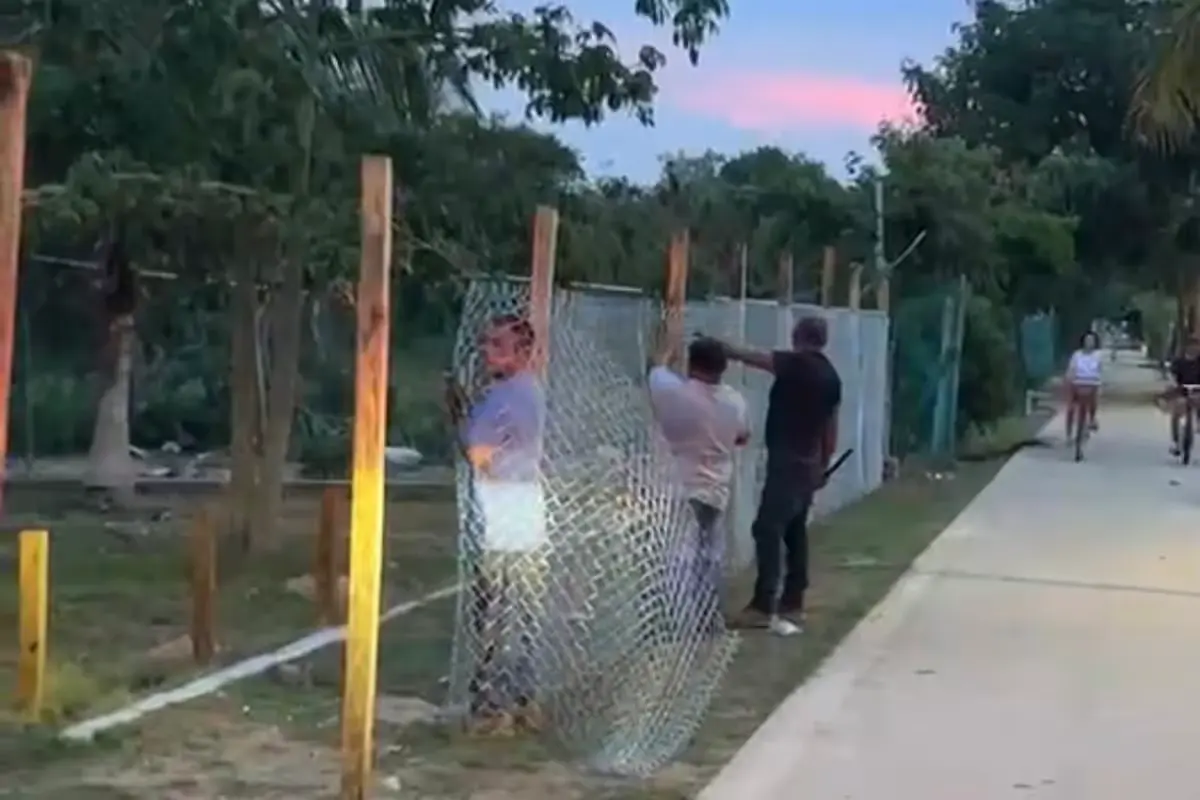
PLAYA DEL CARMEN, Quintana Roo — A dispute over beach access erupted Wednesday in Playa del Carmen after workers began installing posts along Fifth Avenue, effectively blocking public access to Playa 72 in the Luis Donaldo Colosio neighborhood.
The work triggered an immediate response from nearby residents, who tore down the barrier after discovering it. Municipal police arrived at the scene to prevent a confrontation between the workers and residents opposing the closure. The person or company behind the attempted closure has not been publicly identified.
Local activist Cristóbal Carreón condemned the installation, saying residents would not allow private individuals or businesses to restrict access to the beach. He said the Colosio coastline already has too few public access points and called for residents to organize in defense of public passage to the sea.
“We will not allow anyone to take over or prohibit people from accessing the beaches,” Carreón said, according to local reporting. “There is already no access along Fifth Avenue in the Colosio neighborhood, and we are demanding that more access points be opened so people can enjoy the beaches.”
Why Playa 72 Matters
Playa 72 is one of the better-known beach access points in the northern part of Playa del Carmen. Travel and local guide listings identify the access near Fifth Avenue North and Avenida Luis Donaldo Colosio, making it one of the public routes residents and visitors use to reach the beach in an area where coastal access has become increasingly limited by private development, fencing and beachfront businesses.
Unlike the central beach areas near Parque Fundadores or Calle 38, the Colosio coastline has long had a more neighborhood feel. It is used by residents walking dogs, families seeking a less crowded beach and people living in the rapidly changing northern section of the city. That is why any attempt to block a remaining access point is likely to provoke a strong reaction.
Mexican Law Protects Public Beach Access
The conflict also touches on a broader legal issue. In Mexico, beaches are considered national property and are for public use. A 2020 reform to the Ley General de Bienes Nacionales strengthened the right of free access and transit to beaches and the adjacent federal maritime-terrestrial zone, known as ZOFEMAT.
PROFEPA defines the ZOFEMAT as a strip of firm, walkable land generally 20 meters wide adjoining maritime beaches. The agency has also stated that obstructing free access or free transit through beaches and the federal maritime-terrestrial zone can be subject to enforcement.
The federal reform does not mean every private lot must become a public walkway. But it does mean access to beaches cannot be arbitrarily restricted, conditioned or blocked. When no public access exists, authorities may be required to establish one through agreements, easements or other legal mechanisms.
A Local Flashpoint in a National Debate
Beach access has become a recurring conflict across Mexico’s coastal destinations. Similar disputes have emerged in places such as Tulum, Punta de Mita and other high-value beach communities where residents say hotels, developments or private concessions have made it difficult to reach areas that are legally public. Federal authorities have repeatedly stated that public access to beaches must be guaranteed under the law.
In Playa del Carmen, the issue is especially sensitive because development pressure has steadily moved north through the Colosio neighborhood. As beachfront land has become more valuable, residents have become more vigilant about retaining access to the coastline.
Wednesday’s incident at Playa 72 did not result in reported injuries, and police presence helped prevent the dispute from escalating. But the quick reaction by neighbors shows how little patience remains for perceived attempts to close off the beach.
For residents, the issue is straightforward: Playa 72 is not just another patch of sand. It is one of the few remaining practical ways for people in Colosio to reach the sea.
The next question is whether municipal or federal authorities will identify who ordered the posts installed, determine whether any permits existed, and guarantee that the access remains open.
More Community
- SCJN Orders Quintana Roo to Legislate Disability Representation
- Playa del Carmen to Review Legal Status of Chen Zubul Property
- Cancún’s Huayacán and 135 Avenue Roadworks Reach 65% Completion
- Playa del Carmen Hosts Second National Firefighters Congress With 750-Plus Participants
- Cozumel Freezes New Street Vendor Permits as Review Committee Stalls
More Playa del Carmen
- Quintana Roo Braces for Four Days of Heavy Rain and Flooding
- Mental Health and Addiction Top Concerns Among Playa del Carmen Youth, Survey Finds
- Structures Collapse at Abandoned Hotel in Playa del Carmen Tourist Zone
- Playa del Carmen Health Center in Villas del Sol to Close Two Days for Maintenance
- Mara Lezama Delivers 288 Infonavit Homes in Puerto Aventuras as Quintana Roo Targets 76,000