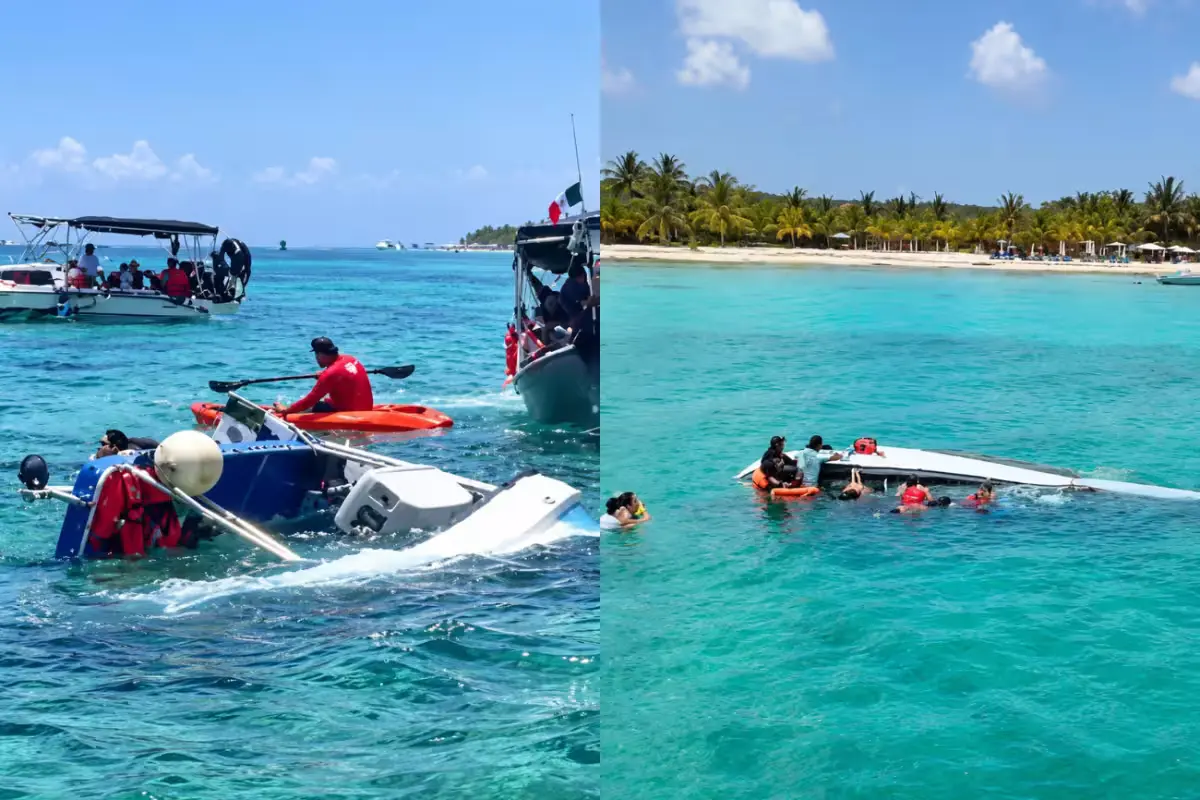
COZUMEL, Quintana Roo — Passengers rescued from a tourist boat that sank off the southern coast of Cozumel are accusing the operator of overcrowding and negligence, saying the vessel may have been carrying far more people than its listed capacity allowed.
The boat has been identified in multiple local reports as “TEA” or “Tea,” although no official report from the Port Captain’s office had been publicly released at the time of writing to confirm the vessel’s registration details, ownership, permitted capacity or official cause of the sinking.
The incident occurred Monday afternoon, July 13, while the vessel was operating a nautical tourism excursion off Cozumel’s southern hotel zone. Local reports place the sinking near the Iberostar area, while another report cited the area near Hotel Occidental. Authorities have not yet issued a full official account reconciling those details.
According to one passenger who spoke anonymously, the boat was carrying 19 passengers and three crew members, while the hull reportedly displayed a maximum capacity of 12 people. That passenger’s account has not been independently confirmed by maritime authorities, but several local reports also cited apparent overcapacity as a possible factor in the sinking.
No serious injuries or missing persons were officially reported in the immediate aftermath. Nearby boats joined the rescue effort, and maritime authorities responded to assist passengers and evaluate the vessel.
Passengers said they had purchased tickets from kiosks along Rafael E. Melgar Avenue for approximately 550 pesos per person for a trip to El Cielo, one of Cozumel’s most popular snorkeling areas. The excursion reportedly included children, some of whom suffered panic attacks during the emergency but were rescued without serious physical injury.
“We got on thinking it was a safe trip. When the boat started sinking, we just thought about getting the kids out of the water. It was very distressing,” one affected passenger said.
The same passenger alleged that after the sinking, the person who sold the tickets did not assist them with lost belongings or follow-up support.
The official cause of the sinking remains under investigation. The Port Captain’s office is expected to determine whether the incident was caused by mechanical failure, operational decisions, weather or sea conditions, overloading, or a failure to comply with maritime safety rules.
That investigation will be particularly important because Mexican maritime regulations require nautical tourism operators to follow specific safety obligations. The regulations for the Navigation and Maritime Commerce Law state that vessels providing tourism services must have safety and lifesaving equipment established in their safety certificate. They must also display a visible notice or plate showing the vessel’s maximum capacity for passengers and crew.
A 2024 Mexican maritime safety standard also states that passenger, recreational and sports vessels must have a mark indicating the number of passengers and crew authorized under the vessel’s safety certificate.
That makes the passenger claim especially relevant. If the vessel’s posted capacity was indeed 12 people, and if 22 people were aboard, the case would raise serious questions about whether the boat should have been allowed to depart.
Witnesses and passengers have also questioned why inspectors or port personnel present at the dock did not stop the vessel before departure if it was visibly overloaded. Those claims have not been addressed publicly by the Port Captain’s office.
Local nautical service provider Alberto Ortiz said authorities must determine exactly what happened, while resident Jeny Ordóñez called for more constant inspections of tourist boats to prevent similar incidents.
The sinking comes only weeks after another tourist vessel went down near Isla de la Pasión, north of Cozumel, leaving one person dead. In that case, the vessel was identified as “Es una casa” and was carrying eight tourists when it sank about 300 meters from the coast. Navy personnel, local security forces and Civil Protection took part in the rescue, but one passenger died after resuscitation efforts.
That earlier fatal incident makes Monday’s sinking more than an isolated scare. Cozumel’s nautical tourism industry is central to the island’s economy, with thousands of visitors booking snorkeling, diving, beach club and reef tours each year. But repeated incidents raise questions about inspection practices, passenger capacity, operator responsibility and whether tourists are being given enough information before boarding.
For visitors, the practical lesson is simple: before booking any boat tour, ask the operator for the name of the vessel, confirm whether life jackets are available and required, look for the posted passenger capacity, and avoid boarding if the boat appears overcrowded. A cheap or convenient tour is not worth the risk if basic safety questions are brushed aside.
For Cozumel, the issue is larger. The island depends on the trust of visitors who come to experience its reefs, beaches and marine life. Every maritime incident puts that trust under pressure. The Port Captain’s final report will now be key to determining whether the sinking of the “TEA” was an unavoidable emergency or a preventable failure in oversight.
More Business
- Chetumal Entrepreneur Develops Automatic Hammock Rocker for Mexico
- Quintana Roo Adds 35,000 Formal Jobs, Outpacing National Growth Fourfold
- Mexico’s Peanut Production Tops 86,000 Tons, Up 23.3% in 2025
- Uber Driver Murdered in Cancun’s La Joya: What We Know
- Mexican Caribbean Courts Convention Business at Las Vegas Trade Show
More Cozumel
- FPMC Opens Txepo’s Art + Architecture Dreamscape in Cozumel
- Winjet Drops 9 p.m. Cozumel Ferry, Narrowing Options for Late Travelers
- Cozumel Bird Festival Records 70 Species Across Island Sites
- Monarch Butterfly’s Caribbean Migration Route Revealed in Quintana Roo
- Researchers Document First Recorded Spawning of Priority Coral Species in Cozumel Reef Park