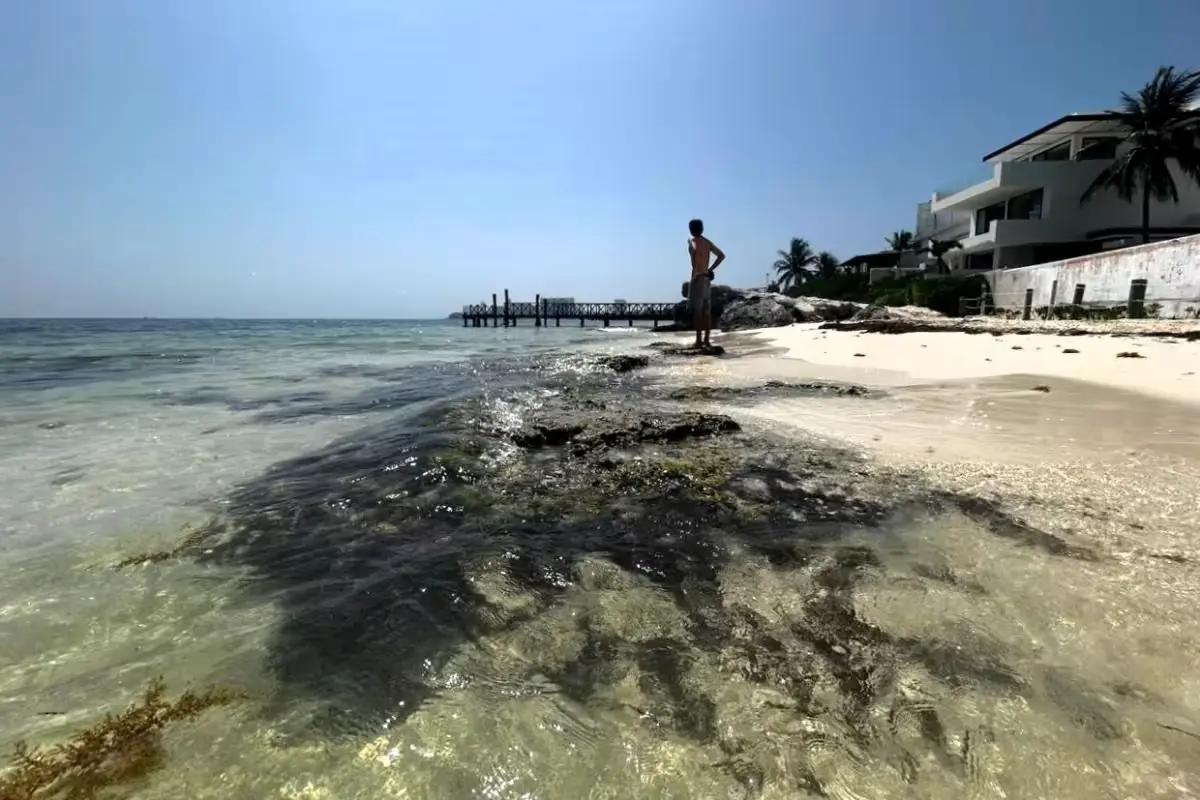
AKUMAL, Quintana Roo — Mexico’s Secretariat of Environment and Natural Resources has approved an environmental impact authorization for a private beach restoration project at an unnamed hotel in Akumal, where erosion has reportedly been removing as much as 11.4 meters of beach per year.
The project was authorized under environmental file 23QR2024T004, according to local reporting based on SEMARNAT documentation. The authorization allows work to proceed over an 18-month construction period, with a 50-year operating and maintenance period for the intervention.
The approved work includes protective coastal structures, artificial dunes, revegetation of the dune ridge and the extraction of 12,954 cubic meters of sand from the seabed in front of the property. The plan also calls for expanding an existing pier to create a rustic wooden walkway.
The case is drawing attention not only because of the work itself, but because it is moving forward while a much larger state-backed plan to restore public beaches in Quintana Roo remains delayed. The state proposal would intervene along 33.5 kilometers of coastline, including 12 kilometers in Cancún, 12 kilometers in Playa del Carmen, seven kilometers in Puerto Morelos and 2.5 kilometers in Cozumel. That broader public program, announced previously, is still awaiting environmental approval.
Why Akumal Matters
Akumal is not just another beach town on the Riviera Maya. Its name is commonly translated from Maya as “place of the turtles,” and the area is internationally known for sea turtles, seagrass beds, coral communities and shallow coastal waters used for snorkeling and diving.
The marine area of Bahía de Akumal was established as a federal refuge for the protection of marine species in 2016. CONANP has described it as a biologically rich area used for feeding and resting by three sea turtle species: green turtle, loggerhead and hawksbill.
Federal protection documents for Bahía de Akumal also identify a total refuge area of approximately 1,653 hectares, divided into subzones including the marine-coastal strip, Akumal Bay and Xcacel-Xcacelito. Those documents emphasize the need to regulate activities that could affect the protection and recovery of natural elements in the refuge.
That context does not mean every coastal project in Akumal is automatically prohibited. It does mean that beach work involving sand extraction, structures, dunes or nearshore areas deserves close scrutiny because the coastline is tied to sensitive marine habitat, turtle nesting and tourism activity.
The Debate Over Private Versus Public Beach Rescue
The approval has also raised a familiar question in Quintana Roo: why can a private hotel project move ahead while broader public beach restoration remains stalled?
The private Akumal project addresses erosion in front of one property. The state’s public beach recovery plan, by contrast, would involve multiple municipalities and a far larger stretch of coast. Larger projects often require more complex technical studies, more coordination among federal, state and municipal authorities, and more scrutiny over sand sources, coastal dynamics, environmental impacts and public access.
Still, the optics are difficult to ignore. A hotel beach in Akumal now has federal approval for restoration work, while public beaches in Cancún, Playa del Carmen, Puerto Morelos and Cozumel are still waiting.
Why Experts Are Cautious
Beach restoration can help protect property, rebuild recreational beach area and provide a buffer against waves and storms. But it is not a permanent fix. Beach nourishment generally means adding sand to an eroded beach, often from offshore or nearby marine sources. Over time, waves, storms and currents continue moving that sand. In many cases, the work has to be repeated.
The more controversial part is the use of protective structures. Coastal structures can trap sand in one area but reduce the natural supply of sand moving along the coast, which may worsen erosion on neighboring beaches. NOAA coastal guidance notes that groins and similar structures can deprive downshore beaches of sand, effectively redirecting the erosion problem rather than solving it.
That is the concern behind what local specialists described as the “headland effect.” When a restored or protected section of beach projects farther seaward than adjacent areas, waves and currents can behave differently around its edges. Sand may accumulate in the protected area while erosion increases on the neighboring shoreline.
Other Private Projects Are Also Moving Through the System
The Akumal authorization is not an isolated case. SEMARNAT also authorized a beach reconditioning project earlier this year for Puerto Cancún UC69, covering about 785 meters of shoreline between an existing breakwater and the golf course area. That project was approved for five years of execution and 50 years of maintenance.
Meanwhile, a private proposal by Banca Mifel remains under review for Punta Nizuc. That project would restore approximately 5,625 square meters of beach with an estimated investment of 14 million pesos. In Playa del Carmen, another proposal seeks to restore 8.6 kilometers of coastline by extracting 2.5 million cubic meters of sand and installing containment structures.
Those projects underscore the scale of the erosion problem along the Mexican Caribbean. They also show why restoration is becoming a recurring policy issue rather than a one-off hotel maintenance concern.
What Happens Next
SEMARNAT’s approval means the Akumal project can proceed under the conditions established in its environmental authorization. Those conditions have not been fully detailed in the public summaries reviewed, so it is not yet clear what monitoring, mitigation, turtle-protection measures, construction restrictions or sand-extraction limits will apply beyond the basic scope described.
For Akumal residents, environmental groups and neighboring property owners, the questions to watch are practical ones: where exactly the sand will be extracted, how construction will be timed around turtle nesting and tourism activity, whether the project will affect adjacent beaches, and whether monitoring results will be made public.
For now, the project is best understood as a private effort to hold sand in front of one Akumal hotel, approved in a destination where erosion, turtle habitat, public beach access and coastal development are already tightly intertwined.
The hotel’s name remains the missing piece. The authorization number is public, but the property behind it has not yet been clearly identified in the available reporting.
More Environment
- Playa del Carmen to Review Legal Status of Chen Zubul Property
- Quintana Roo Braces for Four Days of Heavy Rain and Flooding
- Sheinbaum Allocates 2 Billion Pesos to Fight Sargassum in Quintana Roo
- Five Ejidos Seek Alliance to Protect Chichankanab Lagoon in José María Morelos
- Maya Frog and Toad Shell Pendants May Reveal Ancient Trade Routes