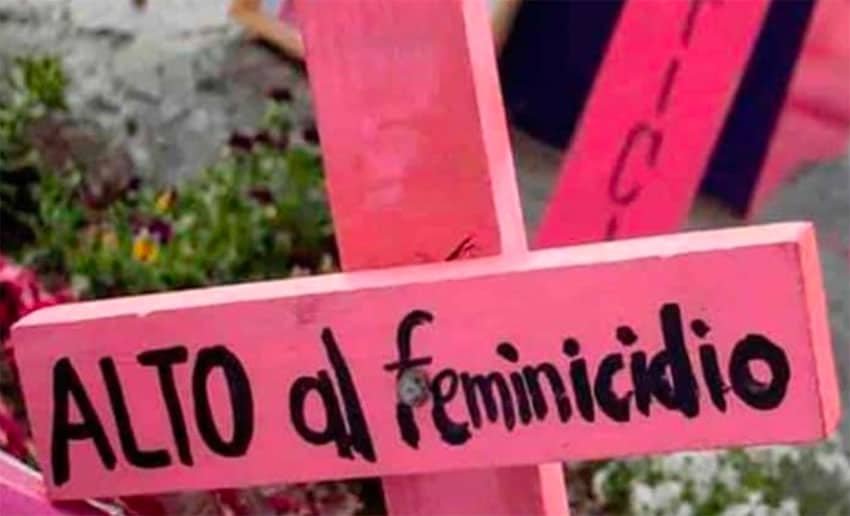
Mexico City — President Claudia Sheinbaum on Wednesday proposed a General Law against Femicide aimed at standardizing the crime across all 32 Mexican states, strengthening investigations, and imposing harsher penalties for gender-based killings.
During her morning press conference on July 15, Sheinbaum called femicide the ultimate expression of discrimination and aggression against women, stating it involves taking a life simply because the victim is female.
“As the first woman president, I assumed the responsibility of protecting women from violence,” Sheinbaum said as she signed the initiative, which will be sent to Congress for debate.
The proposal seeks to establish a uniform definition of femicide nationwide, with prison sentences of 50 to 70 years. It outlines 10 gender-based criteria to classify a killing as femicide, including sexual violence, prior aggression against the victim, power imbalances, stereotypes, or discrimination. The bill also lists 19 aggravating factors that would increase penalties when the victim is a girl, adolescent, elderly woman, pregnant woman, person with a disability, journalist, human rights defender, or migrant, and it criminalizes attempted femicide.
Nohamy Hermida, head of the Directorate for Attention to Sexual Diversity in Benito Juárez municipality, welcomed the move. “We celebrate the effort to standardize the crime of femicide across Mexico. A single definition, clear penalties, and a focus on vulnerable groups provide certainty for victims,” she said. “Our role is to ensure that once approved, the law is applied with a gender perspective.”
Tania Ramírez, a member of the civil society group Siempre Unidas, said standardizing the crime is progress but warned that the real challenge lies in enforcement. “The greatest challenge will be ensuring that institutions carry out effective investigations, provide adequate care for victims, and follow due process with a gender perspective,” she said. “It’s not enough to change laws if there are no actions to prevent these crimes and ensure perpetrators are brought to justice.”
Hayde Saldaña Martínez, commissioner for the Search for Persons, also backed the initiative. “We celebrate the proposed law against femicide presented by President Sheinbaum. We see this as part of the transformation, pushing legal reforms to guarantee a life free of violence for women, girls, boys, and society. The women of Quintana Roo and all of Mexico cannot wait any longer,” she said.
In a citizen survey conducted in Cancún, residents expressed cautious optimism. “The issue is not just about making stricter laws, but ensuring investigations are transparent and that victims and their families receive real support. A very good law is useless if it is not applied honestly and without favoritism. That is the hard part to eradicate,” said Alejandra May, a school principal.
Miriam Ramos, a homemaker and professional, said, “The initiative is good because it would facilitate investigations by standardizing legislation nationwide; however, I think there are many criteria within the justice system itself.”
Karen Guadalupe Estrada May, a convenience store assistant manager, argued that women face greater risk due to their gender and called for harsher punishments, even life imprisonment, for particularly brutal cases. “They leave a child without a mother, a mother without a daughter, and a sister without a family member,” she said. However, she stressed that the law must be applied fairly when a woman kills another woman.
“It’s a great advance, especially standardizing the treatment of femicide across the country so that the same guidelines are followed regardless of where it occurs. That would leave no doubt because the criteria would be completely established without being classified differently. The issue of child custody when the aggressor is the father is also important,” said Carmen García, a public accountant.
Another woman consulted said, “Femicide is an alarming problem worldwide, but structural norms prevent reforms that punish those responsible as they should, and many cases remain unpunished. Unfortunately, laws are not made to protect women. It is very worrying to see that many women leave for work and never return; that generates fear and uncertainty.”
Marcela Martínez, an administrative worker, said that while tougher penalties can be a strong measure, impunity remains the main problem. “It is of little use to increase punishments if investigations are not carried out with a gender perspective and those responsible are not really brought to justice,” she said.
The presidential initiative will be sent to Congress for discussion during the next ordinary session beginning in September, aiming to establish a common framework to combat femicide across Mexico.
Quintana Roo ranks fifth nationwide for the highest femicide rate per 100,000 women, with eight cases recorded between January and May 2026, according to the latest report from the Executive Secretariat of the National Public Security System (SESNSP). The state’s rate of 0.75 is nearly double the national average of 0.39, and all victims were over 18. The report also placed Cancún as the third municipality with the most femicides in the country, with five cases, behind only Culiacán, Sinaloa, and Reynosa, Tamaulipas. Nationwide, 36.5% of femicides are concentrated in just 20 municipalities. In the Yucatán Peninsula, Quintana Roo also led the statistics, with Yucatán reporting three femicides and Campeche two during the same period.
More Crime
- Playa del Carmen Mayor Responds to Puerto Aventuras Mayor’s Arrest on Extortion Charges
- Loose Horses on Reforma-Bacalar Highway Crash Leave Mare Dead, Second Horse Injured
- Former Gubernatorial Candidate Laura Fernández Piña Loses Appeal Against 20-Year Public Office Ban
- Three Men Sentenced in Quintana Roo for Sexual Abuse of Minors, One Receives 120 Years
- Cancún Authorities Identify 19-Year-Old Woman Found Dead Near Supermanzana 201
More Quintana Roo
- SCJN Orders Quintana Roo to Legislate Disability Representation
- Cancun Tourism Slumps 7% as Industry Leaders Urge Marketing Overhaul
- Quintana Roo Braces for Four Days of Heavy Rain and Flooding
- Quintana Roo Prison System Scores Drop Sharply Over Overcrowding and Neglect
- Quintana Roo to Host Caribbean Culture Festival 2026 With Belize as Guest of Honor