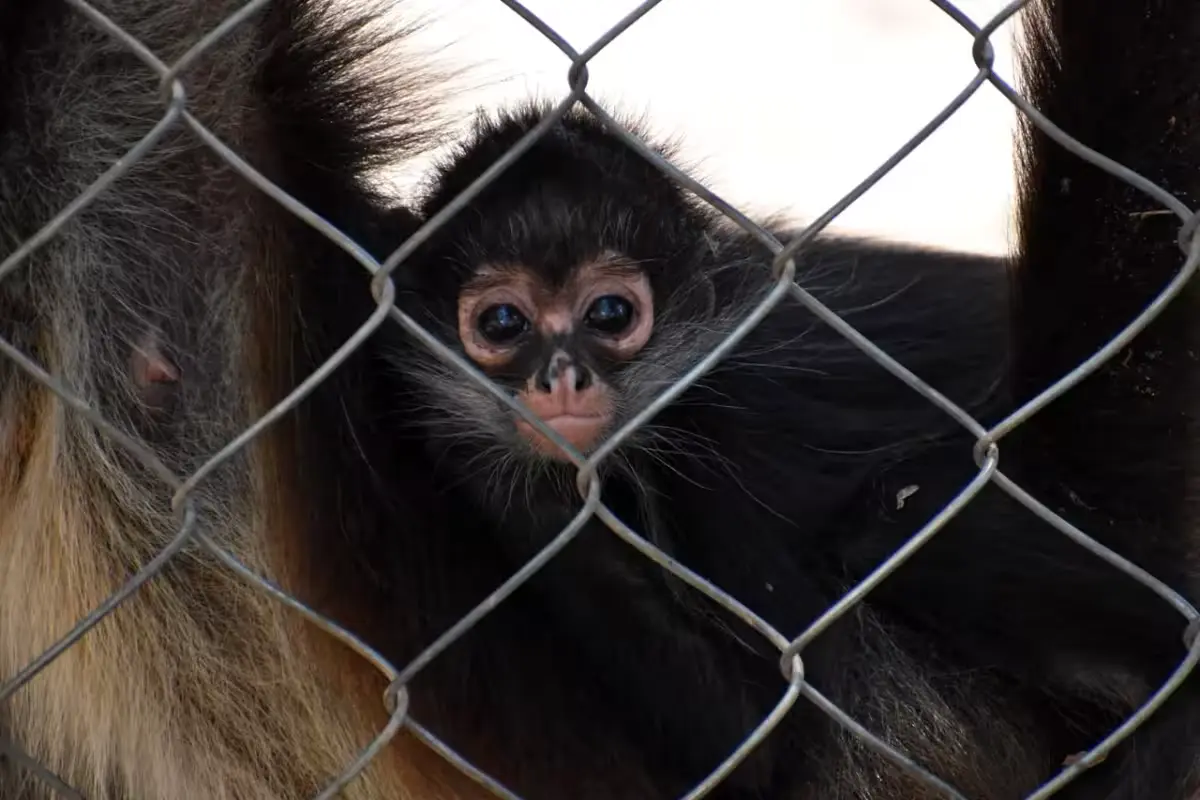
Mérida, Yucatán — Profepa, Mexico’s federal environmental protection agency, has launched a national campaign called “Monkeys Are Not Pets” to discourage the purchase, extraction, sale and keeping of primates as companion animals. The campaign comes amid repeated seizures of spider monkeys in Yucatán, where illegal wildlife trafficking remains a persistent threat.
In May, during an operation covering seven southeastern states, Profepa inspectors rescued a spider monkey at San Roque market in Mérida’s San José Tecoh neighborhood. In March, the agency said it received, evaluated and returned another spider monkey to its habitat as part of a regional operation. And in 2025, a spider monkey was seized along with 25 parrots from a vehicle traveling on the Campeche-Mérida federal highway; authorities said the animals were being transported without proof of legal origin.
Three native species at risk
Mexico is home to three native primate species: the spider monkey (Ateles geoffroyi), the black howler monkey (Alouatta pigra) and the mantled howler monkey (Alouatta palliata). All three are listed as endangered and primarily inhabit tall and medium rainforests in the country’s southeast. These animals play a key role in seed dispersal, helping regenerate forests and serving as indicators of tropical forest health, according to Profepa.
A brutal journey
The agency warns that capturing infants disrupts natural groups and can reduce their reproductive capacity. The extraction process is often violent: infants are torn from their mothers, who may be killed during capture. Some monkeys die falling from trees, being crushed by their mothers, or during transport. Packed into boxes, suitcases and other containers, they endure overcrowding, hunger, dehydration, wounds, fractures, infections and malnutrition.
Suffering continues in captivity, Profepa says. Early separation from their mother and social group causes physical and behavioral problems, and captivity prevents them from developing natural behaviors. Some pet monkeys develop abnormal behaviors such as biting, screaming and pulling out their own hair. As they grow, they can become difficult to handle due to their strength and natural instincts. They require social interaction, stimulation and environmental conditions that are nearly impossible to replicate in a home. They can also transmit or contract infectious diseases, and their bites can cause injuries requiring medical attention.
Profepa says that for every primate sold as a pet, at least three others die during capture or transport. Between 2019 and 2026, Profepa inspections have resulted in the seizure of 137 primates nationwide: 96 spider monkeys, 24 black howler monkeys and 17 mantled howler monkeys.
Demand drives illegal trade
The “Monkeys Are Not Pets” campaign aims to reach people considering acquiring a primate and to explain that keeping one at home does not make it a pet. Profepa says demand keeps the illegal extraction and commercialization chain active. Federal law prohibits extractive use of primates: Article 60 Bis of the General Wildlife Law states that no primate may be subject to extractive use, whether for subsistence or commercial purposes, except as established by law.
Profepa is urging the public not to buy, extract, give away or keep primates as pets, and to report any activity related to their trafficking or illegal possession. The agency emphasizes that the best place for these animals is their natural habitat — not a private home.
More Environment
- Maya Frog and Toad Shell Pendants May Reveal Ancient Trade Routes
- Heavy Rains to Soak Quintana Roo as Unstable Weather Moves In
- Brain-Eating Amoeba Found in Six Artificial Lakes in Mérida; Water Contact Restricted
- Semarnat Approves Artificial Reefs and Sand Relocation for Akumal Hotel
- Chetumal Plans 836 Million Pesos in Stormwater Works to Curb Flooding