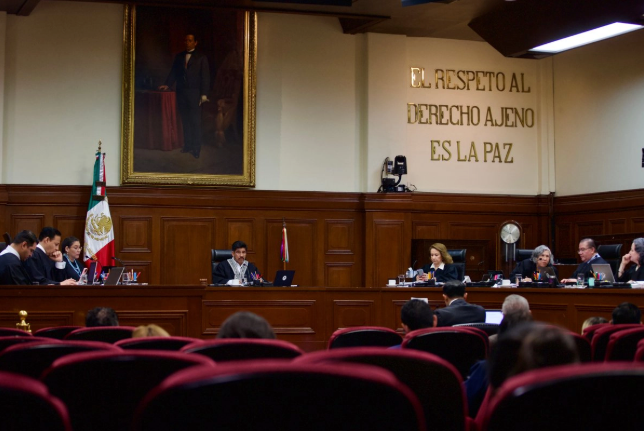
Mexico City — Mexico’s Supreme Court on Wednesday denied an injunction to Calizas Industriales del Carmen (Calica), a subsidiary of U.S.-based Vulcan Materials, upholding the Mexican Navy’s authority to carry out Coast Guard duties along the country’s coasts, marine zones and port facilities.
The full court, or Pleno, unanimously approved a draft ruling by Justice Irving Espinosa Betanzo that declared constitutional Article 2, Section V, Subsection a) of the Organic Law of the Mexican Navy. That provision grants the naval force powers of surveillance, verification, inspection and visits in those areas.
Calica challenged the rule after a May 2023 letter in which Navy personnel requested access to the surveillance cameras at the port terminal it operates in Punta Venado, Quintana Roo, along with the system’s username and password. The court rejected the challenge to the law itself and sent the case back to a collegiate tribunal to decide the legality of the Navy’s specific request.
The justice argued that the contested provision does not violate Article 129 of the Constitution, because a reform enacted on September 30, 2024 means the Armed Forces’ peacetime duties are no longer restricted exclusively to matters directly tied to military discipline.
“Article 129 of the Constitution establishes that, in peacetime, military authorities may exercise the functions set out both in the Constitution and in the laws that stem from it, which incorporates a principle of legal reservation. This means it is up to Congress to determine, through a law in the formal and material sense, what other powers the Army, Air Force and Navy of Mexico may exercise,” he said.
The contested provision was repealed in November 2025, but the replacement law kept the Coast Guard functions in place. The court reviewed the substance of the case because the disputed letter was issued in 2023 and the transitional rules require pending matters to be resolved under the earlier legislation.
More Courts
- Mexico’s Supreme Court Rules Cannabis Edibles for Personal Use Are Not Sanctioned
- Mexico’s Supreme Court Revokes Suspension Allowing Xcaret to Use Maya Symbols
- ICSID Orders Mexico to Pay $15.9 Million Over Calica Quarry, Leaves AMLO-Era Claims Pending
- Playa del Carmen Finances Under Investigation Over Nearly 890 Million Pesos in Liabilities
- Judge Rejects Injunction to Protect Sac Actún Cave System From Riviera Maya Highway
More Playa del Carmen
- Xcaret Marine Animal Hospital Gives Sea Turtles a Second Chance in Quintana Roo
- Constituyentes Residents Demand Electricity and Drinking Water in Lázaro Cárdenas
- Mexico’s Semarnat Approves Three-Breakwater Project to Restore Playa del Carmen Beach
- Quintana Roo Removes More Than 124,000 Tons of Sargassum as Season Nears End
- Playa del Carmen Activists Blast Urban Sprawl in the Jungle