
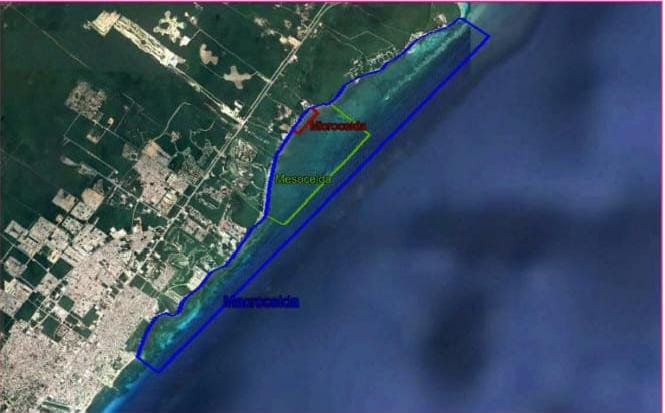
Playa del Carmen, Quintana Roo — Mexico’s Environment and Natural Resources Secretariat (Semarnat) has conditionally approved a project to rebuild Bahía del Carmen beach with three breakwaters and artificial sand replenishment along a stretch of coastline between the Tres Ríos and Blue Bay Grand Esmeralda hotel complexes, north of Playa del Carmen.
The work will take place on a property known as Rancho Porvenir II, where the developer argued the area has suffered major beach loss. According to the project’s environmental impact statement, the shoreline has narrowed by more than 30 meters since 2004, with erosion accelerating after 2019.
Alberto Ramón Bache Zaraluz, a private developer, filed the proposal with Semarnat in June 2023. It calls for three protective structures parallel to the shoreline, intended to help the beach recover.
Sand for the fill would come from a marine sand bank off Playa Mamitas, roughly 9.5 kilometers from the site where the project would be built.
Beyond the breakwaters and the added sand, the plan includes an artificial dune, an outfall or spillway, and measures to protect the mangroves already growing in the area.
Approval Comes With 19 Conditions
The Directorate General for Environmental Impact and Risk authorized the project on a conditional basis and imposed 19 measures and requirements that must be met during execution.
The permit runs for six years for site preparation and construction, and 30 years for operation and maintenance.
Among the conditions, the developer must set up a coordination mechanism with the National Institute of Indigenous Peoples, Semarnat’s Coordinating Unit for Social Participation and Transparency, and other relevant agencies before starting any work, in order to determine the applicable indigenous consultation procedure.
The developer must document the outcome of that process in the corresponding minutes if consultation is required, or submit documentation from the institute establishing that it is not.
The presence of mangroves in the area also prompted specific requirements from the environmental authority. Semarnat ordered the protection and conservation of the existing mangrove clumps and demanded an alternative to planned edging around them that guarantees the viability of conservation work, taking into account the natural dynamics of this type of vegetation and its vulnerability to direct and indirect disturbance.
The developer must also submit evidence of mangrove ecosystem monitoring carried out from 2009 to the present as part of the environmental follow-up measures.
The project therefore cannot proceed on the strength of the environmental authorization alone. It must comply with all 19 conditions set by Semarnat, particularly those covering mangrove protection, coastal dynamics and the participation of indigenous communities.
The decision opens the door to renewed intervention along the Playa del Carmen coastline in a sector where the developer itself acknowledges a significant loss of beach over the past two decades and a worsening of the problem in recent years.
More Development
- Puerto Morelos Completes $10.4 Million Peso Rebuild of Fishing Pier
- Quintana Roo Real Estate Market Matures Behind $1 Billion in Investment
- Mexico’s Supreme Court Denies Calica Amparo, Upholds Navy’s Coast Guard Role
- Constituyentes Residents Demand Electricity and Drinking Water in Lázaro Cárdenas
- Photograph Exposes Damage to Cave and Karst Aquifer in Mexico’s Caribbean
More Playa del Carmen
- Xcaret Marine Animal Hospital Gives Sea Turtles a Second Chance in Quintana Roo
- Quintana Roo Removes More Than 124,000 Tons of Sargassum as Season Nears End
- Playa del Carmen Activists Blast Urban Sprawl in the Jungle
- Mexico’s Supreme Court Revokes Suspension Allowing Xcaret to Use Maya Symbols
- Quintana Roo Business Group Moves to Shield Companies From Extortion and Protection Rackets
