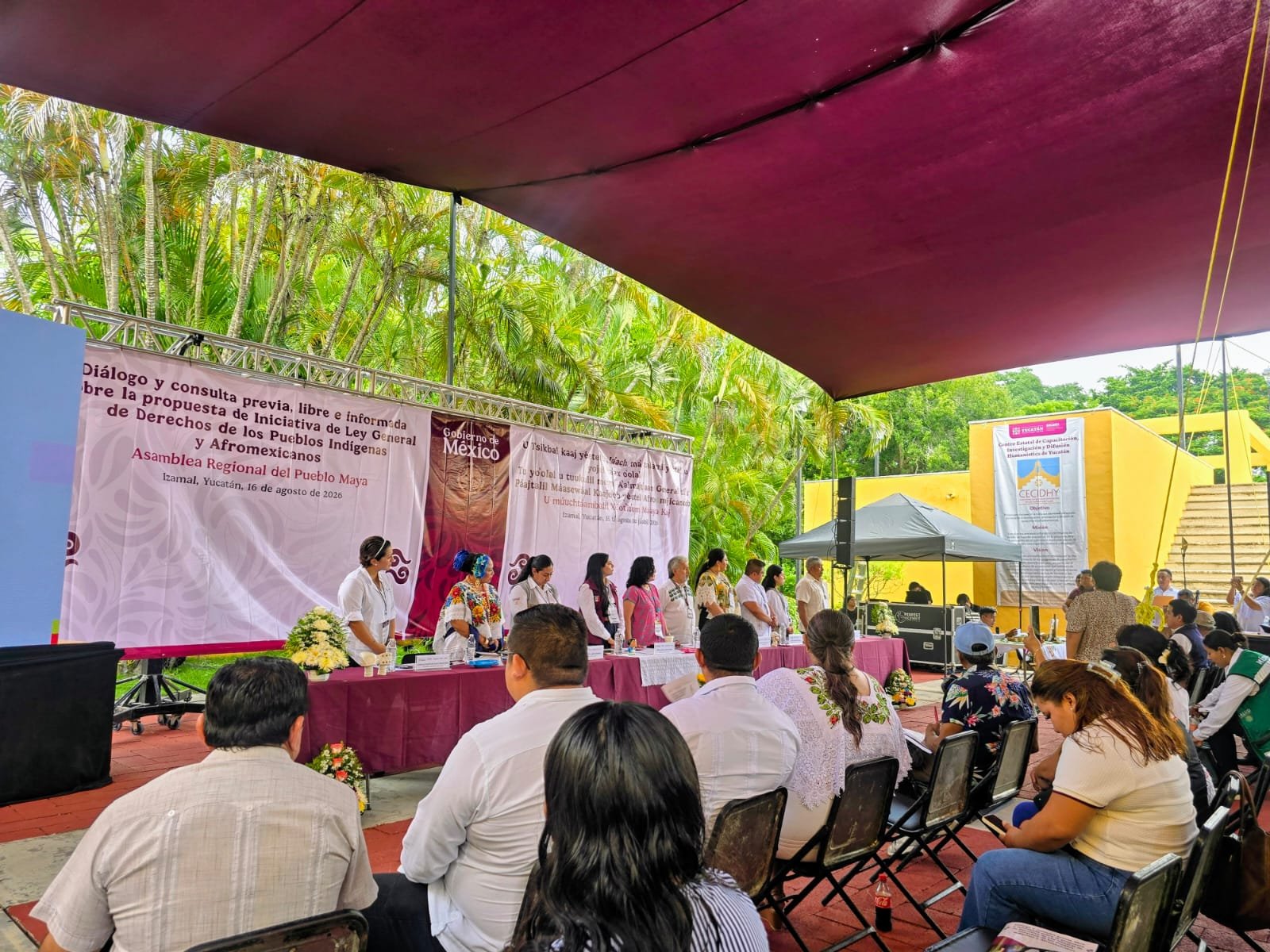
Mérida, Yucatán — The Peninsular Maya Council for Autonomy has refused to endorse a proposed federal law on the rights of Indigenous and Afro-Mexican peoples, saying the government’s consultation process does not meet the standards for a free, prior and informed consultation.
In a statement released through the collective Communities for Autonomy, organizations and community representatives from the Yucatan Peninsula described the exercise as a “simulation” and warned they would not allow their participation to be used to back a proposal that, they argue, does not represent the interests of Indigenous peoples.
The statement came after consultation meetings held in Izamal and Valladolid on Sunday, August 16, as part of the national consultation on the initiative. The council said not all Indigenous authorities, community councils or non-partisan community leaders were invited to those meetings.
The council also objected to municipal representatives taking part in the working groups under the argument that they had INPI’s endorsement, saying ejido and municipal commissioners cannot replace Indigenous authorities or represent the communities as a whole.
Launched in July 2026, the national consultation includes 82 regional assemblies and seven working tables meant to gather the views of 16,728 communities, 69 Indigenous peoples and the Afro-Mexican people. The organizations questioned that the process is being carried out on the basis of a proposal already drafted by the government, with the same institutions tasked with collecting and systematizing the opinions.
“This is not a consultation. It is a simulation,” the document said.
One of the main objections centers on the right to consultation that the law itself would establish. The communities warned that the initiative would give the Interior Secretariat (Segob) and the National Institute of Indigenous Peoples (INPI) the power to determine when a project has a “significant impact” and, therefore, when consultation is required. In practice, they said, that could limit the right of communities to participate in decisions affecting their territories.
“Ratifying this text would be signing our own resignation. We will not do it,” they said.
In the peninsula, the council linked this concern to conflicts and projects affecting the territory, including pig farms, agribusiness, megaprojects, real estate development, the Maya Train and threats to water and cenotes.
Among their demands, the organizations said the current consultation should not be recognized as a free, prior and informed consultation. They also called for the process to be redesigned with the participation of Indigenous peoples, sufficient time and translation into their languages, and for it to be carried out through their own authorities and assemblies.
They further asked that the proposal eliminate the so-called “strategic areas” and the criterion of “significant impact” as filters for accessing the right to consultation, and that the consultation be binding, including the right of peoples to grant or deny their consent.
The statement also calls for changes to Articles 30 and 31 so that the recognition of an Indigenous people does not depend on INPI or the National Catalog, for the expansion of Indigenous amparo protection, and for the explicit recognition of the peninsula’s forms of organization and self-government.
The communities also demanded that the rights recognized in the law be backed by earmarked and direct funding, rather than stating that their implementation will not require new resources.
The Peninsular Maya Council for Autonomy includes representatives from Isla Aguada, Isla Arena, Ich Ek, Ixil, Telchaquillo and El Cuyo, as well as the Community Indigenous Council of San Francisco Suc Tuc, the Indigenous Government Council of Pisté de Chichén Itzá, Communities for Autonomy and the 3D Indigenous Foundation.
“The Maya communities of the Yucatan Peninsula will not endorse a simulated consultation,” they concluded.
More Politics
- Quintana Roo Lawmakers Move to Curb Political Use of Social Programs
- INE Launches 2027 Elections in Quintana Roo Without Candidate Background Checks
- Quintana Roo Education and Training Chiefs Resign to Seek Morena’s Chetumal Nod
- Judge Halts Trump Border Barrier in Big Bend National Park
- Quintana Roo Remains Far from Electronic Voting, INE Official Says