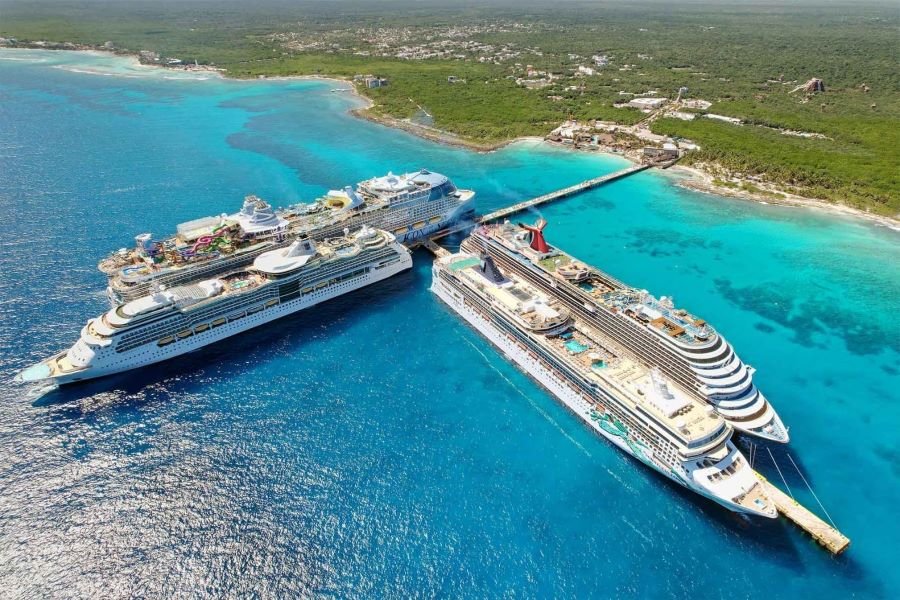
Chetumal, Quintana Roo — Business owners and residents of the port town of Mahahual have voiced strong opposition to plans that would channel funds from a cruise passenger trust to finance the Barrio Mágico project in Chetumal.
Gerardo Pérez Zafra, president of the Coparmex business chamber in Mahahual, said the group supports initiatives that boost Chetumal’s economy but insisted such projects should be funded from other sources, not a trust whose purpose is directly tied to cruise activity in Mahahual and Cozumel.
In an open letter circulated Wednesday, tourism sector representatives recalled that in November 2023, Governor Mara Lezama sent a bill to the state Congress to reform Article 51 of Quintana Roo’s Rights Law, strengthening the fee charged to cruise passengers arriving in the state. According to the reform’s rationale, the fee was intended to generate resources for growing tourism infrastructure needs, bolster security in host destinations, and create a fund for natural disaster response.
The business leaders argued that the reform makes clear the funds must be spent in the places where cruise passengers actually arrive and move about — a condition they say Chetumal does not meet.
They explained that while virtually all of Cozumel is part of the cruise passenger experience, in Mahahual there is an interpretation that would allow trust funds to be used for projects outside the visitors’ usual route, such as Chetumal’s Barrio Mágico.
In the business sector’s view, this possibility lacks operational logic and legal basis, since cruise passengers who disembark at Mahahual do not include Chetumal in their itineraries, mainly due to the distance between the two destinations.
The business leaders emphasized that for Chetumal to become a beneficiary of these funds, it would first need to demonstrate that there is infrastructure demand generated by cruise passenger flow to the state capital — a condition that currently does not exist.
From a legal standpoint, they said, the principle of origin and destination of the fee paid by foreign tourists must be respected: the charge should translate into services and infrastructure that directly benefit those who pay it.
They noted that Mahahual continues to receive no benefits from the trust, despite being one of Mexico’s main cruise ports. For years, local business owners have invested their own resources to improve facilities, keep beaches clean, strengthen tourism services, and raise the quality of visitor attention, without a single peso from the trust being allocated to bolster the destination’s tourism infrastructure, public services, or security.
The group warned that diverting trust funds to projects unrelated to cruise-generated tourism could open the door to legal challenges, since there is no direct link between the tax and the services received by those who pay it.
As a precedent, they cited the case of Puerto Vallarta, where a fee charged to foreign cruise passengers was declared unconstitutional on grounds related to the lack of correspondence between the payment demanded and the services actually provided.
The business leaders called for decisions on the trust’s allocation to be made prudently, prioritizing the needs of the destinations that generate the funds and respecting the purpose for which they were collected.
More Economy
- Mexico’s Auto Exports Slump 12% as US Tariffs Take Toll
- Mexico’s Inflation Accelerates for a Second Straight Month to 3.45%
- Tren Maya Freight Project Targets 4.7 Million Tons by 2030
- Mexicana de Aviación Adds 24 Winter Flights to Tulum as Rivals Pull Out
- Cancún Business Council Launches Push to Diversify Quintana Roo’s Economy Beyond Tourism
More Chetumal
- Power Outage in Chetumal Forces Closure of Quintana Roo Labor Courts
- Playa del Carmen Mayor Joins Quintana Roo’s 52nd Statehood Anniversary in Chetumal
- Chetumal Airport Customs Nears Full Operation Next Year
- Former Quintana Roo Tourist Police Chief Bound Over for Trial in Human Trafficking Case
- Pre-Hispanic Frog Pendants From Tren Maya Route Shed Light on Ancient Maya Trade