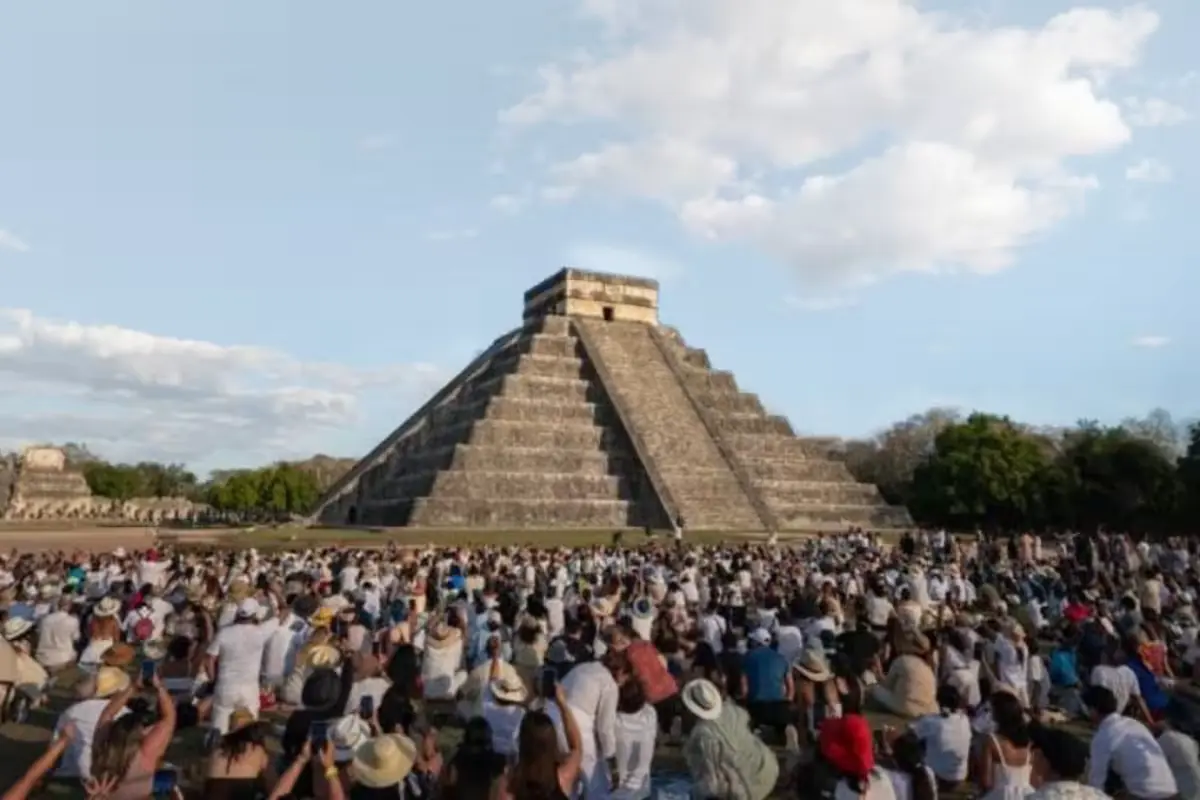
Mérida, Yucatán — Chichén Itzá has lost its position as Mexico’s most visited archaeological site, at least temporarily, as a dispute over a new visitor center drives a sharp decline in tourism. Teotihuacán, in the State of Mexico, surpassed the Maya wonder in May and November 2025, according to data from the National Institute of Anthropology and History (INAH).
Yucatán’s cultural tourism dropped 8.7% in the first half of 2026, with 1,392,656 visitors to its archaeological sites and museums from January to June, down from 1,526,027 in the same period last year. Chichén Itzá, a UNESCO World Heritage site and one of the New Seven Wonders of the World, saw 984,119 tourists in the semester, a 13.8% decline of 157,651 visitors year-on-year.
Conflict Over Visitor Center
The crisis centers on the Catvi (Visitor Attention Center), opened by INAH on March 27, 2026. Vendors and artisans who previously operated at the old tourist stop and inside the archaeological zone refuse to relocate there, arguing the move cuts their sales. The conflict escalated in May when a group of merchants occupied the facilities, shutting the site for 11 days until INAH reopened it on June 1.
The closure coincided with Chichén’s worst month: May saw a 34.5% monthly drop in visitors, with only 104,117 tourists compared to Teotihuacán’s 110,113 — a margin of just 5,996. In November 2025, Teotihuacán had already overtaken Chichén by a larger margin of 64,934 visitors.
Chichén Itzá had held the top spot since 2020, when it surpassed Teotihuacán during the COVID-19 pandemic. Its intermittent fall to second place signals that the vendor conflict is now measurably affecting its national standing.
Broader Decline in Yucatán
The negative trend extends beyond Chichén. After a promising January (313,390 visitors, up 9.2% from 2025), Yucatán’s cultural tourism plunged 23.9% in February, rebounded 17.3% in March due to spring equinox events, then fell 17.2% in April, 28% in May, and 2.4% in June.
Chichén lost visitors in four of the first six months of 2026 compared to 2025: down 22.4% in February, 28.1% in April, 26.4% in May, and 0.97% in June. Only January and March saw annual increases of 12.8% and 1.5%, respectively.
However, June showed signs of recovery, with 161,011 visitors — up 17.3% from May and just 0.97% below June 2025. That was the smallest annual variation of the semester and the only one suggesting stabilization after the 11-day closure.
In June, the five most visited sites in Yucatán were: Chichén Itzá (122,165), Uxmal (11,542), Ek Balam (5,164), Dzibilchaltún (3,562), and Xcambó (3,121). Chichén remains dominant within the state, with a lead of over 110,000 visitors over second-place Uxmal.
Peninsula-Wide Trends
In Quintana Roo, which holds fourth place nationally, Tulum attracted 28,246 visitors in June, followed by Chacchoben with 17,716. In Campeche, which dropped from 11th to 12th in the national ranking, Edzná drew 2,579 visitors and Calakmul just 1,202, highlighting the state’s underdeveloped tourism potential.
Yucatán remains the second most popular cultural destination in Mexico, behind Mexico City, which recorded 4,451,052 visitors in the semester — 2.1 times Yucatán’s total. Quintana Roo had 898,801 tourists, while Campeche fell from 235,075 in all of 2025 to just 112,178 in the first half of 2026.
Yucatán’s current figures are far from its 2018 record of nearly 4 million visitors. In 2025, the state ranked seventh in the 2016-2026 decade, behind 2017 (3,641,251), 2019 (3,391,477), 2022 (3,307,185), 2023 (3,125,399), and 2016 (2,967,028).
Chichén Still Leads in Foreign Visitors
Despite the overall decline, Chichén Itzá remains the top archaeological site for foreign visitors, with 70,591 paid foreign tickets in June 2026, ahead of the National Museum of Anthropology (36,315) and Teotihuacán (30,377). It is the preferred destination for international tourists and ranks fourth among Mexican visitors, with 51,574 nationals in June.
The numbers reflect a struggle between modernizing the site and preserving the livelihoods of generations of artisans. INAH insists on moving vendors to the Catvi to streamline access, while opponents argue the relocation threatens their income — a conflict that has already cost thousands of visitors and a once-uncontested national lead.
The challenge for authorities is to resolve the dispute before Chichén’s advantage over Teotihuacán, now reduced to a few thousand tourists, disappears entirely. If the June recovery holds in the second half of the year, Yucatán could narrow the gap with 2025’s total of 2,925,988 visitors. But if the Catvi conflict drags on, the state risks falling below that threshold for the first time since the pandemic.
More Tourism
- Cancún Restaurant Sector Welcomes Extended Hours in Hotel Zone
- Hyperbaric Chamber Saves Diver Who Suffered Decompression Sickness in Tizimín, Yucatán
- Tropical Storm Isaias Forms in Gulf of Mexico, Forecast to Hit US as Category 2 Hurricane
- Cozumel Tightens Crocodile Response Protocols After Sightings
- Cozumel Hotel Occupancy Rises in September, but Tourist Spending Falls