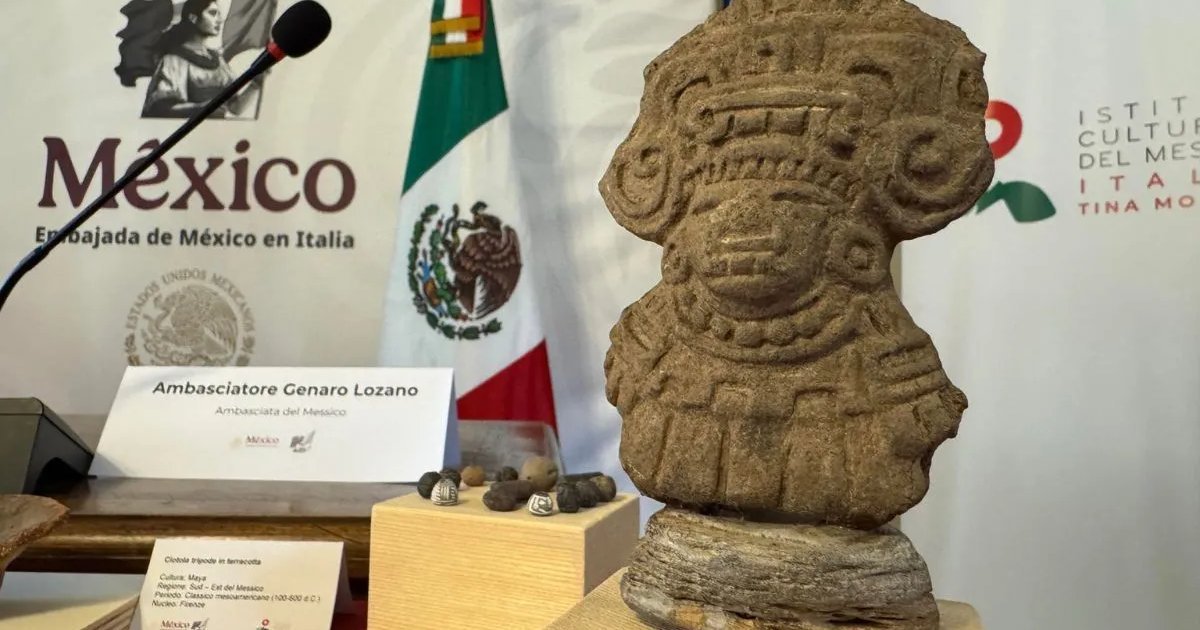
Rome, Italy — Italy has returned 27 pre-Columbian archaeological and paleontological pieces to Mexico, recovered by the Carabinieri’s Cultural Heritage Protection Unit (TPC) in multiple operations against illegal art trafficking.
The formal handover took place at the Mexican Embassy in Rome, where Carabinieri Brigadier General Antonio Petti delivered the items to Mexican Ambassador Genaro Lozano. The ceremony was also attended by Mónica de la Mora Kuri, director of the Tina Modotti Mexican Cultural Institute.
Ambassador Lozano said the pieces “represent the living history of Mexico,” emphasizing that their value lies not in money but in “memory, justice, and recovering and keeping history alive.” He noted that since 2013, more than 840 pieces have been repatriated, and collaboration with Italy has been “very successful,” as part of the international campaign “My Heritage Is Not for Sale” promoted by President Claudia Sheinbaum.
General Petti explained that the objects are in “absolutely excellent condition” after being intercepted at customs, online auctions, and private collections. He celebrated that they “can return to their places of origin and restore the legacy of Mexico’s cultural identity.”
The recovery was the result of a complex investigation by police units in Florence, Monza, Rome, and Ancona. Among the returned items are three Teotihuacan heads from the Central Highlands (200 BC – 650 AD) found in an inheritance in Milan, two Mayan terracotta figurines from the Early Classic period (100–400 AD) seized in Rome, and a tripod bowl recovered after a voluntary surrender in Monza.
Investigations in Florence also led to the location of 16 pre-Columbian pieces being illegally offered on a well-known e-commerce platform. The shipment also includes three exceptional fossil fish from the Late Cretaceous period, detected by TPC agents in Venice at customs inside an illegal postal shipment from Nuevo León.
The pieces, cataloged by Mexico’s National Institute of Anthropology and History (INAH) as archaeological monuments that are inalienable property of the nation, will be transferred to Mexico for authorities to decide on their museum distribution or return to their regions of origin.
More Culture
- Cancún to Host Climate Change Colloquium With Experts From Mexico, Guatemala and New York
- Free Theater Production ‘Catsup’ Brings Pandemic Childhood Story to Cancún
- Documentary on Puebla River Defenders Screens Free in Cancún
- Cancún Looks to Promote Its Cultural Heritage to Tourists
- Playa del Carmen Opens Nominations for Elvia Carrillo Puerto Award Honoring Outstanding Women