
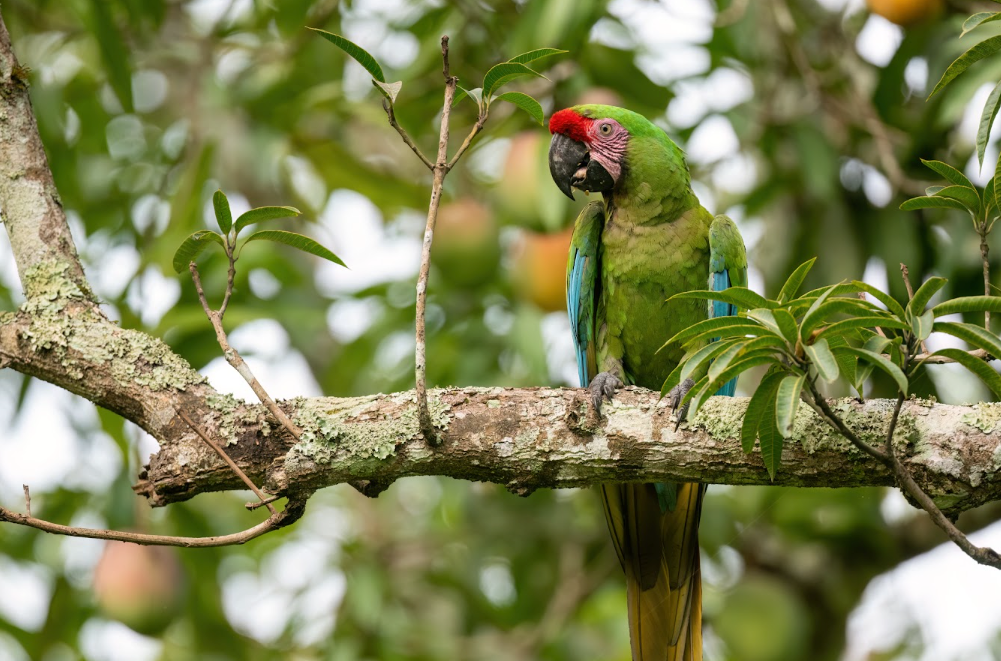
Tulum, Quintana Roo — The green macaw, known scientifically as Ara militaris, faces a growing threat in Mexico and across Latin America from illegal trafficking, hunting and the destruction of its natural habitat, scientist Cristóbal Carrión warned, calling for urgent action to protect the emblematic tropical species.
- Scientific name: Ara militaris
- Size: 70 to 80 centimeters long, with a wingspan of 90 to 110 centimeters
- Weight: 900 to 1,100 grams
- Range: From northern Mexico to northeastern Argentina
- Diet: Mainly large fruits
Also called the military macaw in different regions, the bird stands out for its imposing size and vibrant olive-green plumage — the shade from which it takes the name militaris. It belongs to a family with several subspecies, including Ara militaris mexicanus and Ara militaris bolivianus, which show slight variations in coloration but share the same striking appearance.
The green macaw measures 70 to 80 centimeters in length, with a wingspan that reaches 90 to 110 centimeters when its wings are fully extended. It weighs between 900 and 1,100 grams, making it one of the largest birds of its kind in the wild. Among its distinctive features are a tuft of down on the forehead and a featherless white facial patch marked with black lines that resembles war paint — another possible source of its name.
Unlike other species, the green macaw shows no obvious sexual dimorphism, making it difficult to tell males from females without specialized knowledge. Its beak is strong and black, while its legs are gray.
Its habitat is tropical and subtropical humid forest stretching from northern Mexico — mainly in Pacific and Gulf coast regions — to northeastern Argentina. But its presence is fragmented rather than continuous, which increases its vulnerability, Carrión said. In Mexico, it can be found in areas such as the Sierra Gorda, Tehuacán-Cuicatlán, Chiapas and the Yucatan Peninsula.
The International Union for Conservation of Nature (IUCN) classifies the species as vulnerable, with an estimated population of fewer than 10,000 individuals and in decline. In Mexico, the official standard NOM-059-SEMARNAT lists it as endangered, underscoring the seriousness of its situation.
Trafficking and Habitat Loss
Among the main threats are illegal trafficking, fueled by demand for the bird as a pet and in shows, and habitat loss caused by changes in land use. Although conservation and controlled breeding centers exist, the problem persists in black markets and through illegal practices.
Beyond its beauty, the green macaw plays a crucial role in ecosystems as a seed disperser. By feeding on large fruits, it cleans seeds of pulp and drops them as it moves, helping forests regenerate. The process is vital for many plants that have co-evolved with these birds and depend on them to reproduce.
The birds are social, moving in groups, feeding together and following well-defined daily patterns. Their activity begins at dawn, when they start foraging, and ends at dusk, when they return to roosts they occupy for long periods.
Breeding season varies by region and is influenced by factors such as temperature and rainfall, which determine food availability. Internationally, the species is listed in Appendix I of the Convention on International Trade in Endangered Species (CITES), which bans its global trade. In Mexico, removing the bird from the wild is fully restricted, with no allowance even for subsistence purposes.
Seizures Reveal Scale of the Problem
Data from the Federal Attorney’s Office for Environmental Protection (Profepa) reveal the scale of the problem: between 2017 and 2020, authorities seized 176 macaws, 81 of them green macaws. The figures make the species one of the most trafficked in the country.
Faced with that reality, specialists are urging the public not to buy or consume products derived from the bird, such as feathers or live specimens, and to report any illegal activity related to its sale.
The green macaw is not only a symbol of Mexico’s natural wealth but also a key piece in the health of its ecosystems. Its conservation depends largely on collective responsibility and enforcement of environmental laws.
More Environment
- Cancún’s Benito Juárez Recycling Drive Recovers 6.8 Tons of Waste
- US Releases 1 Billion Sterile Flies to Stop Screwworm’s Return
- Delphinus Blue Planet Pulls Out of Deal to Buy The Dolphin Company, Leaving 101 Marine Animals in Limbo
- New Pemex Oil Spill in Gulf Won’t Reach Campeche Beaches, Company Says
- Cozumel Beach Club Kuzá Targets 4,000 Daily Visitors in Protected Area With CONANP Backing
More Quintana Roo
- No Long Weekend for Quintana Roo Students: Classes Held Sept. 14-15, Suspended Only Sept. 16
- Quintana Roo Bill Would Jail Pet Owners Who Abandon or Neglect Animals
- Quintana Roo Real Estate Market Matures Behind $1 Billion in Investment
- Least Tern Nests Under Watch in Sian Ka’an Reserve as Threats Mount
- Quintana Roo Removes More Than 124,000 Tons of Sargassum as Season Nears End
