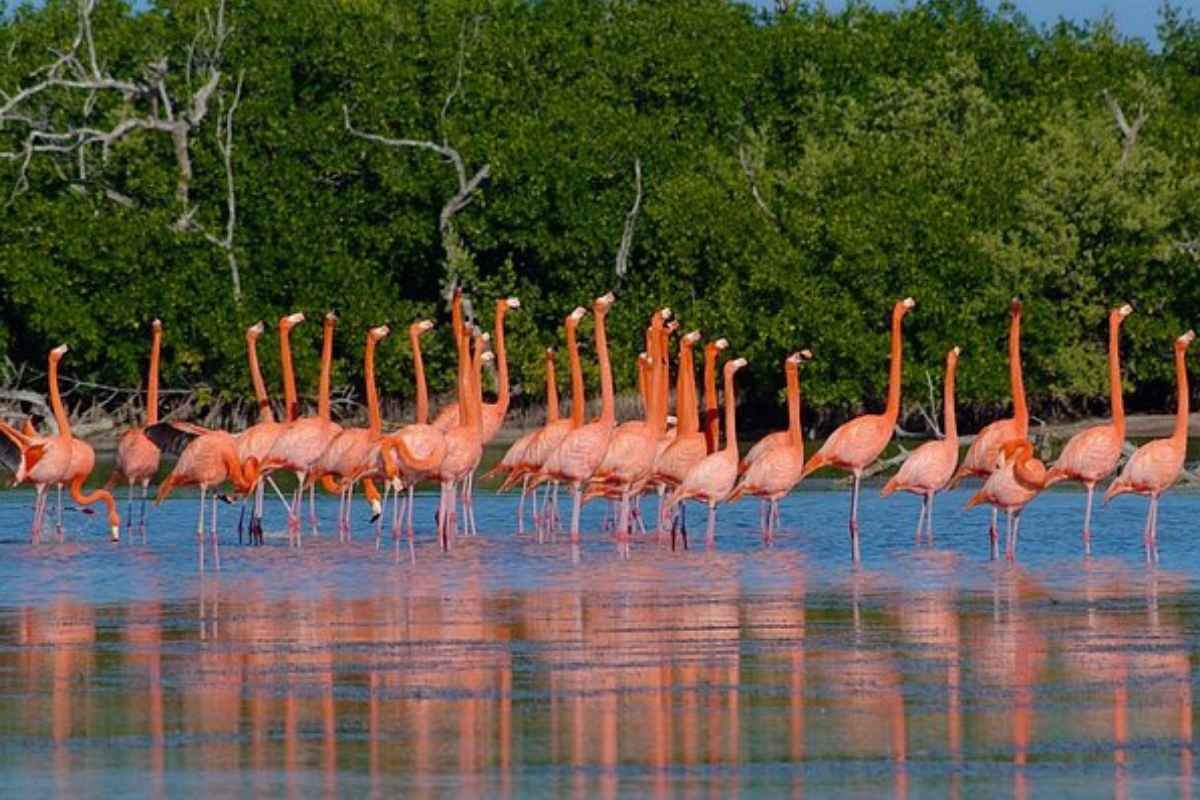
Celestún, Yucatán — November marks the start of one of the year’s biggest gatherings of pink flamingos on Yucatán’s western coast, as thousands of birds settle into the Ría Celestún Biosphere Reserve to feed, rest and ride out the winter months.
The seasonal influx, which generally runs from November through March, turns the reserve’s wetlands into one of the prime viewing sites for the Caribbean flamingo (Phoenicopterus ruber), a species known for its pink plumage, long legs and highly social behavior.
The large flocks are among the region’s main natural attractions and underpin nature tourism in the area, especially boat tours through the mangroves and coastal lagoons inside the protected area.
Behind the spectacle, however, is an ecological process essential to the species’ survival, tied to the seasonal movement of flamingo populations along the peninsula’s coastline.
A refuge spanning Yucatán and Campeche
The Ría Celestún Biosphere Reserve covers roughly 81,482 hectares across Yucatán and Campeche and was declared a federal natural protected area on Nov. 27, 2000.
Its territory forms part of a corridor of coastal wetlands made up of mangroves, lagoons, forested islands known as petenes and bodies of water fed by the peninsula’s underground hydrological system.
Those conditions support aquatic organisms that feed a long list of bird species, including the pink flamingo. The birds’ characteristic color comes from carotenoids in their diet of small crustaceans and other aquatic life, which they extract through a specialized filter-feeding system in their bills.
Individuals can reach about 1.4 meters in height and gather in groups ranging from a few dozen to several thousand birds, depending on environmental conditions and food availability.
During winter, Celestún and the neighboring wetlands of Campeche hold a significant share of the regional population, while other birds remain spread across different coastal areas.
Flamingos travel up to 300 kilometers between refuges
The birds’ presence in Celestún is part of a movement cycle that links the peninsula’s western wetlands with breeding grounds in eastern Yucatán.
According to the National Commission of Natural Protected Areas (Conanp), the birds can cover close to 300 kilometers between their winter concentration areas and their main breeding sites.
Chief among those is the Ría Lagartos Biosphere Reserve, which takes in parts of Río Lagartos, San Felipe and Tizimín and ranks as one of Mexico’s most important nesting sites for the Caribbean flamingo.
During the 2026 breeding season, environmental authorities recorded about 24,000 birds in the Ría Lagartos nesting zone, along with roughly 12,500 nests.
Monitoring also documented a hatching rate of 63.84 percent, with about 7,980 chicks recorded.
The figures underscore the biological importance of northern Yucatán’s wetlands for sustaining the population and illustrate how closely the breeding grounds are tied to the areas the birds use in winter.
The species does not necessarily make an international migration each season; a large share of its movement takes place within the peninsula itself, driven by weather, food and breeding conditions.
Mangroves underpin an internationally recognized ecosystem
Ría Celestún’s importance goes well beyond its flamingos.
The reserve is recognized internationally as a Ramsar site for the ecological value of its wetlands and forms part of the UNESCO Man and the Biosphere reserve network.
Its mangroves serve as shelter and nursery grounds for fish, mollusks and crustaceans, while its waterways offer resting and feeding grounds for resident and migratory birds. In winter, the area also hosts species that move from North America toward tropical regions of the continent.
Conserving these ecosystems is especially important given disruptions to natural water flows, changes along the coastline and shifting climate patterns that can alter wildlife movement and reproduction.
Conanp itself has documented changes in the timing of the flamingos’ breeding season linked to variable environmental conditions, a factor that monitoring and conservation programs are watching.
Boat tours and local income
The seasonal concentration draws visitors eager to see the birds in the wild, most of them on guided boat trips through Celestún’s channels and lagoons.
The tours offer a look at the mangroves, a chance to identify other bird species and an up-close view of flamingos feeding in shallow water.
Tourism also supports boat operators, community guides, restaurants and other businesses tied to the local economy.
Tour prices vary by operator, route and number of passengers, so visitors should confirm rates before booking.
Because the flamingos are wild birds living in a protected area, viewing must respect safe distances and avoid maneuvers that scatter or disturb the flocks.
Sightings are not guaranteed on any given day, since concentrations shift with environmental conditions, water levels and the birds’ natural movements.
A season central to the peninsula’s natural heritage
While Celestún is among the best-known places to watch flamingos in winter, the birds also appear elsewhere along the Yucatecan and peninsular coast, including Ría Lagartos, El Cuyo, Sisal and areas of Campeche and Quintana Roo.
Connectivity between these ecosystems gives the species the space it needs to complete the different stages of its life cycle.
As the 2026 winter season begins, Celestún’s wetlands are once again at the center of that dynamic, with thousands of birds dependent on food supplies, stable water bodies and protection of their refuges.
More Environment
- Cancún Construction Blocks Blue Crab Migration Routes to the Sea
- Mahahual Group Urges Wildlife Crossings and Road Signs After Animal Deaths
- Belizean NGO Warns of Rising Manatee Deaths in Chetumal Bay
- Monarch Butterfly Breeding Activity Documented in Cozumel for Third Consecutive Year
- Mahahual Landfill Overflows, Spilling Trash Onto the Cafetal-Mahahual Highway