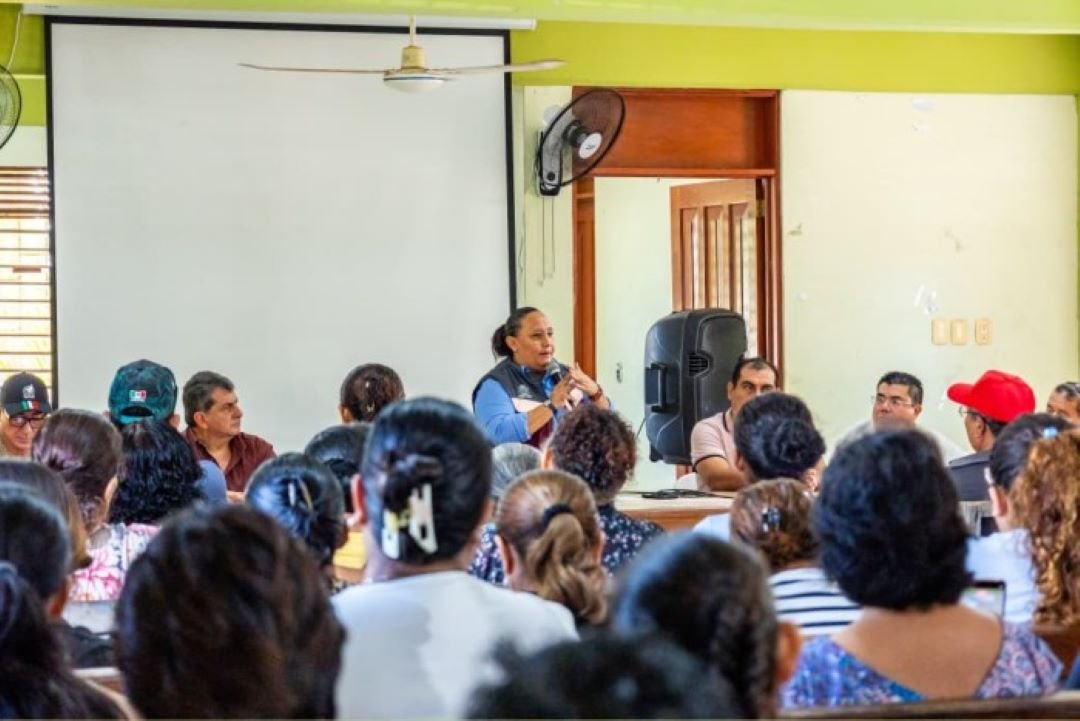
Sabidos, Quintana Roo — The Ejido Sabidos took a step forward Sunday toward securing long-awaited compensation for land occupied by the Kohunlich archaeological zone, after community members ratified agreements previously reached with federal authorities during an ejidal assembly.
At the meeting, Quintana Roo Secretary of Government Cristina Torres Gómez said the National Institute of Anthropology and History (INAH) will handle the paperwork with the federal Finance Secretariat to obtain the funds needed for the payment to the ejido.
Torres Gómez explained that ejidatarios must compile the required documents to build the file that will be submitted to federal authorities, meeting the requirements set by both INAH and the Secretariat of Finance and Public Credit (SHCP).
“We are not going to abandon you. The government of Quintana Roo will be with you from beginning to end on this path,” Torres Gómez told members of the Ejido Sabidos.
The state official said the government will continue supporting the ejidatarios throughout the process and will keep coordinating with the federal agencies involved.
Tourism push for Sabidos
In addition to the compensation process, the assembly agreed on actions to create economic alternatives for Sabidos residents. The state Tourism Secretariat will offer training courses and work on designing a comprehensive tourism project for the community.
Ejidatarios will also present proposals to INAH to allow the sale of food and handicrafts within the Kohunlich archaeological zone, along with other community-benefit projects. The institute will review the proposals according to its regulations on the operation and conservation of archaeological sites.
On conservation, INAH representatives said they are considering requesting funds for fiscal year 2027 to carry out conservation and research work at Kohunlich, which lies within the Ejido Sabidos’ territory.
The meeting included Julio César Ortiz Suárez, INAH’s director of center evaluation, and Jorge Pimentel, the institute’s deputy director of real estate regularization, as well as representatives of the Tourism Secretariat and the Institute of Culture and Arts of Quintana Roo.
Torres Gómez said the meeting helped clarify ejidatarios’ questions about access to public resources and defined next steps for both the compensation and community projects.
More Government
- Mexico’s Lower House Approves Single-Nationality Requirement for Presidency and Governorships
- More Than 200 Children Evacuated From Chetumal Daycare After Electrical Fault
- US Expands Visa Restrictions Targeting Birth Tourism
- Mexico’s Supreme Court Blocks Telmex Bid for Automatic Pay TV Access
- Mexico and EU Bring Modernized Global Agreement to Congress as Senate Ratification Looms
More Chetumal
- Tren Maya Freight Complex in Chetumal to Break Ground in 2027
- Quintana Roo Prisons Add Digital Visit Booking and Family Spaces
- Bamboo Growers From 13 Mexican States Form National Association
- Chetumal Chef Kevin Chávez to Represent Mexico at S.Pellegrino Young Chef Regional Final
- Diocese of Cancún-Chetumal Warns of Man Posing as a Priest in Chetumal