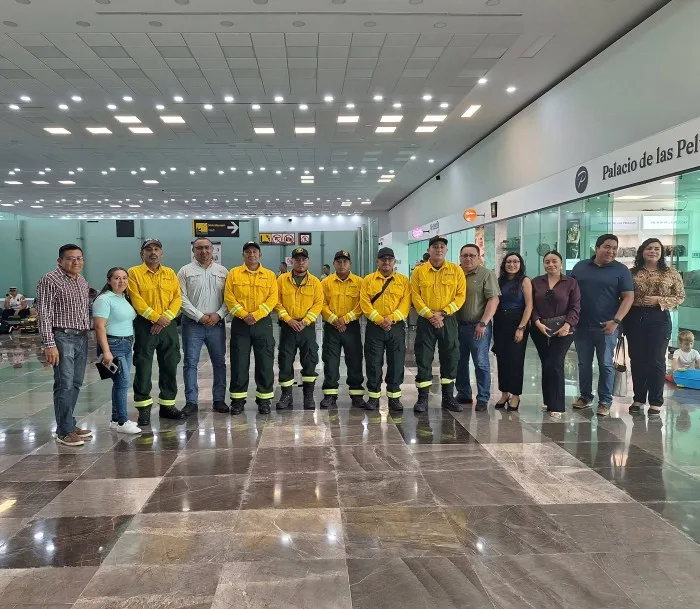
CANCÚN, Quintana Roo — Sixteen wildland firefighters from Quintana Roo have been selected for an international deployment supporting Canada as the country confronts hundreds of active fires and a shortage of available personnel and equipment.
The firefighters belong to Section 39 of the National Union of Workers of the Ministry of Environment and Natural Resources, or SNTSEMARNAT. According to the union, 13 had already reached Canada when it announced the deployment, while three others had been selected to join a later mobilization.
The personnel were routed through Abbotsford, British Columbia, and Thunder Bay, Ontario. Those cities serve as arrival and coordination centers, with crews subsequently assigned to active fire zones according to operational needs.
Section 39 said the assignment reflected years of preparation rather than a last-minute selection.
“Behind it are hours of training, evaluations, physical demands, field experience and, above all, the commitment to always be prepared to serve where most needed,” the union said.
The organization also recognized the personal cost of an international deployment, noting that firefighters leave their families and communities to work for weeks in remote, physically demanding and potentially dangerous conditions.
More than fighting flames
Mexico’s personnel in Canada are trained wildland firefighters, not simply municipal emergency responders. Their work can include constructing firebreaks, extinguishing hot spots, operating portable pumps, removing hazardous trees and conducting thermal searches for heat remaining underground or inside burned vegetation.
Mexican teams deployed this season have supported operations in Ontario and British Columbia. Federal authorities have reported assignments involving the Rinker Lake and Dryden fire complexes, the Atikokan area and the Big Bar complex in British Columbia.
Crews may spend long shifts in difficult terrain, carrying water, fuel, hand tools and protective equipment. Mop-up operations can continue long after visible flames have disappeared because roots and organic material beneath the surface can continue burning and reignite a fire.
Mexico has also deployed technical specialists and an Incident Management Team to assist with planning, logistics, safety and coordination. Federal officials described the management-team deployment as a first for Mexico in its wildfire cooperation with Canada.
Canada reaches its highest preparedness level
The deployment comes as Canada remains at National Preparedness Level 5, the highest rating used by the Canadian Interagency Forest Fire Centre. The designation means national firefighting resources are heavily committed and additional assistance is needed from international partners.
As of the weekend, the center was reporting approximately 625 active fires nationwide. More than 4 million hectares had burned during the 2026 season.
Conditions have been especially serious in western Canada. British Columbia declared a provincial state of emergency as rapidly moving fires forced evacuation orders affecting thousands of residents.
Not every active fire is considered out of control, and the national total changes daily as new fires are detected and others are contained. However, Preparedness Level 5 indicates that the cumulative demand has exceeded what Canadian agencies can comfortably manage with domestic resources alone.
Nearly 400 Mexican personnel deployed across rotations
The Quintana Roo firefighters are part of Mexico’s fourth mobilization to Canada during the current emergency.
According to the Mexican Foreign Affairs Ministry, that contingent consisted of 100 firefighters and two technical specialists drawn from 22 states. Participants include personnel from the National Forestry Commission, state and municipal civil-protection agencies, environmental departments and specialized brigades.
Mexico had deployed nearly 400 personnel across four rotations by the time the latest group was assembled. That does not mean all 400 were working in Canada simultaneously. Some members of earlier contingents had completed their assignments and returned home, leaving approximately 185 Mexican personnel active after the latest rotation, according to federal deployment figures.
An earlier group sent through Thunder Bay included 100 firefighters and four specialists, the National Forestry Commission reported.
A long-running partnership
The assistance is being provided through a bilateral wildfire-cooperation agreement that allows Mexico and Canada to exchange trained personnel and resources when one country’s firefighting capacity is stretched.
Before deployment, Mexican firefighters must satisfy physical-fitness, medical, technical and experience requirements. International assignments also require standardized training so crews from different countries can work under the same incident-command structure.
Canada has assisted Mexico during severe fire seasons as well, making the arrangement a reciprocal one rather than a one-way aid program.
For Section 39, the latest mission carries particular significance because the firefighters represent a state better known internationally for beaches and tourism than for its forest-fire brigades.
“Today you carry with you not only your experience and knowledge, but also the name of Quintana Roo and Mexico,” the union told the selected personnel.
More Community
- Polo strengthens to a Category 5 hurricane off Mexico’s Pacific coast in Record Time
- Cancún: 3 Kidnappers Get 80-Year Sentences Each
- Culture Ministry to Inspect Ceremonial Pole Ahead of Voladores de Papantla Return to Tulum
- Cozumel Launches Rabies Vaccination Drive With 3,000 Free Doses for Pets
- Erasmo Catarino Nearly Drowns at Cancún Beach, Rescued by Raúl Sandoval
More Quintana Roo
- Quintana Roo Climbs 12 Spots to 9th in Competitiveness Index
- Sargassum Collection in Quintana Roo Tops 133,000 Tons, Setting New Record
- Quintana Roo Courts European Airlines to Boost Winter Flights to Cancún
- Mayan Council Urges Mexico’s Supreme Court: Don’t Decide About Us Without Us
- Quintana Roo Construction Demand Jumps 40% on Hotel Renovations