
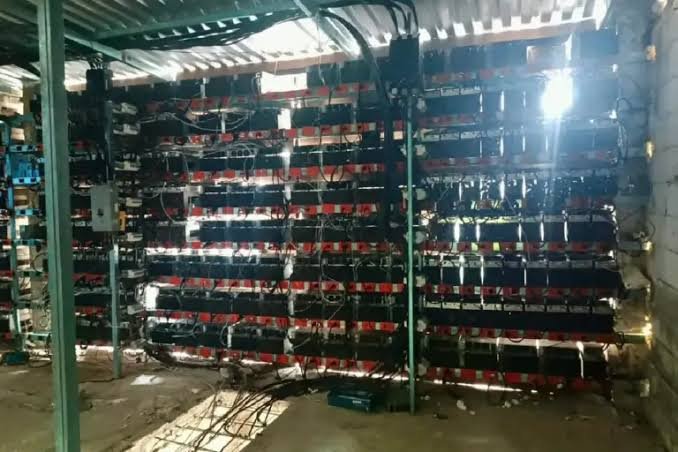
Tlaola, Puebla — A large-scale cryptocurrency mining farm seized in this municipality in the Sierra Norte region of Puebla was stealing electricity from dam infrastructure, the state Public Security Department confirmed Wednesday, saying it found the connections and transformers used to power the complex.
The confirmation shifts the focus of the investigation opened after the property was secured, where authorities previously counted 1,032 devices suspected of being used for crypto mining. Officials are no longer examining only how the facility operated, but also the mechanism it used to obtain the enormous amount of electricity needed to keep it running.
State Public Security Secretary Francisco Sánchez González said the properties involved belong to private individuals and that inspections identified electrical connections that allegedly allowed power to be diverted to the equipment.
A Facility With Massive Power Needs
The scale of the complex helps explain its electricity requirements.
During a raid carried out Sept. 11, federal authorities counted 1,032 possible crypto mining rigs, along with 95 network connection devices, five transformers, three satellite antennas, one microwave antenna and other technological components.
The final tally came after an inventory conducted by the Mexican Navy. Days earlier, preliminary reports mentioned roughly 300 devices, but officials later clarified that both figures referred to the same property.
Running more than a thousand specialized machines at once requires heavy energy consumption and generates large amounts of heat, meaning such centers need electrical infrastructure and additional systems to stay active.
Officials Confirm Power Diversion
The development announced Wednesday was official confirmation that the installation showed signs of energy theft.
According to Sánchez, transformers and connections were found on the properties that allowed electricity to be routed from infrastructure near the dam to the facilities where the equipment was running.
The Federal Prosecutor’s Office (FGR) has an open investigation to determine who installed the connections, how long they operated and how much energy was diverted.
Authorities must also establish who was responsible for managing the technological infrastructure and where the digital assets generated by the operation ended up.
Properties Owned by Private Individuals
Another detail released by the Public Security Department is that the properties tied to the investigation belong to private owners.
The identities of the owners have not been made public, and it has not been established whether they took a direct part in running the equipment.
Sánchez also said that, for now, the investigation has turned up no elements linking local congressman Miguel Márquez Ríos to the facilities. On Sept. 16, the department said it had no indications connecting the legislator to the clandestine farms.
Earlier Case in the Sierra Norte
The Tlaola installation is not the first case of crypto mining and suspected irregular electrical connections detected in the region.
In 2025, authorities investigated another installation in Juan Galindo, in the Nuevo Necaxa area, where infrastructure intended for cryptocurrency mining was also found. The region is home to hydroelectric facilities, including those associated with the Necaxa system.
Investigators are now focused on mapping the network behind the installations, tracing the origin of the equipment and assessing the impact of the clandestine energy consumption used to sustain large-scale crypto mining operations.
More Crime
- Man Detained in Puerto Aventuras After Allegedly Setting Fire to Home During Argument
- Cancún Police Foil Home Invasion in Supermanzana 25, Detain Three Suspects
- Former AMPI Playa del Carmen President Faces Fraud Case Over Undelivered Land
- Gunmen Fire on Ride-Hailing Drivers Along Playa del Carmen-Tulum Highway
- Activists in Playa del Carmen Demand Resignation of Quintana Roo Environment Chief Over Alux 33 Approval