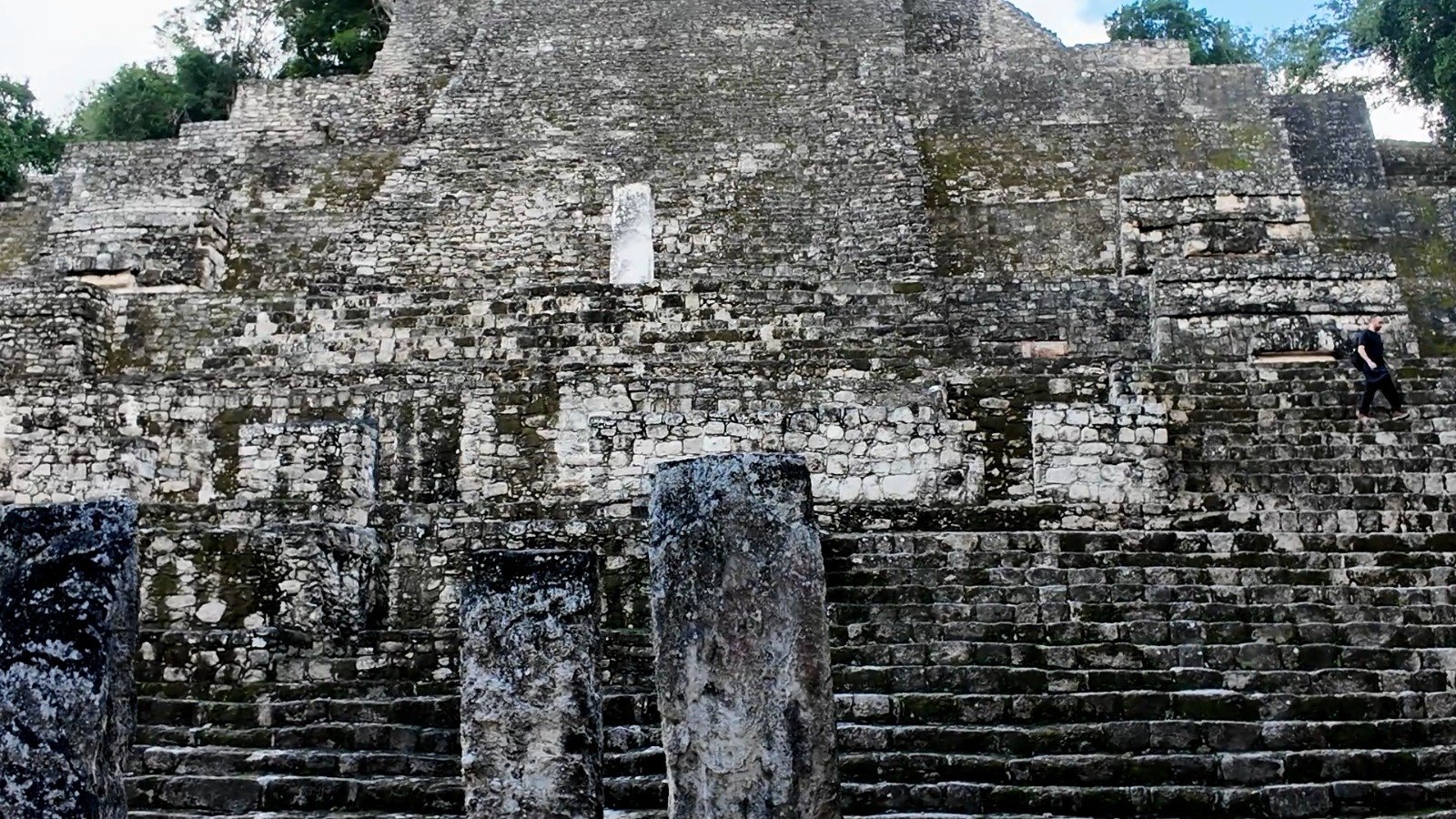
Chetumal, Quintana Roo — The thousands of archaeological finds recorded during construction of the Tren Maya and the Program for the Improvement of Archaeological Zones (Promeza) are changing how researchers interpret one of the most studied episodes in Mesoamerican history: the so-called Maya “collapse.”
Rather than confirming the sudden disappearance of the civilization, the new research points to a more complex process of partial abandonment, migration, re-occupation and social transformation that unfolded over centuries, said Margarito Molina Rendón, director of the INAH Quintana Roo Center.
“You cannot absolutely deny that the collapse existed — that is a theory that has been maintained for a long time — but the new discoveries do not tell us that,” the specialist said.
In an interview, Molina Rendón explained that modern archaeology allows researchers to observe not only the size of the population that lived in a region, based on the settlements found, but also the social processes that followed.
“Archaeology reconstructs not only the population density calculated from the number of archaeological remains that are found, the number of settlements in an area, the population density or estimates of how many people lived there,” he said. “It also analyzes what happened — whether or not there was a collapse, because that is a theory that has been held for a long time, and today new studies show that there was no collapse overnight.”
Molina Rendón said events such as prolonged droughts, internal conflicts, fires or political changes could have driven the transformation of Maya cities, but the new studies show that many sites were not permanently abandoned.
“Something happened, such as a great drought or a great rebellion, or a great fire or a great hurricane, which are generally the theories used to talk about the Maya collapse,” he said. “No — today archaeologists are beginning to see that there really were occupations and re-occupations of sites, that people abandoned them and came back, and that is why some sites show a long continuity of human occupation.”
Ichkabal and the Scale of Maya Cities
He cited the archaeological zone of Ichkabal in Quintana Roo, where research reveals the scale of an ancient Maya city.
“The studies being carried out indicate that the great plaza at Ichkabal tells us that thousands of people — 50,000 — could gather there, and they speak to us of a great city,” he said. “The same archaeologists who worked at Ichkabal compare it with the Zócalo in Mexico City.”
The specialist explained that these large spaces served social, political and religious functions similar to those of modern public squares, where entire communities gathered for ceremonies, political events or celebrations tied to the Maya calendar.
Everyday Life, Ceramics and Property
The archaeological work tied to the Tren Maya and Promeza has also shed light on the daily lives of Maya communities.
On Section 7, between Chetumal and Escárcega, Campeche, researchers found large quantities of ceramics and vessels that provide information about religious practices, diet and social organization.
“The Maya were polytheistic, they had several gods, almost all linked to elements of nature: rain, the sun, water and so on. On ceramics, in some cases, glyphs or small ceramic figures are found — elements that speak of certain deities,” Molina Rendón said.
Another significant find came on Section 5, between Playa del Carmen and Tulum, where archaeologists found a large number of pre-Hispanic albarradas — stone structures that marked off spaces — revealing early forms of territorial organization and property.
“The number of albarradas found between Tulum and Playa del Carmen is enormous — more than 8,000 — and that allowed archaeologists and anthropologists to understand a little beyond what in sociological terms we know as private property,” he said. “Very primitive, perhaps, very primordial, but the separation of these spaces as the property of a peasant family already existed.”
INAH reported that work associated with the Tren Maya led to the registration of 58,657 immovable structures, 1,946 movable artifacts, 1,414,299 ceramic fragments, 699 sets of human remains and 2,252 natural features associated with ancient human settlements.
On sections 5, 6 and 7 of the rail project, crews surveyed 24,481 archaeological monuments. Of those, 8,140 lay along the train’s route, and INAH archaeologists intervened in 7,764 of them during salvage work. Many of the 8,140 monuments were pre-Hispanic albarradas — boundaries of the agricultural plots the Maya used — as well as residential platforms, the agency’s project supervisor said at the time.
Isotopes and Population Movement
Anthropological analysis has also helped identify population movements. At sites such as Tulum, researchers found evidence of people from other regions, including northern Guatemala, while at El Meco the studies point to a population with greater local continuity.
“You might ask, how do they know? Because physical anthropologists, using new techniques and tools based on isotopes — with atomic energy or whatever — can identify through teeth what these people consumed,” Molina Rendón said. “That is, they can identify where a person came from based on their diet.”
El Meco’s Strategic Role
For Ashuni Romero Butrón, who is responsible for the El Meco archaeological zone, the discoveries are valuable not only for their volume but for what they reveal about the daily life of the region’s ancient inhabitants.
At that site, Romero said, researchers found a refuse area that serves as a window into what the population consumed, what tools they used and how they took part in trade networks. El Meco was a key node on that route, the researcher said.
“We don’t have another site of this size in this region; only farther south do we have sites,” Romero said. “Here there is obviously El Rey and San Miguelito, but nothing more.”
The researcher noted that El Meco played a strategic role as a Maya port connected to Isla Mujeres and other Caribbean regions because of its position along pre-Hispanic sea routes.
The new studies stemming from the archaeological research tied to the Tren Maya and Promeza do not rule out the existence of the so-called Maya collapse, but they do offer a broader view — of a civilization that did not disappear suddenly, but instead passed through processes of change, adaptation and continuity over hundreds of years.
More Culture
- Cancún’s Teatro de la Ciudad Nears 75% Capacity Ahead of Second Anniversary
- Explorers Document New Underwater Cave System South of Cozumel
- Activists Find Archaeological Remains at Playa del Carmen Hotel Site
- Cueva Popotitos: New Underwater Cave System Found South of Cozumel
- Tren Maya Archaeological Finds Won’t Be Displayed in Chetumal, INAH Says
More Quintana Roo
- Quintana Roo Enacts ‘Ley Nicole’ Banning Cosmetic Surgery on Minors
- Drought Crisis Forces Quintana Roo Wildlife to Seek Water Near Roads and Towns
- Quintana Roo to Add 10,000 Hotel Rooms by 2028
- Brain-Eating Amoeba Confirmed in Mérida Lake: What to Know in Quintana Roo
- Quintana Roo Graduates 244 New Police Officers and Debuts First Bomb Squad