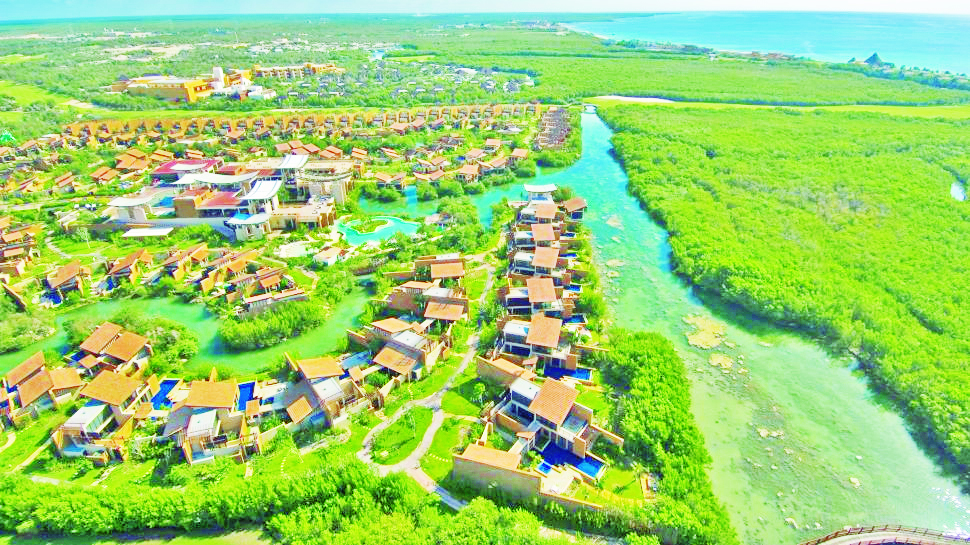
Playa del Carmen, Quintana Roo — A controversial high-density housing megaproject that has faced repeated environmental rejections is back before federal regulators, raising fresh alarms among conservationists and urban planners in one of Mexico’s most ecologically sensitive coastal zones.
Asenda Ciudad Mayakoba, a development of 460 apartments in 17 nine-story buildings plus a basement, is seeking approval from the Secretariat of Environment and Natural Resources (Semarnat) for a third time. The company submitted a new environmental impact statement on May 18, 2026, under file number 23QR2026TD045, requesting a change of forest land use on 4.13 hectares of secondary medium semi-evergreen jungle within a 5.51-hectare plot.
The site is located on lot 33 of Ciudad Mayakoba, at kilometer 299 of Federal Highway 307 connecting Chetumal and Puerto Juárez. The project includes internal roads, swimming pools, terraces, water features, walkways, and conservation areas, to be built in three independent phases. It would be one of the most ambitious vertical developments ever proposed for Playa del Carmen’s northern corridor.
The project’s history dates back to at least 2019, when nearly identical proposals first appeared in federal environmental dockets. Since then, authorities have flagged technical inconsistencies and insufficient information regarding deforestation, hydrological management, and cumulative ecological impact. Despite those setbacks, the developer has returned with a new application, which experts see as an attempt to overcome previous denials through technical and legal reconfiguration.
The renewed push comes at a particularly sensitive time for Playa del Carmen. The Mayakoba corridor has become a symbol of the region’s breakneck real estate expansion, which has replaced vast stretches of jungle with high-density tourist, residential, and commercial developments. The area sits atop a network of caves, underground rivers, cenotes, and biological corridors critical to the region’s ecological balance.
Corporate records show that Asenda Ciudad Mayakoba S.A. de C.V. was formally incorporated in March 2018 in Playa del Carmen, with a business purpose covering development, construction, and marketing of real estate complexes, vertical condominiums, and housing projects. Shareholders originally included Huaribe S.A. de C.V. and Inmobiliaria Parque Reforma S.A. de C.V., with board members such as Andrés Pan de Soraluce Muguiro, Agustín María Sarasola Sánchez-Castillo, Rodrigo Díaz Álvarez, and Jaime Santa Ana Tello — names linked to Spanish real estate capital with a history of large-scale tourism and residential megaprojects in Mexico.
During the years the project appeared stalled, the company underwent a major internal restructuring in 2024, including revocation of powers, departure of board members, and appointment of new legal representatives such as Francisco Borja Escalada Jiménez, Diego Laresgoiti Matute, Moisés Pérez Estrada, and María Fernanda Alatriste Parrodi. Real estate analysts say such moves typically signal refinancing, share reorganization, or strategic relaunch of stalled projects.
The full environmental impact statement has not been made publicly available, preventing detailed review of the company’s hydrological studies, mitigation strategies, and ecological assessments. But the mere re-filing has already triggered warnings from environmental watchdogs and citizen groups who see the project as another incursion of predatory urban development into the last remaining forest fragments of northern Quintana Roo.
More Business
- Cancun Hotels Push for 6% Rate Hike and Promotion Support
- Cancun Hotels Get Free Renovation Licenses Until 2026
- Quintana Roo Builders Pin 2026 Hopes on Public Works
- National Guard Allegedly Tied to Cancun Uber Payments
- Tourists Say Playa del Carmen Pemex Station Charged Them $150 for a Partially Filled Tank
More Playa del Carmen
- Playa del Carmen Councilwoman Proposes Reviving Under-Bridge Spaces Along Boulevard
- Playa del Carmen Council Advances Land Approvals for Two IMSS Medical Units
- Alleged International Money Laundering Operator ‘El Panameño’ Arrested in Playa del Carmen
- Judge Orders Five to Stand Trial for Drug Dealing in Playa del Carmen
- Quintana Roo Prosecutor’s Office Releases Seized Playa del Carmen Property, Leaving Two Dogs Locked Inside for Three Days