
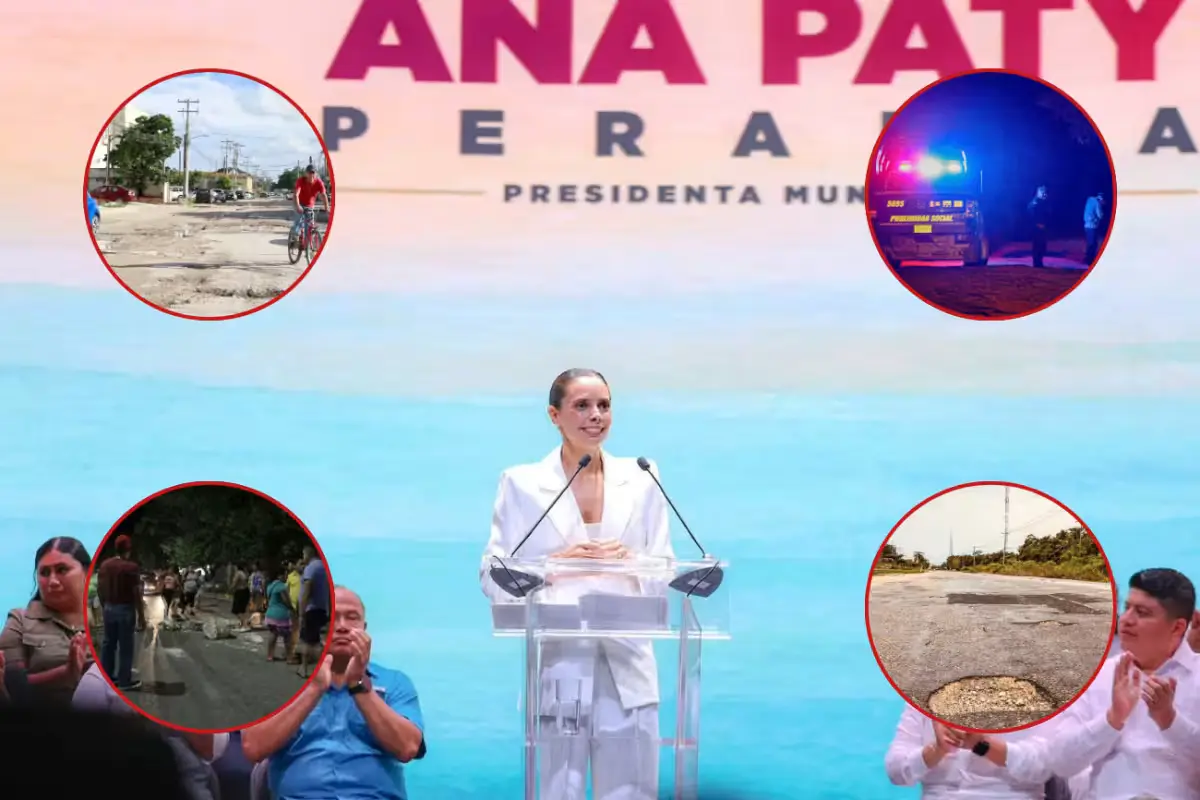
Cancún, Quintana Roo — Cancún’s municipal government reported 995.9 million pesos in public works spending during its second year in office, but residents surveyed by POR ESTO! say insecurity, transportation failures, potholes and uneven public services remain unresolved across the city.
Mayor Ana Patricia Peralta de la Peña delivered the document of her Second Government Report to the City Council. Her administration highlighted growth in the municipal budget, which rose from 7.636 billion pesos approved for 2025 to 8.253 billion pesos for 2026 — an increase of 617 million pesos, or 8.1 percent.
Residents questioned how the money is being spent, the condition of the streets and the level of attention their neighborhoods receive.
Insecurity Tops Complaints
Perceptions of insecurity are among the most frequent complaints. According to the National Survey of Urban Public Safety (ENSU) by INEGI (the national statistics agency), 70.1 percent of Cancún residents feel unsafe.
Yareli Solís, who works in the tourism industry, said the situation particularly affects women. “I leave work late and I’m afraid when I travel, so I have to take precautions and let my family know my location in real time,” she said.
The municipal report highlights security actions, while emergency response figures show the demand concentrated in Cancún. The city accounted for 51 percent of all emergency calls statewide, with 893,804 reports. Of those, 319,578 were considered genuine, 516,642 improper and 57,584 were requests for information.
Of 299,816 dispatched response calls, 210,677 were classified as genuine and 91,120 as false. Police assistance accounted for the largest share, at 168,169.
At the state level, the federal government reported a 60 percent drop in intentional homicides in the first half of 2026 compared with the same period in 2025. In Cancún, however, insecurity remains among residents’ main concerns.
From January to July 2026, Quintana Roo opened 34,440 investigation files, 7.32 percent more than the 32,091 recorded in the same period of 2025. Crimes against property accounted for 14,063 of those investigations.
Public Works and Unfinished Roads
The 995.9 million pesos reported for the second year went to infrastructure, roads, mobility, electrification and security-related projects. The first two packages of the Annual Investment Program totaled 748 million pesos, and the municipality later reported close to 1 billion pesos in investment for the year.
Leonardo Téllez said authorities need to coordinate better and give advance notice of where work will begin and what alternatives drivers have. “It’s not possible that in a city so small compared with other urban centers, there is no coordination between authorities to give advance notice of where road works will start, for example, and to inform people of alternative routes,” he said.
He also described Cancún as a young city with the problems of an old one.
The municipality’s own figures show that some major mobility projects remain unfinished. Avenida 135 was 44 percent complete and Avenida Nazaret 47 percent. Together the two projects cover roughly 14 linear kilometers, or about 30 kilometers counting both directions. The intersection of Huayacán, 135 and Colegios is also among the points requiring work; in September 2025 that project was 27 percent complete.
In September, the city launched “Cancún Fluye,” a strategy to analyze and synchronize 178 traffic lights across six zones. It began with 43 signals in the city center.
Those interviewed said road work causes congestion and called for more information about which areas are being worked on and what alternative routes are available.
Uneven Attention Across the City
Ernesto Zepeda, Josué Peña and José Sánchez agreed there are differences in services and public works between different areas of Cancún.
They said the southern zone is growing rapidly and has projects in various spots, while in the north of the city, particularly in working-class neighborhoods, the shortcomings are greater.
Residents linked urban growth to problems with drinking water, public services, mobility and security. The municipal administration reports works and investments in various parts of the city, while those consulted said the work and services do not reach all areas equally. Residents have blocked streets to protest the lack of electricity and water.
Waste, Potholes and Transport
On waste, the municipality reported that its Green Units had cleared 765 illegal dumping sites through July. It also reported 207 people detained, 45 vehicles seized and 755 incident reports.
Street maintenance is another point of complaint. Estela Beltrán and Antonio Ortiz cited pothole problems and said holes multiply on some roads. Both said security “is conspicuous by its absence” in some neighborhoods.
Public transportation is also among the pending issues. In April 2026, the City Council approved the municipality taking on transport responsibilities through the Quintana Roo Mobility Institute, with the aim of moving toward a new model with better routes, vehicles and schedules.
Beltrán and Ortiz described peak-hour travel as inhumane because of the number of passengers traveling at the same time, saying buses run overcrowded with riders packed “like sardines.”
Accessibility ramps for people with disabilities also drew criticism. Those interviewed said some have smooth surfaces that become slippery when it rains, and others are too steep. The complaints refer to areas of daily use and form part of the urban infrastructure conditions residents say must improve.
The municipal budget rose from 7.636 billion pesos approved for 2025 to 8.253 billion for 2026, while reported public works investment in the second year of the administration reached 995.9 million pesos. On the ground, residents say the results of that spending remain uneven across Cancún.
More Government
- Hurricane Polo Hits Category 5; Five Mexican States Brace for Heavy Rain
- Cozumel Submarine Power Cable to Be Installed Oct. 5 After 40-Year Wait
- Cozumel Reports Alcohol and Drug Use Starting at Age 11
- Quintana Roo Congress Ranks Among Mexico’s Least Transparent
- Playa del Carmen Beach Restoration Clears Environmental Hurdle, Mayor Says
More Cancun
- Activist Searching for Missing Brother Sentenced to 80 Years for Cancún Kidnapping
- Cancún Officials Urge Residents to Protect Pets After Reported Puma Sighting in Cuna Maya
- Fraud Suspect Captured in Miami Returned to Quintana Roo After Two Escapes
- Cancún Bar Raid Uncovers Six Possible Human Trafficking Victims
- Shoplifting Rings Target Stores Inside Cancún Airport Terminals