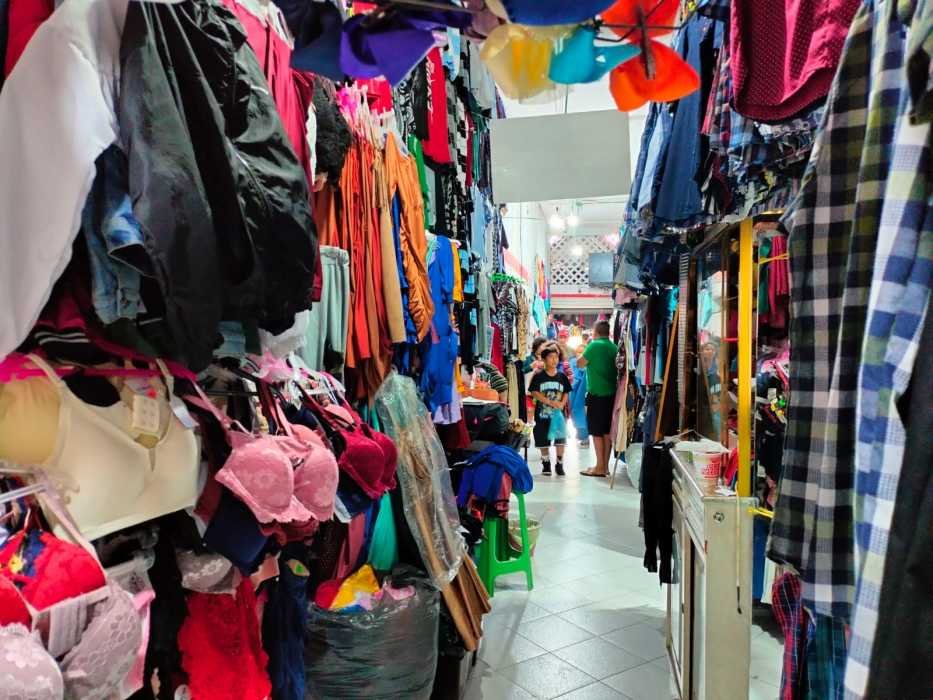
Cancún, Quintana Roo — There are no tourists hunting for Caribbean souvenirs here, and no display windows stocked with luxury goods. The Cancún of big hotel chains and white-sand beaches feels far removed from the aisles of Mercado El Parián, where vendors sell shoes, school uniforms, secondhand clothing and practically anything a family needs to get through the day.
In this part of the city, near El Crucero, one of Cancún’s busiest working-class intersections, commerce moves to a different rhythm. Business does not depend on hotel reservations or the arrival of foreign visitors, but on the wallets of the people who live and work in Mexico’s most important tourist destination.
Approaching the market, the range of goods on offer hints at its history: shoes arranged on shelves, work boots and cowboy boots, quinceañera dresses, guayaberas, hammocks and school uniforms. Farther inside are phone repair shops, locksmiths, watch repairers and small eateries whose prices bear little resemblance to those of restaurants in the hotel zone.
El Parián is one of the few places where a customer can still arrive with a pair of shoes to be repaired, look for a part that is hard to find elsewhere, or ask about the uniform required by a local public school.
A market built under a palapa
Not everything is bustling. Some units sit idle, and in some aisles the number of shoppers is too thin to sustain the pace of earlier years. Of the more than 370 stalls that make up the market, roughly 250 remain in operation. The rest reflect the difficulties facing a popular trade that has had to adapt to Cancún’s growth and to new ways of shopping.
The market is more than 48 years old, though its history began under very different conditions. Before vendors had permanent facilities, they worked under a single palapa in a borrowed space, exposed to the rain and with little access to electricity.
Construction, permanent stalls and a fast-growing city followed. Today the name El Parián is commonly used to describe a much larger commercial zone stretching from El Crucero park to the area around Avenida López Portillo and Calle 19. Its original core, however, sits between Calles 11 and 7, in a section known as Parián 1.
Stalls handed down through generations
Dianely Torres Cano works in one of the shoe stalls. Her shop, which carries her name, has operated for more than 35 years, although her family’s presence in the market goes back almost half a century.
Torres grew up among the stalls and belongs to the second generation of merchants who built a livelihood here.
“I’ve been coming here since I was very young. I’m from the second generation,” she said.
Walking through Parián 1, she identifies businesses not only by what they sell but by the families who have run them for decades. Some stalls have passed from parents to children, from mothers to daughters, from aunts to nieces. Units change hands, but many keep the same line of business and a loyal clientele.
Among them is Doña Elvia’s stall, which sells secondhand clothing and which Torres describes as the oldest in that section. A few steps away work the relatives of other merchants who were part of El Parián’s early years.
“It’s very generational. It passes from generation to generation,” she said.
In a city shaped by the constant arrival of new residents, these businesses also serve as landmarks for people who have watched Cancún transform.
Footwear is one of the traditional trades, and much of the stock comes from Ticul, a town in Yucatán with a long shoemaking history. Vendors also sell linen and cotton guayaberas from Tekit, along with clothing, accessories and goods made across the Yucatan Peninsula — merchandise tied to towns far older than Cancún itself.
The customers who no longer come
Minerva Martínez and Minerva Torres remember when the worries were different. In the early years, rain could ruin a working day and the lack of proper facilities made everything harder. Construction of the market brought better conditions, but also new competitors.
Urban growth brought supermarkets, shopping centers and department stores that changed how Cancún residents shop. Stores such as Del Sol and Super Akí opened nearby, while centers like Las Tiendas de Cancún broadened the options for area consumers.
Now the competition does not even need to open across the street. E-commerce platforms, including Temu and Shein, have become another challenge for small family businesses that must compete on price, promotions and goods delivered straight to the door.
“We do suffer a bit from the drop in sales because of prices. The traveling sales fairs hurt us a lot as merchants too,” one vendor said.
The difference shows in foot traffic. According to estimates shared by the merchants, low season can reduce customer traffic to 30 or 40 people a day in their section, and not all of them buy anything.
The picture changes with the school calendar. Graduations, end-of-year ceremonies and, above all, the return to classes bring families back in search of uniforms, shoes and supplies. December also brings a recovery, driven by Christmas shopping.
To keep up, some vendors have added card terminals and accept electronic transfers. Cash still circulates across the counters, but it is no longer the only way to pay.
Security and traditions
The contrast with the tourist Cancún is unavoidable. While the city markets itself internationally on its beaches, hotels and services, the concerns at El Parián are selling enough shoes, finding buyers for clothing and holding on to customers against online offers.
Its merchants do not live off tourism so much as off the people who sustain the city day to day: workers, students, homemakers and families looking for affordable goods.
Keeping a stall open, however, does not depend on tradition alone. Perceptions of insecurity around El Crucero are another worry for vendors, who say the market is often confused with the entire commercial zone surrounding it.
To address the problem, businesses have installed surveillance cameras inside shops and in outdoor areas, some linked to the C5 monitoring system. Vendors have also asked authorities for police foot patrols inside the market, arguing that patrol cars circling nearby streets are not enough.
The religious calendar still has a place in the market’s life. During Day of the Dead celebrations, stalls stock cempasúchil flowers, sweets for altars and seasonal food, and some merchants work from 6 a.m. until 9 or 10 p.m. Every Dec. 12, merchants and neighbors gather to sing the mañanitas and pray the rosary for the Virgin of Guadalupe.
Through its internal committee, the market also promotes free trade courses, including embroidery and hammock weaving, in coordination with the state Women’s Secretariat. Vendors are considering training in online sales as well — the very activity that poses the greatest competition to traditional shops.
Torres insists on the importance of keeping local customers and making room for regional products. “We want people to know us, more than anything, and to buy local,” she said.
Nearly half a century after its first stalls went up under a palapa, El Parián still holds founding businesses, a new generation of vendors and an inventory that answers the needs of Cancún’s residents. This is the Cancún that rarely appears in tourism promotions — the one people do not visit for vacation, but to work, shop and make a living.
More Culture
- Tizimín Kicks Off Convite 2026 With Jarana Dancing and Ten Home Visits Ahead of Feria de Reyes
- Cancún Opens Pump It Up ‘Big One’ Tournament With More Than 700 Competitors
- Playa del Carmen Union Updates Registry of Musicians and Artists on Quinta Avenida
- Cancún Mayor Ana Paty Peralta Boosts Cultural Offer With Municipal Chamber Orchestra Concerts
- Jade Chale, Queen of Joy of Cozumel Carnival 2026, Dies
More Cancun
- Quintana Roo to Build Three Margarita Maza High Schools in Cancún by 2027
- Unicaribe Graduates Tell Cancún Engineering Students AI Is Reshaping the Job Market
- Cancún, Playa del Carmen and Chetumal Account for 81% of Quintana Roo’s Disappearances
- Cancún Residents Say 3 Million Peso Park Won in 2023 Was Never Built
- Quintana Roo Loses Nearly 15,000 Hectares of Jungle a Year as Real Estate Boom Drives Deforestation