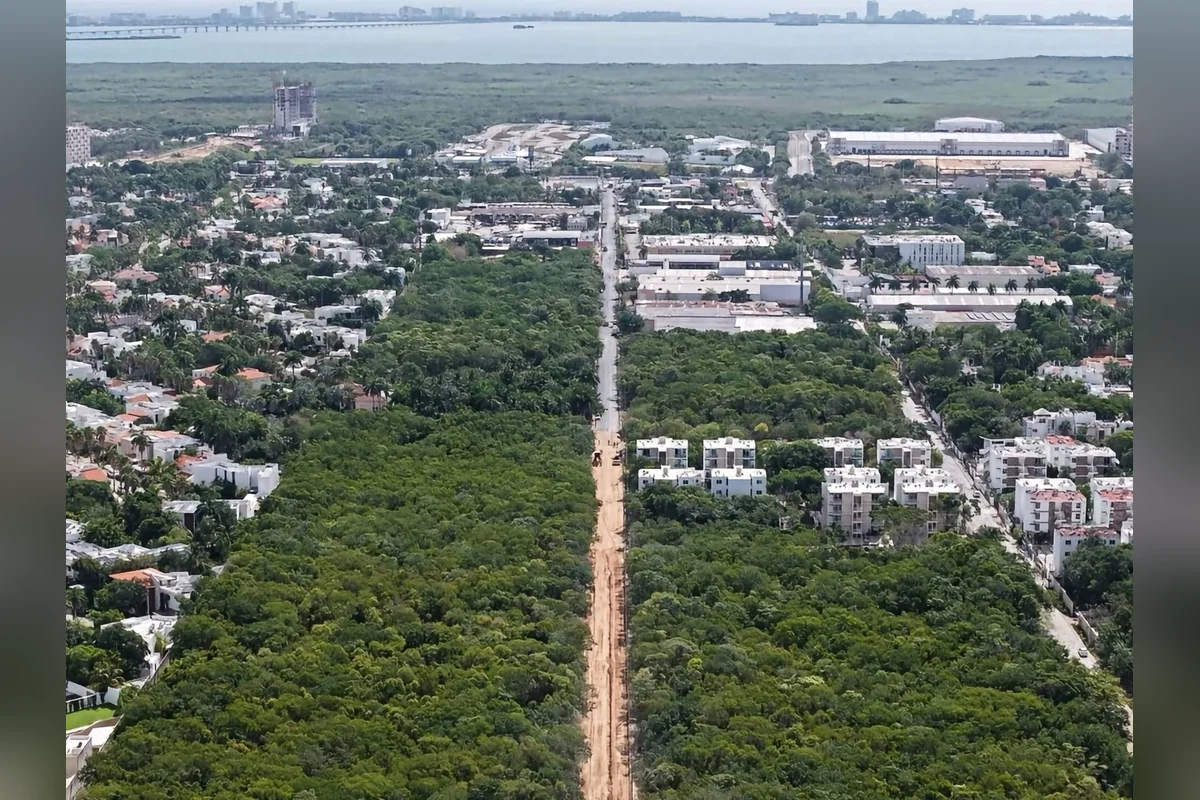
Playa del Carmen, Quintana Roo — Quintana Roo is losing close to 15,000 hectares of jungle every year, with the devastation driven by real estate and tourism development in the north of the state and by agribusiness in the south.
The state environmental prosecutor’s office, known as the PPA, has opened about 430 case files against irregular developments so far this year, most of them concentrated in Cancún, Playa del Carmen and Tulum. Alonso Fernández Lemmen Meyer, who heads the agency, said several cases have already been handed to federal authorities because they encroach on ecosystems under national jurisdiction.
The problem reaches across the state. The Secretariat of Territorial, Urban and Sustainable Development (Sedetus) has identified at least 780 irregular settlements spread over all 11 municipalities.
Residents report jungle clearing in Playa del Carmen
In Playa del Carmen, residents have reported what they suspect is illegal logging along Avenida Constituyentes, near the Palmas 1 and Misión de las Flores subdivisions. Neighbors said heavy machinery moved in as part of preparations for land slated for new apartment complexes and residential lots, and that work began in early November.
Manuel Gómez, who lives in the area, said the clearing appeared overnight.
“It was last Wednesday when we realized they were removing the jungle,” he said. “I left for work and by the time we noticed they had already cleared a section next to the highway, and further into the jungle they had cleared another stretch, and then they put up signs for the subdivisions they are going to build.”
Residents asked the municipal Directorate of Sustainable Environment and Climate Change, as well as the Federal Environmental Protection Agency (Profepa), to step in. They want inspectors to verify whether the companies behind the works hold valid environmental impact permits issued by Semarnat, the federal environment ministry, along with the required authorization to change land use on forested property.
So far, neither municipal nor federal environmental authorities have issued a public statement or reported inspection records specifically tied to the land between Palmas 1 and Misión de las Flores.
Federal authorities shutter illegally cleared land
In similar recent cases, Profepa has issued precautionary closures on properties operating outside the rules. On Oct. 21, Semarnat announced the closure of a site in Playa del Carmen after confirming the unauthorized total clearing of 14,632 square meters of medium sub-evergreen jungle.
In its ruling, the federal authority stressed that “activities involving the removal of forest vegetation must be carried out in compliance with the corresponding legal requirements, in order to prevent damage to ecosystems and protect natural resources.”
The most common violations are clearing without environmental impact permits and direct harm to the habitats of protected species.
The state is also seeing a proliferation of clandestine sargassum dumps. The PPA recently shut down two privately operated sites in Puerto Morelos and Tulum. Neither had containment liners or collection permits, so leachate was seeping into the subsoil mixed with other waste.
Nearly 58,000 hectares lost in four years
A technical assessment of deforestation in the Yucatan Peninsula between 2019 and 2023, published in 2024 by the Mexican Civil Council for Sustainable Forestry (CCMSS), found that Quintana Roo lost 58,319 hectares of forested land over that four-year period — an average of 14,595 hectares a year.
The report pointed to real estate expansion and the conversion of land to urban use as key factors in the municipalities of the northern coastal zone, including Playa del Carmen.
Data from Global Forest Watch and the University of Maryland show that Bacalar lost more than 68,000 hectares of forest between 2001 and 2023, and a further 22,000 hectares of medium jungle between 2018 and 2024, cleared to open mechanized farmland.
How to report illegal clearing
Environmental authorities note that citizen complaints are the legal basis for ordering inspections and closures, and that the filing channel depends on the location and type of site.
Profepa handles encroachment on the federal maritime-terrestrial zone, damage to mangroves, wetland filling, and projects lacking a federal environmental impact statement. Reports can be filed toll-free at 800-776-3372 (800-PROFEPA), through gob.mx/profepa, or by email at denuncias@profepa.gob.mx.
The PPA handles local vegetation clearing outside federal jurisdiction, clandestine dumps and improper waste management. Complaints go through the state government portal, the email address denuncias.ppa@qroo.gob.mx, or in person at its offices in Chetumal and Cancún.
For a complaint to be accepted and an inspection ordered, residents should provide as much evidence as possible: the exact location of the property via GPS coordinates or a Google Maps link, a precise address and road references, and a clear account of the events, including whether heavy machinery was used to fill wetlands or clear trees, or debris was dumped. Photographs or video showing the works, license plates of dump trucks or equipment numbers are also essential, along with company names or details visible on signs at the site.
Complainants must give their full name and address to receive legal notifications, but the law guarantees they can request that their identity be kept confidential. Authorities issue a case number that residents can use to track inspection deadlines and any suspension or permanent closure orders.
More Environment
- Isla Mujeres Returns to New Orleans DEMA Show to Boost Dive Tourism After Seven-Year Absence
- Cancún Plants 3,531 Trees, Keeps Sights on 11,000 Target by 2027
- Cozumel Adds 25 Wells to Boost Drinking Water Supply
- Ferry Out of Service Since 2018 Partially Sinks at Isla Mujeres Dock
- Punta Esmeralda Access Road Work Lacks Environmental Permit, Biologist Warns
More Cancun
- Quintana Roo to Build Three Margarita Maza High Schools in Cancún by 2027
- Unicaribe Graduates Tell Cancún Engineering Students AI Is Reshaping the Job Market
- Cancún, Playa del Carmen and Chetumal Account for 81% of Quintana Roo’s Disappearances
- Cancún Residents Say 3 Million Peso Park Won in 2023 Was Never Built
- Cancún Airport Schedules 953 Flights in Best Weekend Since August