
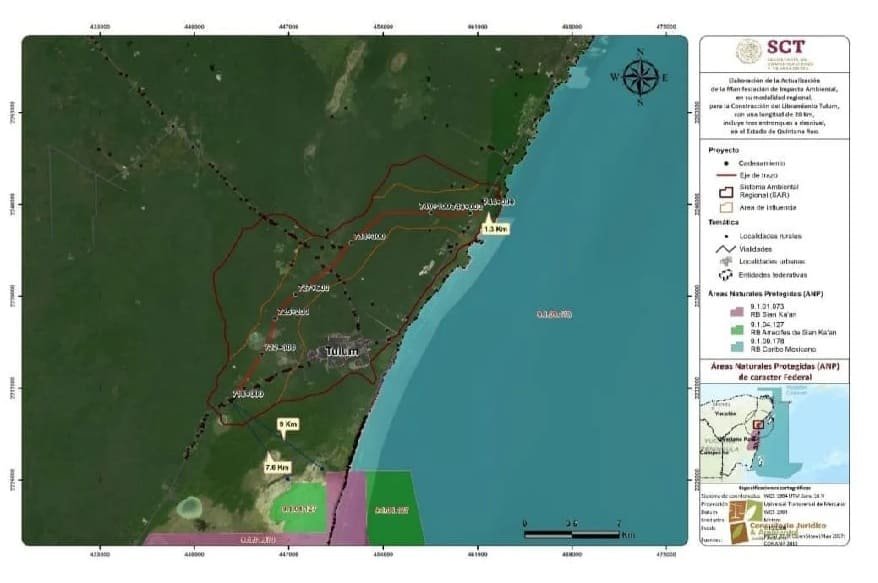
TULUM, Quintana Roo — The Director General of Public Infrastructure, Christian Moguel, has confirmed that officials are preparing a new environmental impact report for the Tulum bypass. The announcement clarified that the larger infrastructure initiative has not been cancelled, but rather that the original environmental impact declaration (MIA) has been formally withdrawn and will be re-submitted once updated.
The original MIA was filed in May 2021 in tandem with the project plan, which calls for a 26-kilometre highway featuring three grade-separated interchanges (at Carrillo Puerto, Cobá and Playa del Carmen) designed to divert through-traffic around downtown Tulum.
Moguel explained that during further technical study, authorities uncovered additional complexities—most notably a network of subterranean cave and groundwater systems beneath the proposed route. This new data triggered the withdrawal of the earlier declaration. The formal request was submitted to the Secretaría de Infraestructura, Comunicaciones y Transportes (SICT) in September, accepted by the federal General Directorate of Environmental Impact and Risk (DGIRA) on October 2 and officially resolved by October 29, 2025.
The project remains, in principle, alive: “There is a redefinition of the routes for the northern and southern branches, and that is the main reason (for the withdrawal). The project has not been canceled, only the original environmental impact declaration. It is moving forward,” Moguel said.
In terms of progress, the project’s preparatory work is advancing: Moguel reported that topographic and photogrammetric flights are 100% complete, while the informative presentations by the federal government stand at about 65% completion. These surveys and data-gathering efforts are expected to shape adjustments to the final highway alignment before construction can begin.
Historically, the bypass concept has been discussed for more than a decade as a remedy for Tulum’s escalating traffic congestion, particularly along the federal Highway 307 corridor which intersects the town. Previous local news sources described the project in 2024 as still at the pre-investment stage, with an estimated cost around 972 million pesos at that time; more recent figures suggest cost projections may exceed one billion pesos.
The broader goal is to relieve heavy traffic passing through the urban centre of Tulum, improve connectivity between Playa del Carmen, the new airport and regional tourist destinations, while also supporting planned growth and infrastructure enhancement.
As of now, the key takeaway is: the bypass remains on the books, but construction is not yet underway. Its future hinges on the completion of the updated environmental impact study and the subsequent approval of the revised route. Stakeholders—including local residents, tourism operators and development observers—are watching closely for how the project balances mobility needs with environmental protection in a sensitive region of the Riviera Maya.
More Lifestyle
- Tulum’s Mureco Museum Adds 53 Mesoamerican Pieces for Second Anniversary
- Chetumal Entrepreneur Develops Automatic Hammock Rocker for Mexico
- Cancún Prepares Janal Pixán 2026 at Puerto Juárez, Aims to Double Attendance
- Mental Health and Addiction Top Concerns Among Playa del Carmen Youth, Survey Finds
- Cancún Opens Registration for Janal Pixan 2026 Catrina and Altar Contests
More Tulum
- Zamna Tulum 2027: Dates, Lineup and Ticket Details
- Cancun Tourism Slumps 7% as Industry Leaders Urge Marketing Overhaul
- Quintana Roo Braces for Four Days of Heavy Rain and Flooding
- Tulum’s Mureco Museum Adds 53 Archaeological Pieces From Across Mesoamerica
- Tulum Fishing Cooperative Seeks Funding to Modernize Its Facilities
