
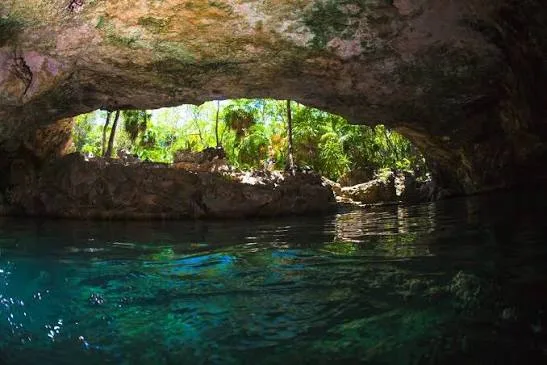
Akumal, Quintana Roo — Residents have regained access to Cenote Balam Ha following a months-long dispute over the property, but the community group caring for the site is still seeking formal authority to manage it.
The cenote is now open under the supervision of the Balam-Ha Community Group and local community guardians, who say their goal is to protect the area while preserving public access to one of Akumal’s natural spaces.
Antonio, a member of the community guardians committee, said residents recovered access through negotiations and continued work at the site.
“We did have a conflict there, but by remaining present and doing things properly, we were able to regain access,” he said.
Residents of Akumal and elsewhere in Tulum municipality can currently enter without charge. Voluntary contributions are accepted for maintenance.
The group is charging other Mexican visitors 100 pesos and international visitors 300 pesos. Organizers describe the arrangement as a community ecotourism program intended to pay for conservation and upkeep rather than generate private profits.
Regular opening hours, visitor limits and a detailed breakdown of how the admission revenue will be managed have not yet been published.
Reopening follows a community protest
The dispute attracted wider attention in April after a local cenote defender known as “Juanito” was arrested at Balam Ha on suspicion of trespassing.
Residents responded by partially blocking the entrance to Akumal with rocks and signs demanding his release. The protest continued for several hours before municipal and state authorities opened negotiations with community representatives.
Juanito was subsequently released, and the blockade was removed.
The underlying property dispute was not resolved. Authorities said it would continue through the appropriate legal process while residents were permitted to enter the cenotes for free, family-oriented community use.
The agreement prohibited commercial activity, alcohol sales and street vending at the site. The introduction of admission charges for visitors now raises a question that has not been publicly answered: whether the proposed ecotourism program will be formally authorized as a nonprofit conservation activity.
Community group awaits legal recognition
The guardians are working with Tulum authorities and the Quintana Roo Strategic Projects Agency, known as AGEPRO, to obtain a document formally recognizing the community’s role in caring for and administering Balam Ha.
AGEPRO manages property belonging to the state government, including its registration, custody, assignment and authorized use. Its involvement indicates that the future of the cenote depends not only on environmental considerations but also on resolving the legal status of the land.
Local reporting about the April negotiations identified the disputed property as belonging to AGEPRO. Other reports referred to documents presented by private parties seeking to establish possession, although those claims have not been resolved publicly.
An accommodation business has also operated under the name Villas and Cenote Balam-Ha, marketing the cenote as part of a private jungle property near Akumal. The relationship between that business, the disputed land and the community’s current management of the cenote has not been clearly explained by authorities.
Until AGEPRO issues the requested document, the reopening should not be understood as a transfer of ownership or a permanent concession to the community group.
Why access matters in Akumal
The guardians say the project grew from a lack of freely accessible natural areas for Akumal residents.
Although the community is surrounded by cenotes, jungle and coastline, many recreation areas are inside privately controlled properties or tourism developments. Admission prices at commercial cenotes can also make regular visits impractical for local families.
Balam Ha’s reopening gives residents access to a natural swimming area without an entrance fee, while the charges paid by outside visitors are intended to support maintenance.
The cenote is also part of the interconnected limestone aquifer beneath the Yucatán Peninsula. Pollution entering one opening can travel through the underground water system, making sanitation, visitor management and protection of the surrounding vegetation particularly important.
A cenote conservation guide available through the United Nations Development Programme recommends monitoring water quality, controlling visitor numbers, protecting native vegetation and preventing sunscreen, insect repellent, garbage and wastewater from entering these fragile environments.
The Balam-Ha group has not yet published water-quality results, a visitor-capacity study or a complete list of swimming and safety rules. Anyone planning to visit should confirm current access conditions locally and follow the instructions of the community guardians.
For now, Cenote Balam Ha is open again. Whether community stewardship becomes permanent will depend on the legal agreement still being negotiated with AGEPRO and the Tulum government.
More Environment
- Playa del Carmen to Review Legal Status of Chen Zubul Property
- Quintana Roo Braces for Four Days of Heavy Rain and Flooding
- Sheinbaum Allocates 2 Billion Pesos to Fight Sargassum in Quintana Roo
- Five Ejidos Seek Alliance to Protect Chichankanab Lagoon in José María Morelos
- Maya Frog and Toad Shell Pendants May Reveal Ancient Trade Routes