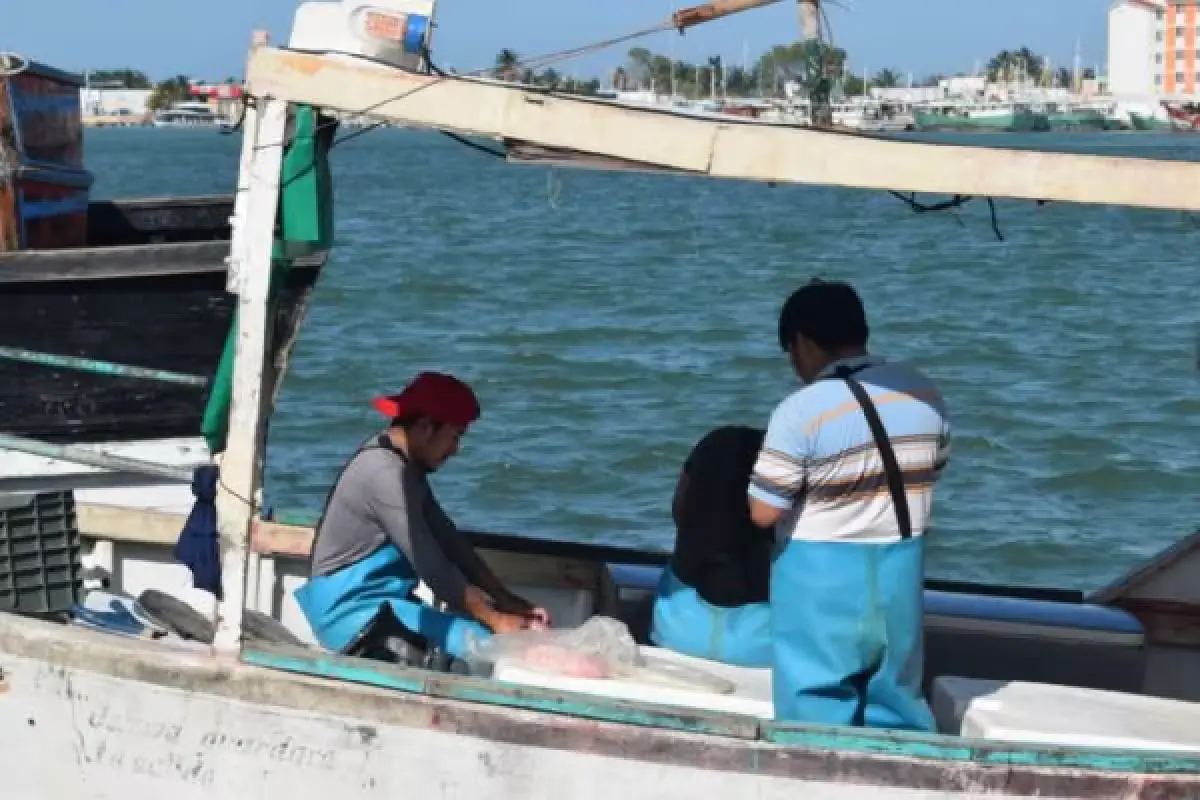
Celestún, Yucatán — A decade ago, fisherman Carlos Andrés Gómez would leave before dawn from Celestún and return with his boat full. A hundred kilograms of grouper in a day was routine. Today, he sometimes finds none. “Here in Celestún it’s already very difficult to find grouper; fishing for it is just a memory,” he says, a sentiment shared by thousands of coastal families across the peninsula.
Gómez’s experience reflects a crisis that statistics can no longer hide. The state government acknowledges a 17% drop in grouper-related fish production over the past decade, and the National Fisheries Charter warns that the fishery historically supports about 12,000 fishers and their families along Yucatan’s coastline. Fish processors, cooperatives, boat owners, and entire communities feel the weight of a collapsing fishery.
But there is news the sector has been waiting for: after more than a decade without updates, the Grouper Fishery Management Plan for Yucatan — originally published in 2014 — is in its final phase of institutional review and is expected to be published in the Official Gazette of the Federation this year. If that happens, the real challenge begins.
A Design That Was Born Old
The original 2014 document arrived in a very different context. Grouper was still abundant in several parts of the Gulf, cooperatives operated with acceptable margins, and pressure on reefs had not reached current levels. For years, that plan was the legal and technical framework regulating one of the country’s most important fisheries. But time — and overexploitation — left it obsolete.
The update, formally initiated in 2024, was not a desk job. Researchers from the Mexican Institute for Sustainable Fisheries and Aquaculture Research (Imipas), fisheries authorities, civil society organizations, and the productive sector itself sat at the same table to build a new public policy instrument from the ground up.
“The update is not just an Imipas job; it’s everyone’s job,” said María del Carmen Monroy García, a researcher at Imipas’s Yucalpetén Fisheries Research Center.
Dialogue Before Decree
The methodology adopted to build the new plan was unusually participatory for Mexican fisheries policy standards. The process went through internal technical reviews, working groups with specialists, socialization workshops with fishers and academics, and culminated in the reinstatement of the Fishery Advisory Committee, a key body to ensure follow-up once the plan takes effect.
Claudia Febles Gutiérrez, coordinator of the Resilient Communities project at the Environmental Defense Fund (EDF), described the logic: “First we worked with experts who know the resource, then with the sector to hear their opinions, and then with researchers in general. That’s how it was built.”
This staggered dialogue allowed the final document to be more than a technical exercise: it became a proposal with broad support, agreed upon by those who depend on the resource and those who study it.
Four Objectives, Eleven Strategies, 56 Actions
The new Grouper Fishery Management Plan is structured around four objectives, 11 strategies, and 56 concrete actions aimed at both recovering the grouper population and ensuring the long-term sustainability of the fishery. Unlike previous versions — which accumulated an endless list of hard-to-implement measures — this document aims to be more operational and realistic, reducing the number of actions and focusing on those that are truly viable.
Its four priority axes are: recovery of the resource and fishery sustainability, economic strengthening of the activity, social well-being of coastal communities, and habitat restoration.
The plan also looks at the entire production chain: from scientific evaluation of the resource and updated studies on grouper reproductive biology, to promoting complementary economic activities, improving social security for fishers, and environmental education programs for communities.
It is worth clarifying what the plan does not do, at least immediately: it does not change minimum catch sizes or modify closed seasons. Instead, it proposes research lines that could support such adjustments in the future, once scientific evidence justifies them.
Aquaculture as an Unexpected Ally
One of the most novel proposals emerging from the update process is the incorporation of aquaculture as a complementary strategy for species restoration — not as a substitute for artisanal fishing, but as a tool to repopulate areas where grouper has practically disappeared.
Claudia Durruty Lagunes, an academic at UNAM, welcomed this opening: “The fact that aquaculture is seen as an activity that can contribute to restoration is positive.” The proposal adds to the recognized need to strengthen knowledge about the reproductive cycle of the red grouper — the most studied species in the region — and associated species that inhabit the same reefs.
The Challenge No One Wants to Avoid
All consulted specialists agree that the true test of the new plan will not be its publication in the Official Gazette, but its daily implementation.
“The challenge is that it be applied. We have the plan, but the important thing is to execute the actions,” warned Monroy García, summarizing the historical frustration of fisheries policy in Mexico: well-written documents that remain on institutional shelves.
Febles Gutiérrez pointed to co-responsibility as the real driver of change: “The idea is that it doesn’t stay on paper. That all involved can say: how can we help?”
While the document advances through its publication process, work has already begun with the Advisory Committee and the technical group to define implementation routes — a step specialists consider essential so that the plan does not suffer the same fate as its predecessors.
More Business
- Zamna Tulum 2027: Dates, Lineup and Ticket Details
- Cancun Tourism Slumps 7% as Industry Leaders Urge Marketing Overhaul
- Puerto Morelos Port Eyes New Guatemala Trade Route
- Cozumel Freezes New Street Vendor Permits as Review Committee Stalls
- Chetumal Entrepreneur Develops Automatic Hammock Rocker for Mexico