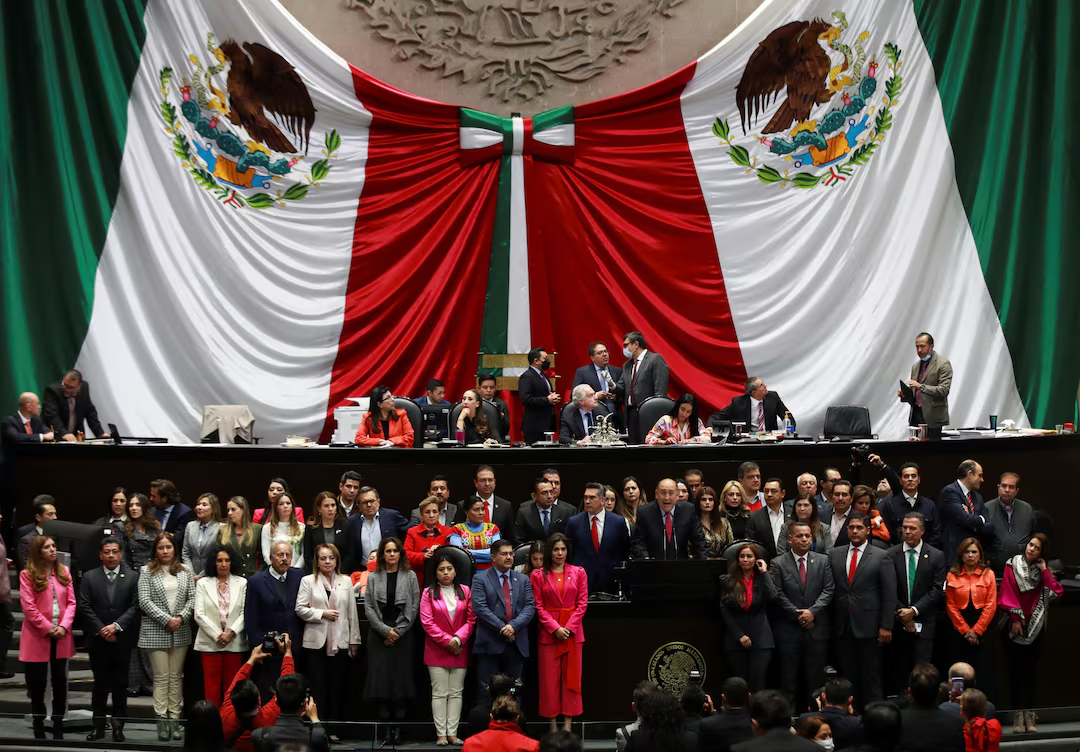
MEXICO CITY — Women now hold roughly half the seats in Mexico’s federal Congress, placing the country among the most gender-balanced national legislatures in the world.
According to the Inter-Parliamentary Union’s June 2026 ranking, women hold 252 of 500 seats in Mexico’s Chamber of Deputies, or 50.4 percent, and 65 of 128 seats in the Senate, or 50.8 percent. The IPU lists Mexico among the countries that have reached parity or elected more women than men in the lower or single chamber of parliament.
The milestone is not the result of political parties voluntarily making more room for women. It is the result of years of legal reform, electoral pressure and feminist organizing that eventually turned gender parity into a constitutional requirement.
In 2019, Mexico approved the reform widely known as “Paridad en Todo,” or “Parity in Everything.” The measure established gender parity as a constitutional principle not only for Congress, but across federal, state and municipal government, as well as autonomous public institutions and judicial bodies. Mexico’s National Women’s Institute described the reform at the time as a turning point for building a more representative, inclusive democracy.
The rule changed the mechanics of power. Political parties are required to nominate women and men equally for elected office, making parity part of the electoral system rather than a campaign promise. That legal framework has helped move Mexico from a country where women were historically underrepresented in politics to one where parity is now a basic expectation of democratic life.
The shift is also visible at the top of government. Claudia Sheinbaum became Mexico’s first woman president in 2024, joining other recent firsts that include women leading the Supreme Court and the Bank of Mexico. Reuters has noted that Mexico’s gains in women’s political representation now stand out internationally, even as the country continues to face deep challenges around gender-based violence and discrimination.
The broader lesson is straightforward: representation did not happen by accident. Mexico rewrote the rules so that women could no longer be treated as occasional participants in public life.
Parity does not solve every problem, and equal numbers do not automatically guarantee equal power. But Mexico’s Congress now reflects a democratic principle that many countries are still struggling to reach: women are not guests at the table. They are half the country, and the law now requires the political system to recognize that.
More Politics
- Puerto Morelos Mayor Denies Detention After Federal Search of Rented Home
- Mexico’s Federal Prosecutor Charges Former Chihuahua Attorney General With Treason Over CIA Role in Drug Lab Raid
- Quintana Roo Health Secretary Flavio Rosado Resigns to Seek Morena’s Isla Mujeres Candidacy
- Mexico Expects US Tariff Relief Despite Delayed USMCA Talks
- Poverty Fell 38% in Quintana Roo, Governor Mara Lezama Says