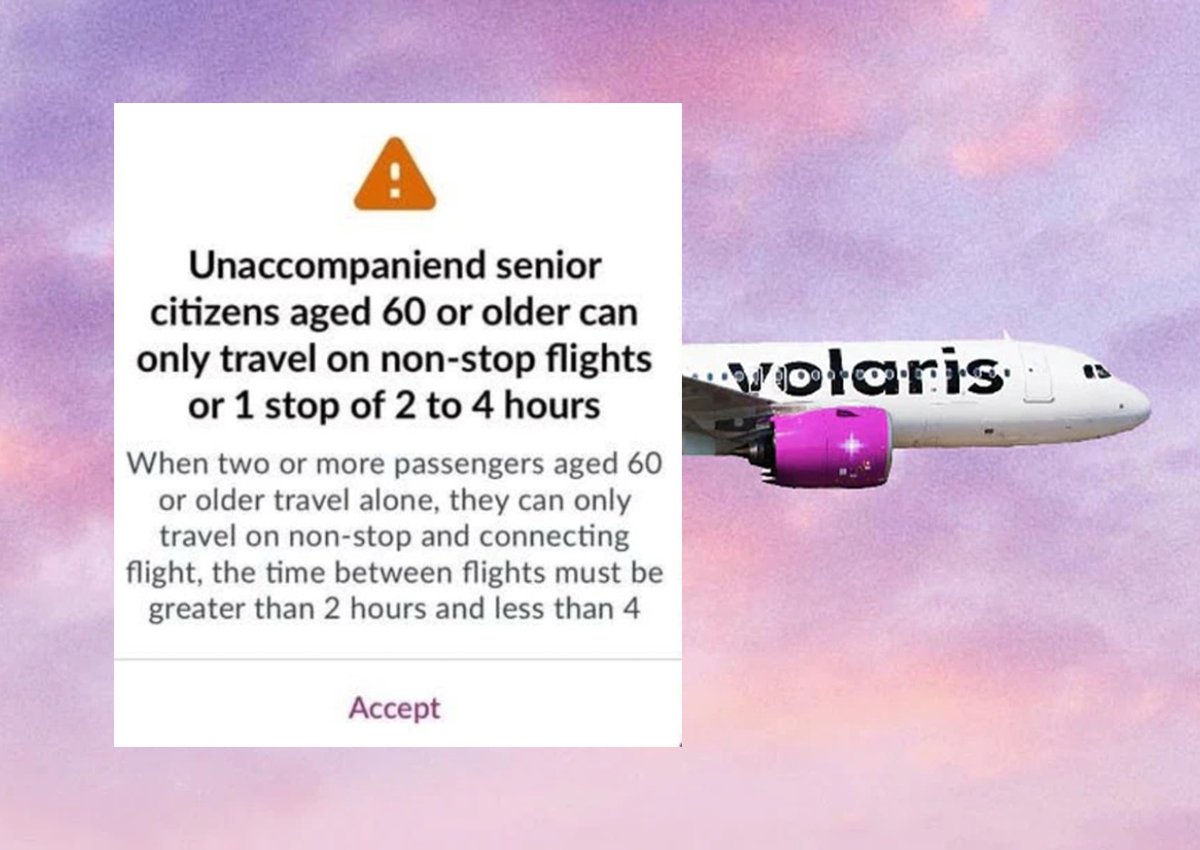
Mexico — A booking notice appearing during Volaris’ online checkout process has drawn attention from foreign residents, frequent flyers and older travelers in Mexico, after passengers reported seeing a warning limiting some unaccompanied travelers aged 60 or older to specific types of itineraries.
According to screenshots circulated in online travel and expat groups, the message states: “Unaccompanied senior citizens aged 60 or older can only travel on non-stop flights or 1 stop of 2 to 4 hours.” Several travelers say the notice appeared while using the Volaris website or app. Volaris has not issued a public explanation of the pop-up, and the restriction does not appear in the airline’s publicly available page for its senior assistance service.
The notice has raised questions because Mexican aviation rules do not appear to impose a general age-based restriction on healthy adults. Mexico’s Federal Civil Aviation Agency, AFAC, publishes guidance for passengers with disabilities and reduced mobility, focusing on accessibility, support services and the transport of mobility devices, but it does not list a rule requiring travelers over 60 to fly nonstop or limit connections to a specific layover window.
Volaris does offer a special assistance service for older passengers called Volaris te Acompaña, or Volaris Is With You. The service is intended for adults aged 60 and older who want help with airport check-in, boarding, the flight itself and arrival at their destination. On the Spanish version of Volaris’ website, the airline states clearly that the service is optional.
The English-language page describes the program as a service for passengers 60 and older who need assistance through the travel process, while Volaris’ broader special-services page says the program applies to unaccompanied elderly passengers who need support from the origin airport to the final destination.
That distinction matters. An optional assistance service is different from a booking restriction. The reported pop-up appears to go further, suggesting that unaccompanied passengers aged 60 or older may be limited to nonstop flights or single-connection itineraries with a layover of two to four hours. Volaris has not publicly clarified whether the message reflects a formal policy, an operational recommendation, a booking-system rule or a requirement tied only to passengers using the assistance program.
Mexico does use age 60 as the legal threshold for “adulto mayor,” or older adult. The federal Law on the Rights of Older Adults protects the rights of people aged 60 and over and emphasizes dignity, quality of life and non-discrimination. That classification is commonly used for benefits and assistance programs, including discounts through INAPAM, Mexico’s national institute for older adults. Aeroméxico, for example, uses age 60 for its INAPAM discount information.
But being classified as an older adult for benefits is not the same as being presumed unable to manage a normal flight itinerary. That is the part of the reported Volaris notice that has surprised travelers, especially foreign residents who routinely fly through Mexico City, Guadalajara, Monterrey, Tijuana and other hubs.
The logic may be operational. Volaris is a low-cost airline with a large network across Mexico, the United States, Central America and South America. Short connections can be stressful at large or congested airports, and missed connections create problems for both passengers and airlines. A two-to-four-hour layover window may reduce the risk of a missed flight, especially for passengers who have requested assistance.
Still, the age threshold has raised eyebrows. Many airlines offer older travelers optional help, priority services or discounts. Restrictions are more commonly associated with unaccompanied minors, passengers who require medical clearance or travelers whose condition prevents them from flying safely without support. Mexican passenger-rights guidance from Profeco notes that airlines must prioritize adults older than 60 in some situations, such as denied boarding due to oversales, but it does not describe age alone as a basis for limiting itinerary options.
For travelers who rely on Volaris, the practical issue is simple: the pop-up could mean fewer available itineraries or higher fares if the system blocks flights with short, long or multiple connections. That may be especially relevant for residents in smaller Mexican cities who often connect through Guadalajara, Mexico City, Monterrey or Tijuana.
Until Volaris explains the rule publicly, passengers aged 60 or older booking solo trips should check the itinerary carefully before paying, take screenshots of any warning that appears and contact the airline directly if the system limits flight options. The clearest point for now is that Volaris’ optional senior assistance service is real, but the reported connection restriction remains poorly explained.