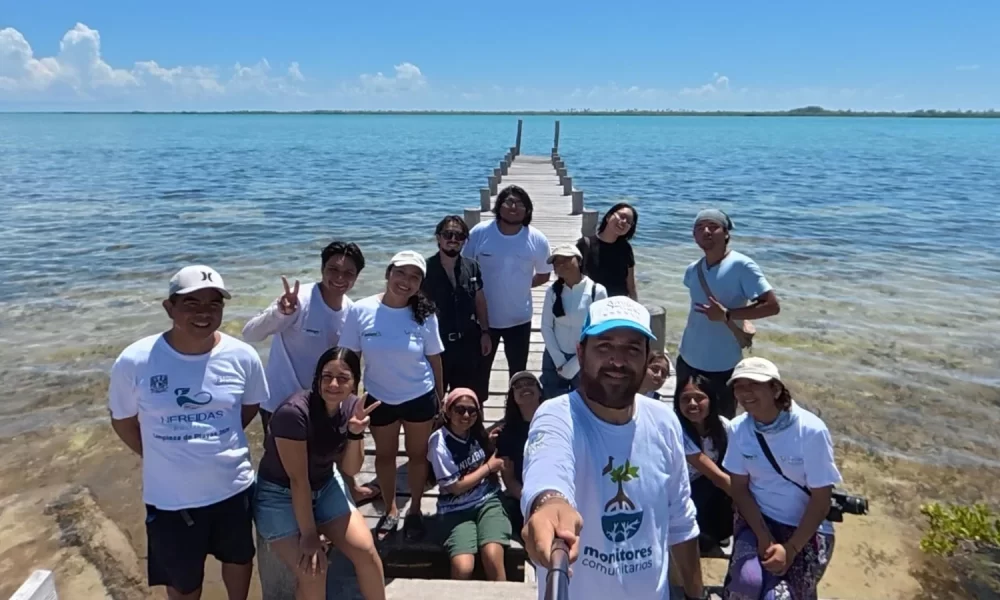
Cancún, Quintana Roo — Environmental engineering students at Universidad del Caribe have completed a full year of joint environmental monitoring with the Amigos de Sian Ka’an association at one of Mexico’s most valuable nature reserves, a UNESCO World Heritage Site since 1987.
The students, from the university’s Department of Basic Sciences and Engineering, marked five field trips to the reserve since May 2025, gathering data on biological diversity, carbon flows, and water volume and direction within the lagoon system they are studying.
El Playón Was the Study Site
The most recent fieldwork took place at El Playón, about three kilometers from the community of Javier Rojo Gómez in Punta Allen. The team worked over four days, from August 29 to September 1.
El Playón is a mangrove restoration site that has suffered severe degradation since 1982, when the construction of a dirt road interrupted the natural flow of water and damaged more than 500 hectares. Restoration efforts have been underway since then to reopen water channels, and the current work is aimed at tracking the site’s reforestation and coastal hydrology.
Three Teams, Three Lines of Research
Researchers, interns and fellow students split into three teams, dividing the work of assessing how mangroves are recovering and storing carbon, how water moves through the system, and which animal species are returning.
The mangrove team collected leaf litter from representative areas, recorded physicochemical data and flood levels, and observed the growth rate of propagules in areas reforested by the community. On the final day, the team extracted sediment cores to be analyzed in Universidad del Caribe’s laboratory.
The coastal hydraulics team spent the first three days measuring water flow and physicochemical parameters to understand the direction and volume of water moving through coastal lagoons, rivers and the sea in relation to the mangroves. On the last day, the team ran bathymetric profiles from the shoreline out to 100 meters, a technique used to describe the slope of the seabed.
The third team focused on wildlife. It conducted bird observations in the mornings and afternoons, carried out photo transects for marine fauna, and installed camera traps in the mangrove to determine whether species are returning to the restored areas.
Who Took Part
The effort relied on the participation and interest of Universidad del Caribe students and faculty.
Students involved were Luah Real Villareal, Emilio Alejandro Lombardo Cab, Emili Guadalupe Lara Hernández, Santiago Emilio Magdaleno Chávez, José Ernesto Maldonado Aguilar, Suemy Adriana Rodríguez Chi, Mariana Valencia Sánchez, Citlalli Montserrat Lara Reyes, Jenifer Guadalupe López Pérez, David Adolfo Poot Bojórquez and Kiara Villegas Barriento.
They were joined by faculty members Jennifer Méndez Torrez and Juan Francisco Bárcenas Graniel, and by Alonso A. Serna Medina and Israel E. Ortiz Ponce of Amigos de Sian Ka’an A.C.
More Environment
- Laura Beristain Returns to Politics With Environmental Banner in Playa del Carmen
- Wind Farm Project in Southern Quintana Roo Moves Forward
- Witness Alleges Sea Turtle Eggs and Hatchlings Taken From Nests at Cozumel’s Chen Río
- PROFEPA Inspectors Denied Access to Jaguar at Cancún’s Pepe Tigre
- Playa del Carmen Announces New Alameda-Style Park With Zipline and Amphitheater
More Tulum
- Culture Ministry Plans Return of Papantla Flyers to Tulum
- Human Remains Found Near Ka’an Lu’um Lagoon in Tulum
- Tulum Vacation Rentals Push Tourists Into Irregular Zones, Hotel Leader Warns
- Tulum Adds Artisan Market and Caribbean Culture Festival to Its Tourism Lineup
- Culture Ministry to Inspect Ceremonial Pole Ahead of Voladores de Papantla Return to Tulum