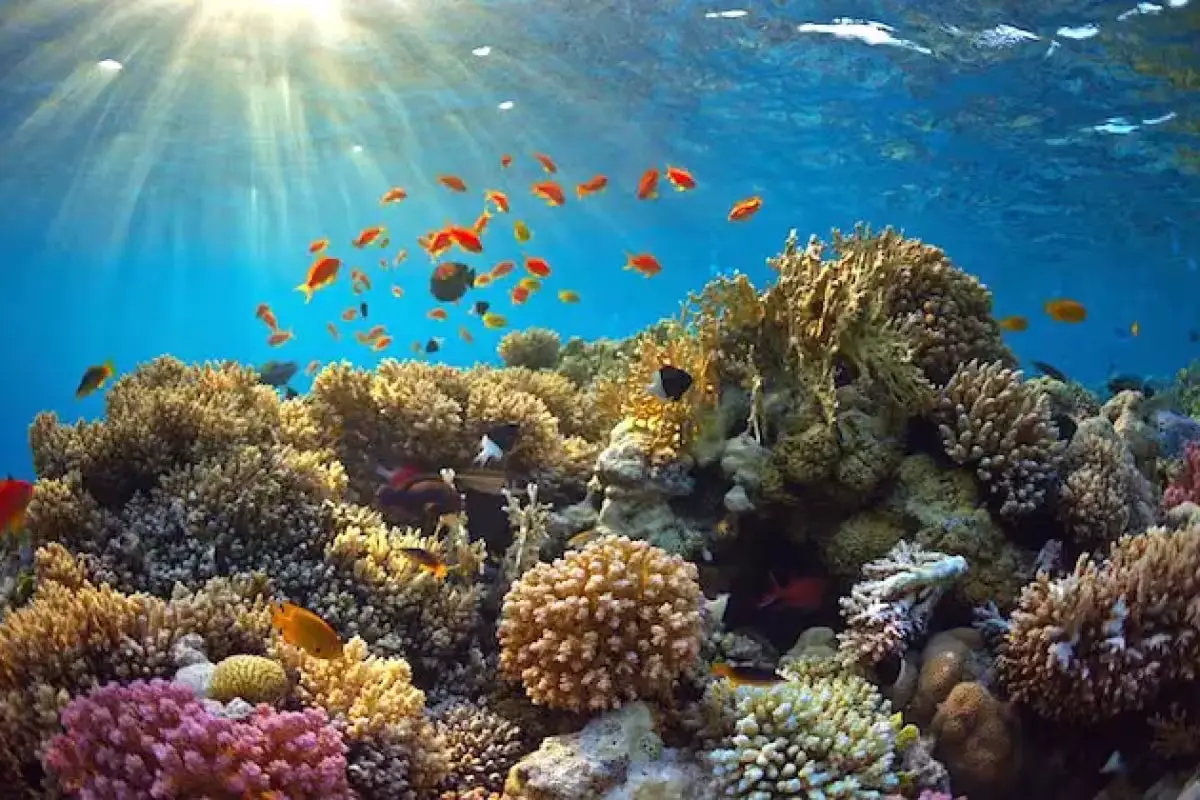
Mérida, Yucatán — A new study from the National Autonomous University of Mexico (UNAM) warns that Alacranes Reef, the largest coral reef in the Gulf of Mexico and the only one described in the state of Yucatán, is being protected with outdated data, leaving most of its ecologically critical areas exposed to degradation.
Published in the journal Regional Environmental Change, the research was led by scientists from the UNAM Yucatán campus: Joaquín Rodrigo Garza-Pérez, Ángela Randazzo-Eisemann, Erick Barrera-Falcón, and Rodolfo Rioja-Nieto. The team conducted the most comprehensive assessment of the reef in decades, surveying 111 sites across the 340-square-kilometer platform. They performed fish censuses, benthic video transects, and analyzed high-resolution satellite imagery from RapidEye and Landsat to compare reef conditions between 2000 and 2017.
The Reef Health Index (RHI) for Alacranes stands at 3.3 out of 5, classified as “fair.” More concerning, over 59% of the platform showed documented deterioration between 2000 and 2017, with loss of live coral cover and proliferation of macroalgae — clear signs of ecological stress. In 2018, the Healthy Reefs initiative had already reported that live coral cover in the park was only 11.2%.
The study’s most striking finding emerged when researchers overlayed the park’s current zoning map with a map of high-priority ecological habitats they built from 2022 data. The result: a significant mismatch. Only 12.07% of the reef — about 4,130 hectares — qualifies as high-priority habitat due to structural complexity, connectivity, and species diversity. Yet the existing protection zones do not adequately cover these hotspots.
The researchers identified three critical areas that urgently need full protection:
- Central corridor of reticular coral patches
- Southern area of Isla Desterrada
- Southeast leeward-crest-front zone of the reef
These zones harbor 30 coral species and 116 fish species, including colonies of Acropora cervicornis (staghorn coral) and Acropora prolifera, primary reef builders in the Caribbean. Acropora cervicornis is listed as Critically Endangered on the IUCN Red List and included in CITES Appendix II.
The UNAM team is calling for a paradigm shift in park management: adaptive management based on scientific evidence. This includes updating protection boundaries with current data, continuous satellite monitoring, and enhanced surveillance using technology, community participation, and institutional presence. More than 200 marine protected areas worldwide have updated their zoning in the last 20 years using spatial prioritization methods. Alacranes, the study argues, is long overdue for its turn.
More Environment
- Yucatán Suspends Classes in 27 Municipalities as Tropical Storm Isaías Nears
- Sheinbaum Acknowledges Little Progress in Talks With Vulcan Over Calica
- Quintana Roo Plans 4.4 Billion Peso Wind Farm in Othón P. Blanco
- Tulum Ranks Second as Mexico Claims Six Spots on Best Beaches List
- University of the Caribbean Unveils Crocodile Coexistence Manual in Cancún