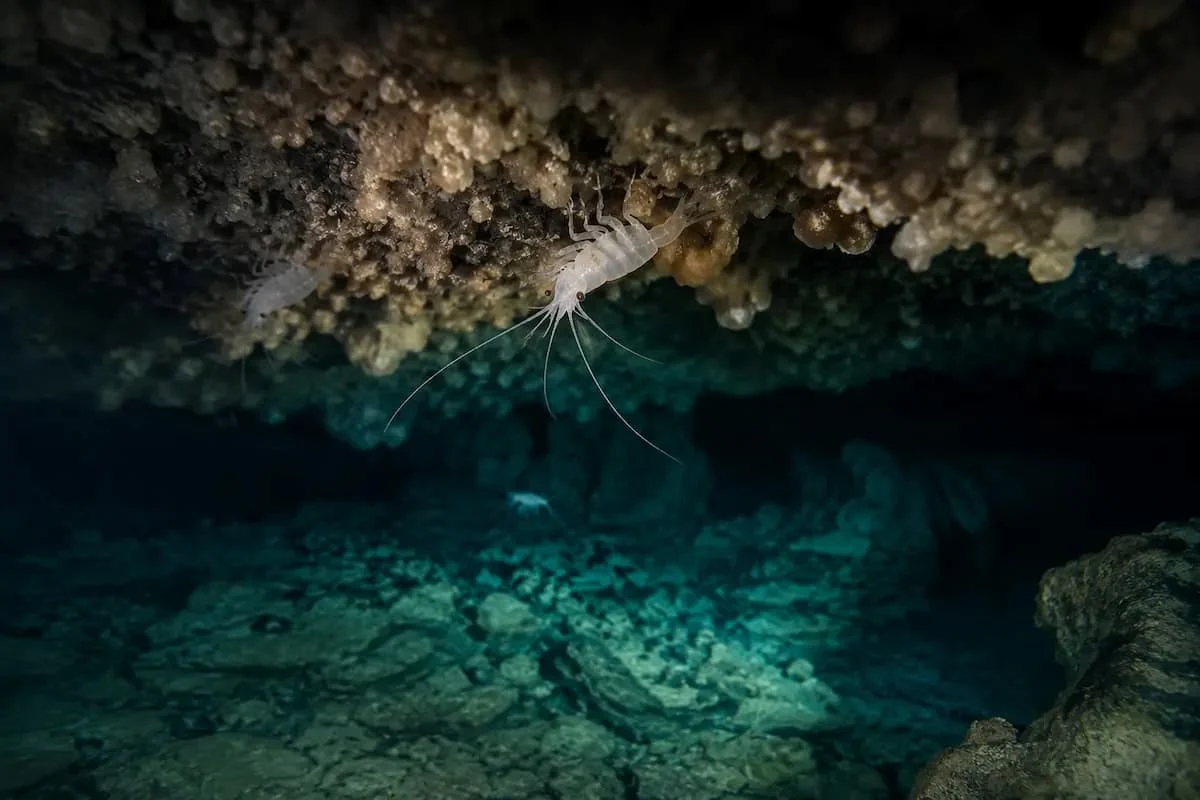
Mérida, Yucatán — Tiny white shrimp, barely noticed by visitors to Yucatan’s cenotes, play an essential role in sustaining life in the region’s flooded underground caves, according to a new study.
The crustaceans, belonging to the genus Typhlatya, form the base of the food chain for numerous species inhabiting the peninsula’s subterranean aquatic systems. Fernando Álvarez Noguera, a researcher at UNAM’s Institute of Biology who has spent over a decade studying these environments, highlighted their importance.
According to the specialist, the survival of much of the cave fauna depends on these shrimp, as they convert bacterial growth into animal biomass that later serves as food for other organisms. The food chain in these ecosystems is largely sustained by their presence, he said.
The shrimp feed through a process that occurs within the caves. Plant debris from the jungle seeps through the limestone rock after decomposing, while small amounts of methane in the subsurface are used by bacteria to produce energy. This mechanism, known as chemosynthesis, generates organic matter without sunlight.
The shrimp exploit this food source. Using specialized structures, they ascend to the ceilings of flooded caverns to scrape and consume the bacterial mats that form on those surfaces.
To deepen understanding of these species, Álvarez Noguera and graduate student Brenda Durán conducted a two-year study in the Ring of Cenotes and the Caribbean Cave Zone. The work examined three of the four species recorded in those protected natural areas.
The results showed that each species uses different resources for feeding, reducing competition among them. Typhlatya mitchelli feeds on decomposing vegetation and nitrifying bacteria in shallow areas, while Typhlatya dzilamensis obtains organic matter in deeper zones near the mixing of fresh and saltwater. Typhlatya pearsei specializes in consuming bacterial biomass located near cave ceilings.
Beyond their ecological importance, these organisms stand out for their evolutionary antiquity. They belong to a lineage that has existed for about 250 million years and is currently distributed in different regions of the world, including the Caribbean, the Mediterranean, Madagascar, Australia, Ascension Island, and the Galapagos.
However, conservation of these species faces growing challenges. Urbanization in the Yucatan Peninsula, along with pollution and deforestation, threatens cenotes and the delicate biological balance they harbor. Researchers emphasize the need to protect these ecosystems to preserve the diversity of organisms that depend on them.
More Environment
- Mexican Army Nears Completion of 16-Kilometer Jungle Road Over Tulum’s Sac Actún Cave System
- Akumal Halts Turtle Swim Tours Through September
- Mexico Assigns $110 Million Navy Budget to Fight Sargassum in Quintana Roo
- Mérida Opens First Green Corridor to Fight Climate Change
- El Niño Keeps Atlantic Hurricane-Free, Setting Record for Latest First Storm in Decades