
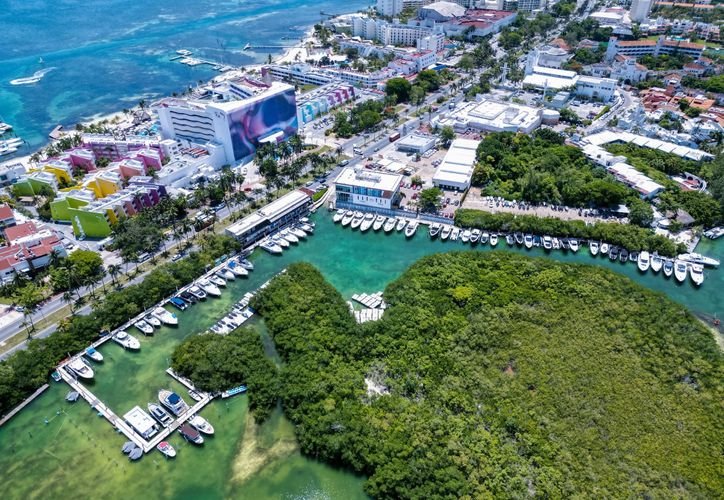
Cancún, Quintana Roo — Mexico’s Environment and Natural Resources Department (Semarnat) has approved Quattro Marina, a floating dock with offices planned at kilometer 3.3 of Bulevar Kukulcán, beside Marina Kaybal in Cancún’s hotel zone. The developer behind the project is Marina Isla Cancún.
The development will occupy less than 1,000 square meters of federal land next to the water. On shore, the company plans two buildings — a ground floor and three upper levels — that will house offices, a warehouse, restrooms and parking spaces for employees and visitors. On the lagoon itself, crews will assemble a modular dock for tour yachts and jet skis, with room for roughly 100 berths when boats and personal watercraft are counted together.
Investment Figure Kept Confidential
The company marked the investment amount in its environmental filing as confidential, so no public figure exists for what the project will cost. What the filing does specify is the timeline: five years to prepare the site and build, and a useful life of nearly a century if the facility is maintained. The company still needs a federal maritime land concession before crews drive the first piling.
Environmental Concerns Remain Unresolved
The environmental study states that the site is already disturbed and that the mangrove along the shoreline falls outside the project boundary, which will be covered by a monitoring program. Environmentalists have argued that every new dock in Nichupté adds pressure to a water body already crowded with berths and fixed structures. The impact authorization does not settle that debate; it only allows the company to continue the process of operating nautical tourism in one of the most heavily used lagoons in the Mexican Caribbean.
Quattro Marina sits on a short stretch of the boulevard that already mixes hotels, restaurants and other docking facilities. The filing itself acknowledges that the developers chose the location precisely for that commercial proximity and for quick access to the Caribbean. In practice, that means more engines, more moorings and more boat traffic in a lagoon system that also absorbs the Nichupté Bridge and recurring complaints about pilings and landfill.
Before opening to the public, the company must still secure the federal land title and nautical permits from the harbor master’s office. Without those documents, the environmental ruling alone is not enough.
More Development
- Puerto Morelos Completes $10.4 Million Peso Rebuild of Fishing Pier
- Quintana Roo Real Estate Market Matures Behind $1 Billion in Investment
- Mexico’s Supreme Court Denies Calica Amparo, Upholds Navy’s Coast Guard Role
- Constituyentes Residents Demand Electricity and Drinking Water in Lázaro Cárdenas
- Photograph Exposes Damage to Cave and Karst Aquifer in Mexico’s Caribbean
More Cancun
- Cancún’s Benito Juárez Recycling Drive Recovers 6.8 Tons of Waste
- Only 1% of Mexicans in Quintana Roo Leave a Will, Leaving 99% of Families in Inheritance Court
- Human Remains Found in Abandoned Vehicle in Cancún’s Tres Reyes Neighborhood
- Cuban Man Charged in Knife Attack on Cancún Hotel Worker
- Cancún Hotel Group Develops Own Technology to Tackle Sargassum