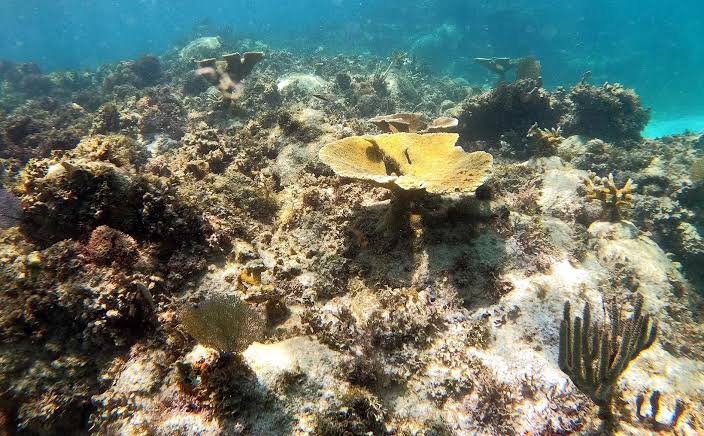
Chetumal, Quintana Roo — A coral reef is far more than turquoise water and brightly colored corals. Beneath the surface lies a complex web of organisms that sustains much of marine life — and that web now faces accumulating threats from sargassum, pollution, coastal development and climate change, according to marine ecology specialist Nancy Cabanillas Terán, a researcher at ECOSUR Chetumal.
Speaking in a talk titled “Beyond the Corals: Stories from the Bottom of the Reef,” presented with the Quintana Roo Council for Humanities, Science and Technology (COQHCYT), Cabanillas Terán and her students Isabella Pérez Posada, Victoria Hernández Zaltrón and Leonardo Rojas López explained that reefs are structures built over hundreds or thousands of years by organisms that deposit calcium carbonate. Corals are the main builders, but a vast diversity of species lives around them and keeps the ecosystem functioning.
The researcher noted that roughly a quarter of marine life is linked in some way to coral reefs, which also underpin fishing and tourism and protect coastlines. At the same time, she warned, reefs are among the most threatened ecosystems and have been for decades.
Sargassum: A Natural Alga That Becomes a Problem
One issue that has drawn the most attention in recent years is sargassum. Cabanillas explained that these floating algae are part of a natural open-ocean ecosystem and provide refuge for various species. The trouble begins when they arrive en masse at the coast, pile up and decompose.
During decomposition, the seaweed produces leachate and alters the water’s physical and chemical conditions, reducing oxygen, raising nutrient levels and disrupting ecosystems normally characterized by nutrient-poor, highly transparent water. The consequences can extend to mass die-offs of marine organisms and shifts in the reef’s ecological relationships.
The specialist recalled that large sargassum strandings became a recurring problem for the Mexican Caribbean starting in the middle of the past decade, and that although the water can temporarily regain its turquoise appearance after a stranding, the effects on the ecosystem can linger.
Sargassum is not the only pressure. Victoria Hernández Zaltrón, a master’s student in Natural Resources and Rural Development, said reefs were already dealing with problems caused by urban and tourism pressure on the coast, pollution, stormwater discharges, excess nutrients and climate change. The loss of corals, in turn, means a loss of structure for the reef and harms the species that depend on them, producing a chain of impacts in which different threats accumulate.
Looking Beyond the Corals
The researchers are also studying lesser-known organisms that are essential to understanding what happens underwater. Leonardo Rojas López works on brittle stars, relatives of starfish and sea urchins, which help recycle matter and energy within the food chain.
Isabella Pérez Posada, a doctoral student in Ecology and Sustainable Development, studies polychaetes, known as marine worms. Although many are microscopic or stay hidden among algae, rocks, sediment and dead coral, they play important roles as consumers and prey for other species and can reflect changes in their environment.
Hernández Zaltrón, for her part, researches sea urchins. She has identified about six species in the Caribbean and noted that these organisms also offer insight into how reefs function and how they are being altered.
Determining whether a reef is in good condition requires more than observing corals, Cabanillas said. Scientists carry out various monitoring efforts to measure live coral cover, diseases present, associated species and the physiological condition of organisms, as well as analyzing their interactions and ecological niches.
She stressed that this perspective must extend beyond the reef itself. In the Yucatan Peninsula, ecosystems are connected physically, hydrologically, biogeochemically and ecologically. Jungle, lagoons, mangroves, dunes, reef lagoons and reefs form part of a single system, meaning changes inland can ultimately affect the sea.
Against that backdrop, the specialists called for better knowledge of Quintana Roo’s ecosystems as a step toward conserving them. Cabanillas Terán argued that scientific curiosity should begin at an early age and that learning about barely visible species — brittle stars, sea urchins and marine worms — shows that the reef depends on far more than its corals.
She added that marine ecosystems also provide essential services to communities, from coastal protection to the conditions that make much of the Mexican Caribbean’s tourism appeal possible. Conservation, she concluded, depends on recognizing that protecting the reef also means protecting its surroundings and the generations that depend on it.
More Environment
- Dolphin Swims Continue in Puerto Aventuras as Cancún Dolphin Debate Simmers
- Punta Allen Lobster Fishermen Report 40 Tons Three Months Into Season
- Mahahual Hosts Nearly 100 Birdwatchers for 12th Regional Pajareada
- Calica Mine Lands to Become Ecological Restoration Zone, Conanp Says
- Bull Shark Diving Hits Carrying Capacity in Playa del Carmen
More Quintana Roo
- Cancún Loses 20 Restaurants So Far This Year, Industry Group Says
- Vacation Rentals Outpace Hotels in Quintana Roo Occupancy
- Tropical Wave 36 Floods Northern Quintana Roo, Hits Tourism
- Yucatán Peninsula Lost 285,580 Hectares of Jungle in 4 Years
- Yucatán Monitors Low-Pressure System in Gulf of Mexico for Possible Cyclone