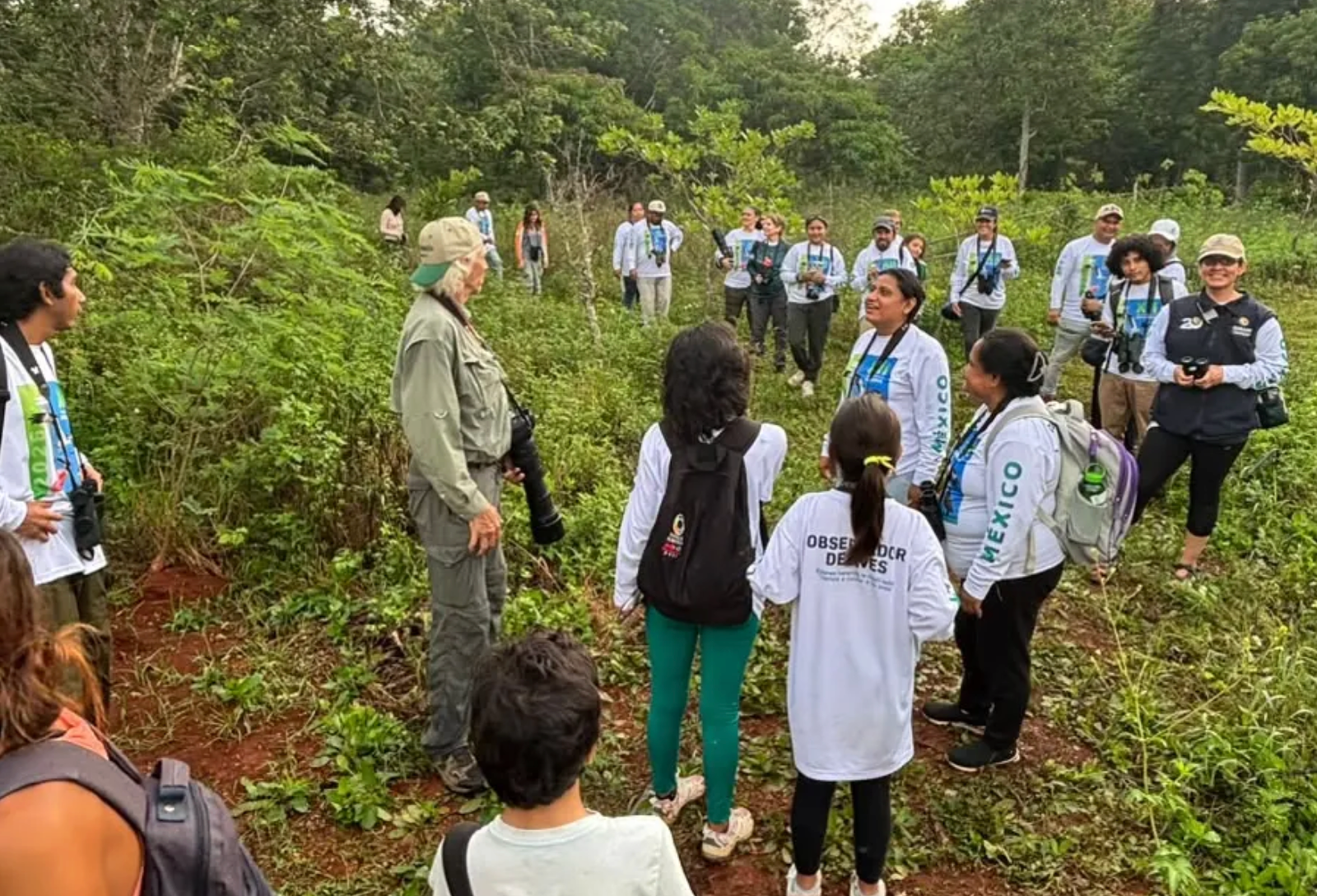
Mahahual, Quintana Roo — Close to 100 birdwatching enthusiasts from across Quintana Roo, the Yucatan Peninsula and other Mexican states gathered in Mahahual this weekend for the 12th Regional Pajareada, an event aimed at promoting conservation, nature tourism and citizen science.
The two-day gathering was organized by Proyecto AAk Mahahual A.C., led by Víctor Rosales, with support from Conabio, Mexico’s National Commission for the Knowledge and Use of Biodiversity. Activities included guided birdwatching, lectures and social events centered on the region’s bird diversity and the ecosystems of the Mexican Caribbean.
Urban Birds Program Takes Center Stage
One of the main topics was the work of the Urban Birds Program (PAU), a participatory science initiative active in 190 localities across all 32 Mexican states. Local leaders run activities that introduce residents to birds and their surroundings.
Tatiana Sánchez, who coordinates the PAU at NABCI-Conabio, said the program seeks to build a direct connection between people and nature, even in places where urbanization appears to have pushed biodiversity aside.
“The Urban Birds Program seeks to blur the border we draw between urban areas and nature. In any ecosystem where you think there is absolutely nothing, you are going to get big surprises,” she said.
Sánchez noted that Mexico is a megadiverse country and that birds can be found in virtually any environment, making it one of the program’s tasks to teach the public to observe more carefully.
“Observing means looking carefully, and we need time, patience and determination to find the great diversity that exists,” she said.
She said a key goal of the pajareadas and the PAU’s work is to change the perception that cities are spaces without nature. Even in areas with noise, traffic and human activity, she said, species can be found that go unnoticed if no one makes the effort to look for them.
The coordinator also stressed the importance of generating knowledge as a starting point for conservation. When people recognize the species living in their community, she said, they gain better tools to get involved in protecting them.
“We don’t protect what we don’t know. When we realize we can do something, we can demand that authorities do something, we can protect, we can make decisions,” she said.
Sánchez called on people to pay attention to everyday spaces and household practices, noting that even small areas can help create favorable conditions for birds and other species. Understanding biodiversity can begin at home, she said, by identifying the trees, plants and other natural features nearby and avoiding practices that, while they may seem positive, end up interfering with wildlife.
Rescue, Mental Health and Local Ecosystems
The event also addressed the responsible handling of wild fauna. Veterinarian Yuliana Xochimitl, of the company Vetling, gave a presentation titled “Am I rescuing, or interfering with the bird’s learning?”, focused on the importance of understanding a species’ behavior before intervening.
Another session explored the link between birdwatching and personal wellbeing. Germán Borges and Carolina Can, of Pajareando Cozumel, delivered a talk titled “Birdwatching: contemplate and connect — bird observation as a tool for mental health.”
Participants toured parts of Mahahual’s ecosystems, where mangroves, dunes, coastal vegetation and other environments serve as shelter and feeding grounds for different species.
Beyond its environmental component, the pajareada offered an opportunity to strengthen nature tourism by linking birdwatching with local cuisine, the community and Mahahual’s natural attractions. Organizers said the event brought together both experienced observers and newcomers, showing that birdwatching can serve as a tool for learning about a territory and encouraging greater responsibility for its conservation.
The 12th Regional Pajareada closed with nearly 100 participants and a call to keep observing, documenting and learning about biodiversity, under a premise raised during the meeting: to conserve an ecosystem, one must first recognize and value the species that live in it.
More Environment
- Why Quintana Roo’s Sewer Gap Is Polluting Cenotes and Coasts
- Hotels in Cancún and Puerto Morelos Restore Coastal Dunes With Native Plants
- Dolphin Swims Continue in Puerto Aventuras as Cancún Dolphin Debate Simmers
- Punta Allen Lobster Fishermen Report 40 Tons Three Months Into Season
- Scientists Warn Sargassum and Pollution Threaten Quintana Roo’s Coral Reefs