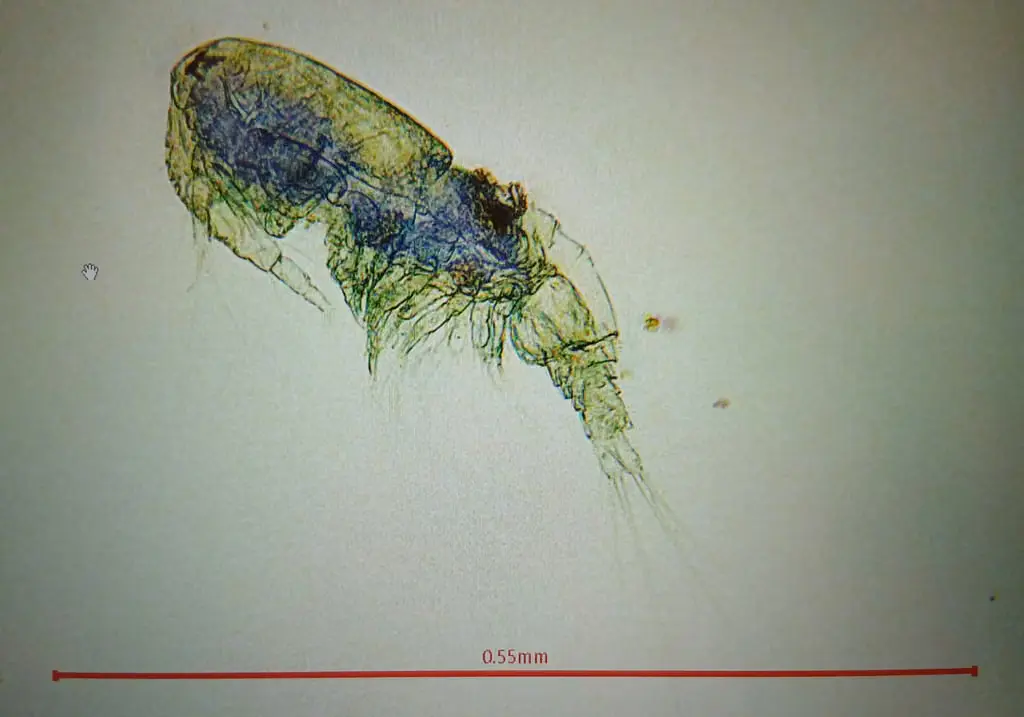
Chemax, Yucatán — Researchers from UQRoo, Cozumel campus, and Ecosur have identified a new genus and species of subterranean copepod in a pool 40 centimeters deep inside the Ko'op Chen cave in Chemax, Yucatán. The crustacean measures less than 0.35 millimeters and was named Aktuncyclops chechmilensis. Its description was published in the international journal Journal of Natural History.
Sampling and Identification
The study is authored by Adrián Cervantes Martínez, Martha Gutiérrez Aguirre and Sarahi Jaime of UQRoo, Cozumel campus, together with Eduardo Suárez Morales of Ecosur. They carried out two sampling outings on January 18 and April 11 of this year near the community of Chechmil, where they obtained nine adult males and one adult female.
The species is a freshwater copepod that lives only underground. To complete its description, the researchers used optical and electron microscopy. They observed that its swimming legs were reduced to two segments, that the fifth pair was fused to the body, and that the spines at the end are curved like claws to grip the bottom.
These details distinguished it from similar genera, such as Bryocyclops, Rybocyclops and Haplocyclops, by the number of segments of its antennae — 14 in males and 11 in females — by the shape of the anal operculum and by three setae on the palp of the jaw, according to the researchers.
Coexisting Organisms and Microendemism
In the same pool, the new species coexists with other small organisms, such as cladocerans of the genus Coronatella, a copepod known as Mastigodiaptomus dorsalis and crustaceans that are still unnamed, for which research will continue.
So far, it has only been recorded in that one cave. The authors consider it a case of microendemism, which makes it more vulnerable to any changes in its environment. They point out that the peninsula's protected natural areas do not cover all subterranean habitats and that the cave systems of the southeast face pressure from tourism development, water extraction, land-use changes and pollution. Therefore, they call for strict conservation strategies to avoid losing fauna that is not even cataloged.
Exploration and Specimen Deposition
The exploration was carried out with speleologists from the Mayab Speleological Circle and with the landowners, members of the Mayan community of Chechmil, while the reference specimens remained in the Zooplankton Collection of Ecosur, in Chetumal.
More Lifestyle
- Free Folk Dance Final in Isla Mujeres: What to Know
- Playa del Carmen Unveils 16 Days of Events Against Gender Violence
- Playa del Carmen Theater Draws Thousands for ‘Conversando con el Diablo’
- Sheinbaum Calls China Trip a Success, Signs Cooperation Deals
- Cold Front 6 and Low-Pressure Channel to Bring Rain and Showers to Quintana Roo on November 19