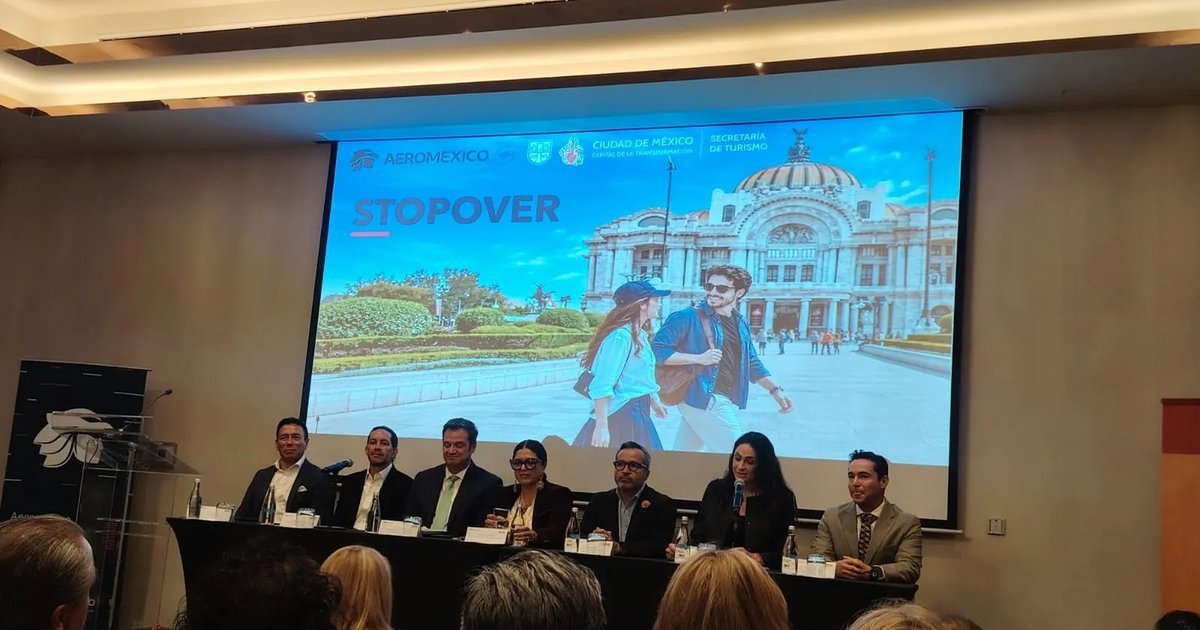
Cancún, Quintana Roo — Cancún officials celebrated the launch of the Stopover program, an alliance between Mexico City’s Tourism Ministry and Aeroméxico that allows passengers to visit both destinations on a single ticket, as the resort city works to attract more long-haul international travelers and cement its role as the main gateway to the Mexican Caribbean.
Juan Pablo de Zulueta Razo, Benito Juárez’s municipal tourism secretary, said the strategy represents a key opportunity to increase arrivals from long-haul markets such as Europe, whose travelers often connect through Mexico City on their way to Quintana Roo.
He said the initiative will let people travel and enjoy two destinations in one trip, turning a layover from a quick transit stop into an extended stay that draws more tourists to both Cancún and Mexico City.
Presented by Mexico City Tourism Secretary Alejandra Frausto Guerrero and José Zapata, Aeroméxico’s vice president of sales for North America and Latin America, the program allows passengers with layovers at Mexico City International Airport or Felipe Ángeles International Airport to stay between 24 hours and seven days in the capital before continuing to their final destination — on the outbound leg, the return leg, or both.
As an example, officials said a traveler flying from Paris to Cancún could collect their luggage, enjoy up to a week of the capital’s cultural and culinary offerings and then fly on to the Mexican Caribbean on the same itinerary. The program is set to expand in 2027, when Aeroméxico opens 10 new routes from the capital — nine of them international, including cities such as Milan, Portland and Fort Lauderdale — bringing its network to 110 connected destinations.
Cancún touts air connectivity and hotel growth
De Zulueta said Cancún maintains direct connections to 134 cities worldwide and continues to expand its air service to the United States and Canada, alongside new routes in the state such as the upcoming direct flight between Milan and Cozumel.
The official said the destination expects to close the year with hotel occupancy rising from 76% to 82%, supported by infrastructure projects including the Nichupté vehicular bridge — more than 11 kilometers long in total — the upcoming Hotel Zone interchange and a modernization of public transport with air-conditioned, connected buses that cut travel times for tourism workers by up to an hour.
He also highlighted private-sector confidence reflected in the opening and renovation of large-scale luxury complexes such as Hyatt Zilara, Palace Resorts, Oasis, Paradisus and The St. Regis.
Beyond sun and sand, De Zulueta said, Cancún is diversifying its offerings through regional connectivity via the Maya Train, the Michelin Guide recognition of three restaurants — including El Kiosco Verde — romance tourism and a busy year-end calendar led by the marathon on December 5 and the Expo Turismo Health & Wellness on December 3.
Mexico City aims to convert transit passengers into visitors
Mexico City, for its part, is looking to use the program to turn millions of transit travelers into actual visitors, strengthening a sector that currently contributes 10% of the capital’s GDP, generates more than 800,000 jobs and accounts for more than 18% of Mexico’s national tourism GDP.
Through the strategy — which builds on joint work with hotels, restaurants and service providers to encourage stays of up to seven nights — capital authorities aim to consolidate the 4.9% growth in air arrivals recorded between January and September 2026 and reach a goal of closing the year with about 65.9 million visitors.
That target is backed by a robust offering of 3,000 daily activities, 65,000 restaurants, nearly 80 Michelin Guide distinctions and a 68% jump in spending with international cards.
More Tourism
- Quintana Roo Tourism Chief Warns of Flight Shortages Into 2027 as Hotel Occupancy Climbs
- Playa del Carmen Sees Surge in Street Vendors as Hotel Occupancy Falls
- Tulum Business Group Demands End to Arbitrary Towing and Extortion
- Tulum to Host Inaugural ‘Raíces de Sol’ Race in 2027
- Playa del Carmen to Promote Community Tourism at Travel Fairs
More Cancun
- Aguakan Completes New Sewer Main on Huayacán Avenue, Benefiting Over 19,000 Cancún Residents
- Mexican Judge Orders Trial for Man Accused of Selling Vapes in Cancún
- Mexican Federal Forces Arrest Alleged Drug Cartel Leader in Cancún
- Cancún’s ‘Día del Pueblo’ Program Serves 150,000 Residents in 2026
- Cancún’s Sigfrido Channel to Close Three Days for Removal of Nine Abandoned Boats