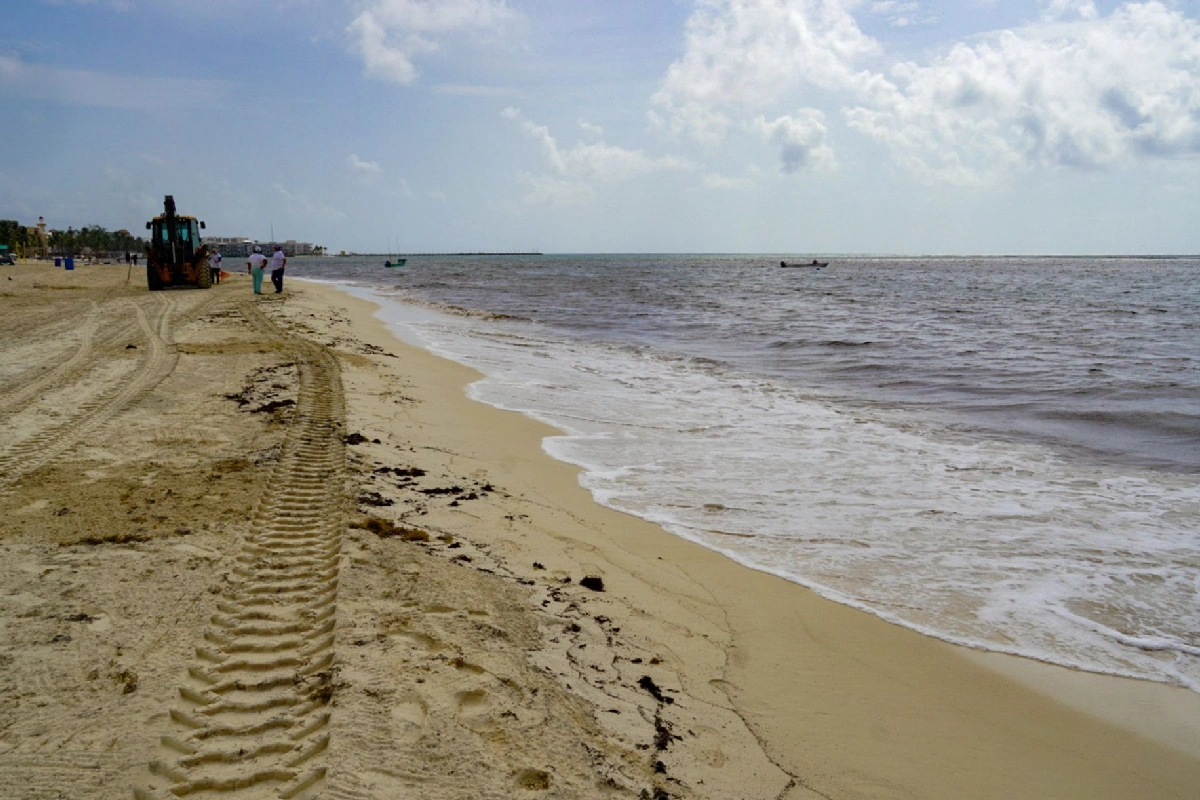
Cancún, Quintana Roo — Sargassum is receding across much of Quintana Roo’s northern coast, with 75% of monitored beaches now reporting low algae levels, while the Mexican Navy reports its largest sargassum collection on record this year.
The latest survey from the Kinich Ka’an Ojo del Cielo Caribbean Sea Environmental Monitoring and Climate Change Network shows that of 100 beaches monitored between Tulum and Isla Mujeres, 75 have low sargassum presence, three are clear, 17 have moderate amounts and only two — Punta Molas and Playa Xhanan on Cozumel — have excessive accumulations. Playa del Carmen and Tulum are among the beaches already seeing conditions improve.
Seaweed landings began to drop in mid-August, the network said, and are expected to decline further through September and October before reaching their seasonal low in November and December.
In the state’s south, the situation remains more difficult. Of 40 monitored beach zones, 16 still have abundant sargassum and 10 are excessive. The hardest-hit areas include Xcalak, Playa Sonrisa and Canal de Zaragoza, while Banco Chinchorro has no sargassum.
The Navy, which coordinates the sargassum response, said it has collected more than 123,400 tons of the algae so far in 2026, exceeding the 92,782 tons removed in all of 2025. Its fleet includes 11 coastal collection vessels with a capacity of about 20 tons each, an ocean-going sargassum-collection vessel, support boats and more than 13,000 containment barriers.
On land, the Navy has deployed 191 personnel as part of Emergency Beach Collection Groups (GREP) in municipalities with the heaviest seaweed influx and tourist activity.
The service said its preventive approach starts offshore, using satellite monitoring, barriers and specialized vessels to intercept sargassum before it reaches the coast. A new vessel, the Sargassum, is being prepared and will boost daily at-sea collection capacity from 627 to 1,227 tons, supporting the ocean-going vessel ARM Natans (BSO-01).
Authorities also plan to spend 2.6 billion pesos on two additional ocean-going sargassum ships, six semi-oceanic vessels, six tugboats, more than 1,500 meters of dynamic barriers and 35 kilometers of containment barriers, as well as an early-warning system and a new dock at Puerto Juárez.
More Environment
- Activists File Complaints Over Heavy Machinery on Cancún’s Playa Delfines Dune
- Semarnat Denies Permit for Beach Restoration Project in Puerto Morelos
- Cancún Hoteliers Push to Reactivate Beach Recovery Trust
- Experts Warn of Climate Crisis in Mexican Caribbean, Urge Urgent Action
- Scientists Say Sargassum Must Be Stopped in the Atlantic, Not on Cancún’s Beaches
More Quintana Roo
- Quintana Roo Human Rights Commission Closes 930 Complaints With Only 13 Recommendations
- Quintana Roo Grants Tax Breaks to Mototaxi Operators
- Quintana Roo Exports Plunge 75.1% in Second Quarter, Ranking Last Nationally
- Quintana Roo Builders Pin 2026 Hopes on Public Works
- Hells Angels Arrest in Cancún: Mexico’s Cartel Link?