
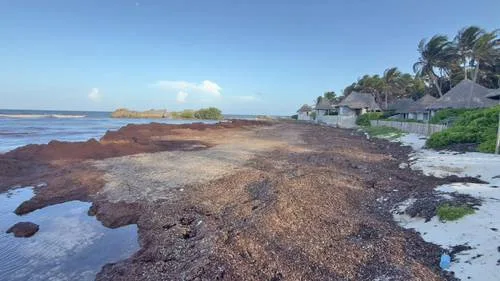
Tulum, Quintana Roo — The latest Sargassum Monitoring Network (RMS) traffic light map shows that 37 of the 40 monitored beaches in Quintana Roo have reached an “excessive” level of the algae, the highest category of infestation. Only one beach registered low levels and two remained free of sargassum, meaning 92.5% of the assessed coastline is now affected — one of the most severe seasons in the last decade.
The Mexican Navy reported that more than 39,500 tons of sargassum had been collected from Quintana Roo’s coasts by the end of May. Other official and state updates put the figure above 50,000 tons during June. Authorities estimate that by the end of 2026, up to 119,000 tons could be removed, far exceeding the roughly 96,000 tons collected in 2025.
Experts from the National Autonomous University of Mexico and the RMS warn that the problem stems from a large-scale oceanic phenomenon. Satellite images show a historic biomass floating in the tropical Atlantic, with currents and winds continuing to drive massive amounts toward the Mexican Caribbean. Municipalities such as Tulum, Mahahual, and the Costa Maya remain under the greatest pressure from the influx, forcing authorities to maintain permanent containment and cleanup operations.
The crisis has led tourism service providers in Puerto Aventuras to use their own boats to help clean up the macroalgae. Captains, sailors, and boat owners have begun manually removing sargassum to keep inlets navigable and reduce the impact on one of the Riviera Maya’s most important tourist areas. The initiative arose from the economic losses facing the sector, with operators reporting a decline in tourism activity and vacation rentals due to the sargassum.
In addition, fishing activity has decreased, environmental damage has occurred, and costs have risen for thousands of businesses that depend directly on the quality of the Caribbean beaches. While work continues to install anti-sargassum barriers, service providers decided to act with available resources to contain the algae and protect the destination’s image.
The problem comes at a critical time for Quintana Roo. According to tourism news outlet Reportur, the citizen-led effort joins institutional containment measures, which in other parts of the state include permanent collection operations to reduce the environmental and economic impact on the Mexican Caribbean coast.
Sargassum affects tourism competitiveness, disrupts marine ecosystems, increases public and private costs, harms health due to gases released during decomposition, and threatens the livelihoods of millions of people who depend directly or indirectly on the sea.
Experts have noted that while each country continues to respond with its own resources, the sargassum belt keeps moving freely for thousands of kilometers, driven by ocean currents. They suggest it may be time to rethink the strategy: just as specialized vessels exist to contain oil spills, an international alliance could develop a fleet of large ships dedicated to intercepting sargassum in the open sea before it reaches the coast. Combined with collection, compaction, satellite monitoring, and artificial intelligence systems, such vessels could remove millions of tons from the highest concentration areas. At the same time, they say, industries capable of converting sargassum into biofuels, fertilizers, bioplastics, construction materials, or paper should be promoted, turning part of an environmental crisis into an economic opportunity for the entire region.
More Environment
- Riviera Maya to Host Aquaponics Congress With Experts From More Than 10 Countries
- Isla Mujeres Seeks Volunteers to Rescue Blue Crabs on September 28 and 29
- Playa del Carmen Fire Calls Rise 4% on Carelessness and Uncontrolled Burns
- Cozumel Releases Nearly 7,000 Sea Turtle Hatchlings in 2026 Nesting Season
- Semarnat Rejects 954-Room Megahotel at Punta Maroma in Playa del Carmen
More Quintana Roo
- New Quintana Roo Press Group Leader Calls for Consensus Journalist Protection Law
- Vehicle Theft in Quintana Roo Falls 24% as Motorcycles Account for 77% of Cases
- UQRoo Cancún Union Workers Allege Rigged Election, Demand Full Rerun
- Quintana Roo Artisans Win Dedicated Law to Protect and Promote Their Craft
- Mundo Maya Nations Agree on Multi-Destination Tourism Route