
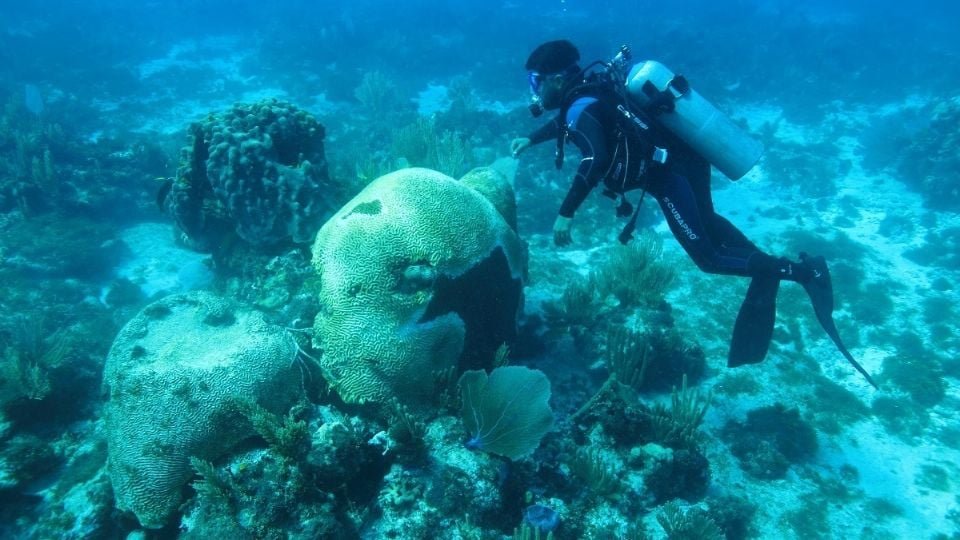
PUERTO MORELOS, Mexico — Experts from the National Autonomous University of Mexico (UNAM) have warned that without effective measures to contain sargassum at sea and reduce pollution, the environmental and touristic future of the Quintana Roo region could be compromised.
The accumulation of sargassum in reef areas causes significant damage to corals due to the excess Nitrogen and Phosphorus generated by its decomposition, creating impacts that will result in the loss of these ecosystems. According to Susana Enríquez Domínguez, a Doctor in Biological Sciences and researcher at the UNAM Reef Systems Academic Unit of the Institute of Marine Sciences and Limnology (ICMyL) in Puerto Morelos, solutions can be offered by collecting the material at sea before it reaches the coast.
Dr. Enríquez pointed out that in recent years, corals in Quintana Roo have been affected by various stressful situations causing damage. These factors, accumulating alongside issues related to global warming and increases in water temperature, are partly responsible for Coral Bleaching, White Syndrome in Corals, and the Detachment of Tissues.
One of the local problems, in addition to the generation of excess nutrients in the water derived from the extensive hotel proliferation in the northern zone, is the presence of sargassum on the coasts. This generates a large amount of Nitrogen and Phosphorus as a result of its composition and presence, blocking sunlight in some areas.
The situation worsens when this organic material is not removed from the reef areas, with the greatest importance given to areas that generate economic resources, while overlooking the spaces that create the interest for attracting the tourists who spend money, the engine of the tourism industry.
“If we were already in a bad situation because there was not enough and effective treatment of wastewater, now we have a problem with the arrival of sargassum that discharges a great many nutrients, accelerating the process of environmental deterioration of the marine grasslands and the coral reefs. With the impact of massive quantities, the impact is brutal,” she said.
The excess nitrogen and phosphorus threatens the health of the marine grasslands and reefs of Quintana Roo. An action to mitigate this damage is to prevent the sargassum from reaching the coast, at least to have control and reduce its impact on the coral reefs. However, a greater effort is needed to locate the area where this material, whose presence will be greater in the coming years, develops and which must be a site with many nutrients where it is generated.
Meanwhile, attention must be paid to this problem not only from an economic aspect, but also at the level of the source that generates this industry, whose future, according to the researcher, is bleak given the lack of concrete actions to improve the environment.
More Cozumel
- Cozumel Launches Rabies Vaccination Drive With 3,000 Free Doses for Pets
- Ultramar Ferry Collides With Xcaret Xailing Vessel at Cozumel’s Muelle Fiscal
- Marc Dubrick Dominates Ironman 70.3 Cozumel, Wins Wire-to-Wire
- Cozumel Opens Applications for 2027 Carnival Kings and Queens
- Tulum Tour Guides Pin Recovery Hopes on Cruise Ships and Year-End Holidays
More Puerto Morelos
- Puerto Morelos Approves Funds to Protect Beaches and Strengthen Sargassum Response
- Puerto Morelos Expands Civil Registry Services With Mobile Brigades
- Coastal Erosion Topples Palm Trees at Playa Coral as Quintana Roo Beach Recovery Slips to 2027
- Quintana Roo Delivers Equipment to 77 Small Businesses Under Transforma Tu Negocio Program
- Pickup Truck Rolls Over on Federal Highway 307 Between Cancún and Puerto Morelos; Driver Walks Away Unharmed
