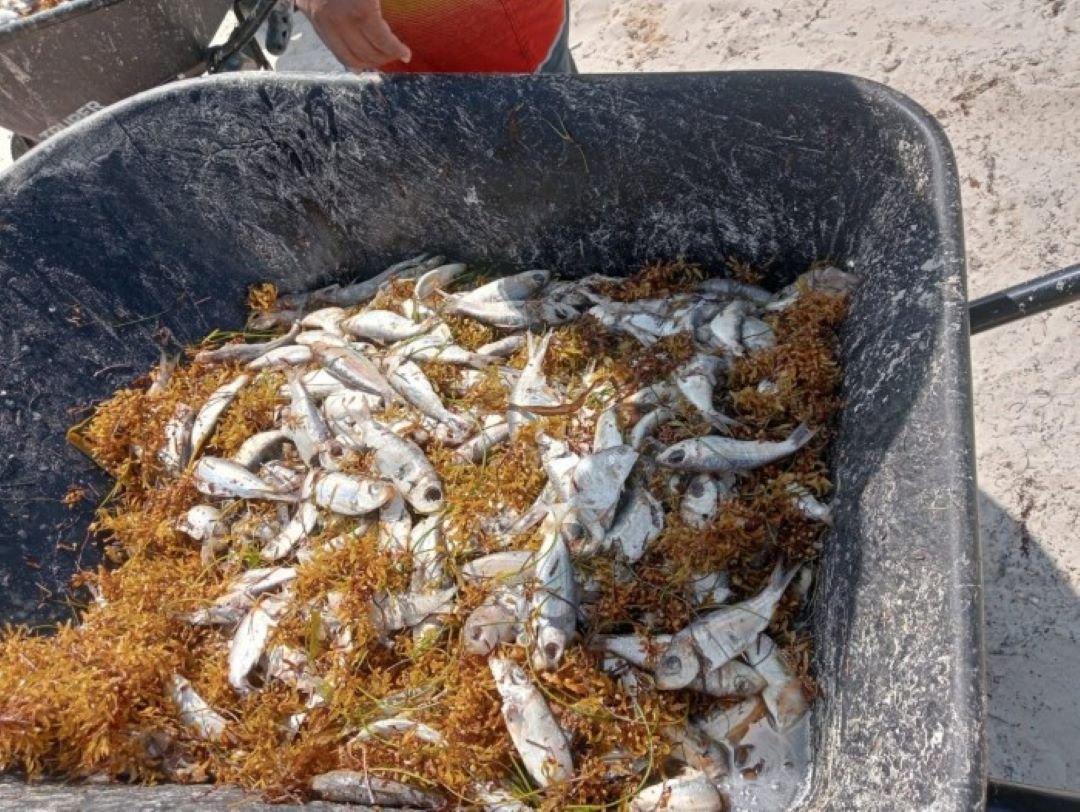
Puerto Morelos, Quintana Roo — The recent wave of hundreds of dead fish in Puerto Morelos is a natural phenomenon linked to sargasso seaweed, according to marine experts and local authorities.
Rosa Elisa Rodríguez Martínez, a researcher at the UNAM Institute of Marine Sciences and Limnology in Puerto Morelos, said the fish deaths are caused by oxygen depletion as sargasso decomposes, altering water quality parameters and harming marine life.
The state Environment, Animal Welfare and Sustainable Mobility Secretariat reported that its director, Gerardo Rosas, met with UNAM biologists who confirmed the event is not unique to the municipality but occurs naturally along various coastlines. It typically happens during periods of calm seas when sargasso decomposes and reduces oxygen levels — a condition known as hypoxia or anoxia — which can kill fish.
Rodríguez, who has studied sargasso and marine fauna for 29 years, noted that the phenomenon has been observed and recorded since 2018. “It will continue to occur when there is an excess of decomposing sargasso, creating a brown tide where oxygen levels drop due to bacterial action,” she said.
Previous studies, including a 2019 publication, reported dead organisms from 78 species across Quintana Roo — not only in Puerto Morelos but in various locations, including bays and headlands, especially during months with low water hydrodynamics.
Rodríguez added that slow-moving organisms such as sea cucumbers, some crustaceans, polychaetes, and other species are also vulnerable in areas of calm water.
Research across the international Caribbean shows that sargasso acts like a sponge, accumulating toxic chemicals during its journey across continents. Direct contact with the algae can cause long-term harm to marine life and humans, she said.
Improper handling of sargasso — from collection to processing — exacerbates the crisis, as the algae are not treated to neutralize their toxins. When sargasso rots on the beach, it releases arsenic, which can damage human and animal lungs and cause cancer over time.
Direct contact with rotting sargasso can also cause nail loss, skin diseases, and affect the blood, eyes, ears, digestive and neurological systems, with rising statistics in Mexico and other Caribbean tourism-dependent countries.
More Environment
- Cancún to Host Climate Change Colloquium With Experts From Mexico, Guatemala and New York
- Tulum Records Over 6,000 Sea Turtle Nests as Beach Furniture Threatens Hatchlings
- Lab Coral Restoration Urgent as Caribbean Reefs Decline, Expert Warns
- Quintana Roo Bolsters Sargassum Strategy With Satellite Monitoring and Research
- Stationary Front to Bring Rain Across Yucatán on Tuesday
More Puerto Morelos
- Free Mammograms Offered in Three Quintana Roo Municipalities
- Puerto Morelos Mayor Denies Detention After Federal Search of Rented Home
- Quintana Roo Names Winners of 2026 State Craft and Embroidery Prizes
- Only Four Sargassum Fishing Permits Processed in Mexico, Imipas Says
- Puerto Morelos Wins Two World Travel Awards for Adventure and Nature Tourism