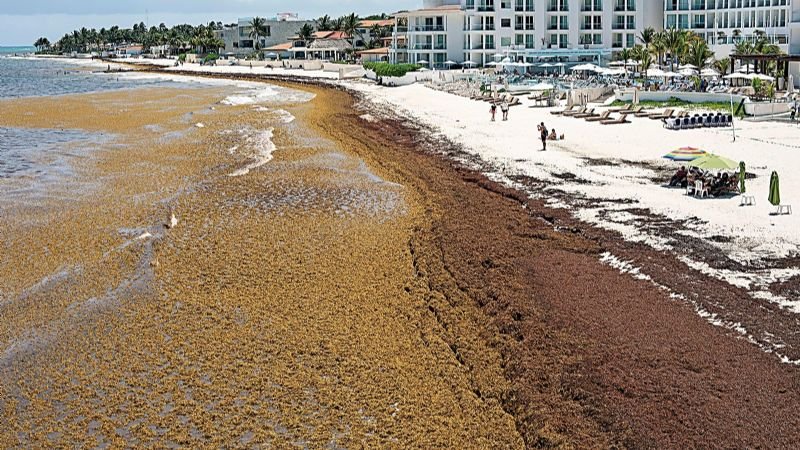
Cancún, Quintana Roo — Researchers from El Colegio de la Frontera Sur (Ecosur) and the National Autonomous University of Mexico (UNAM) have identified vast potential in sargassum, beyond being a mere nuisance on the coasts, revealing applications ranging from clean energy production to high-end cosmetics and construction materials.
Currently, multiple uses have been identified for this algae, highlighting the production of biofuels such as bioethanol and biogas, sustainable construction, applications in the health and beauty industry due to its antioxidant properties, organic fertilizers, and the creation of specialized biofilters for removing contaminants from water.
María de los Ángeles Calixto Romo, a specialist in agro-industrial waste biorefinery at Ecosur, explained that sargassum is a biomass rich in polymers with diverse applications. In research centers, fertilizers, biofilters, construction materials, and bioactive compounds for cosmetic products have already been obtained.
Quintana Roo already has established companies such as Grupo Ensol, Sargapak, and Dianco, and the state government is in the process of establishing a biogas production plant. These initiatives have already achieved the production of cosmetics and compounds for furniture.
Despite its potential, experts warn that utilizing sargassum is not simple, as it can contain heavy metals and hydrogen sulfide.
Therefore, it is essential to conduct rigorous studies to ensure that derived products, especially those for human use, are free of contaminants. Currently, advanced methods such as enzymatic bioreactors and microorganisms are being explored to treat the biomass safely.
Laura Elena Carrillo Bribiesca, a doctor in Physical Oceanography from the same institute, emphasized that sargassum management has evolved from local actions to a more complex governance structure, recognizing that it is a problem that is here to stay.
Sargassum has already been included in the National Fishing Charter, allowing its formal management as an exploitable resource. Institutions such as the Secretariat of the Navy (Semar) and science and technology organizations coordinate working groups covering everything from monitoring to biological impact.
Specialists agree that the quantities of sargassum are “unmanageable” for a single country, so in the coming years of massive arrivals, deep collaboration between academia, government, the private sector, and the international community is required.
More than an isolated problem, sargassum is seen by scientists as a symptom of a broader environmental imbalance, so the current challenge is to change the perspective: stop seeing only the “symptom” (the arrival on beaches) and start managing the resource industrially to mitigate its economic and ecological impacts.
For their part, Luis Felipe Ramírez Verduzco, Marco Antonio Domínguez Aguilar, and Ricardo José Malpica Guadarrama, researchers from the Mexican Petroleum Institute, the private sector, and the National Polytechnic Institute, respectively, explained that sargassum is mainly composed of water (82-87%) and polysaccharides (11-59%), which supply the glucose for its processing into biofuels (ashes, fibers, proteins, fats, vitamins, and metabolites) and allow its transformation into a wide range of products.
Among these are polysaccharides such as alginate, used in foods and pharmaceuticals; secondary metabolites with medicinal properties; lipids and minerals that provide nutrients; as well as proteins and vitamins beneficial for nutrition.
They also indicated that its potential for biofuels is being investigated, taking advantage of the algae as a sustainable energy resource.
Additionally, this planktonic macroalgae can accumulate microplastics in coastal areas, so efficiently removing sargassum that reaches beaches can help combat plastic pollution in marine environments, offering a mitigation strategy.
The massive arrival of sargassum has strongly impacted coastal communities. In places like Cancún and Tulum, enormous economic losses have been reported due to a decline in tourism, as many visitors prefer to avoid beaches filled with these algae, directly harming local businesses that depend on this activity.
The situation has incentivized innovation. Scientists and entrepreneurs are working on projects to convert sargassum into something useful. From biofuels to sustainable products. Thus, this material has the potential to become a source of income instead of just being a problem.
Researchers believe that the future of sargassum in the Mexican Caribbean depends on communities, scientists, and governments coming together to seek sustainable solutions.
Various specialists point out that research and the development of technologies that allow its utilization are key to transforming the problem into both an economic and environmental opportunity.
Furthermore, it is crucial that public policies are implemented that support both its collection and management as well as education and awareness about its impact.
Collaboration between the public and private sectors, as well as community participation, will be essential to effectively face this challenge.
Discover more from Riviera Maya News & Events
Subscribe to get the latest posts sent to your email.